



Key Takeaways
- The Makkah Triangle marks a new phase in the strategic architecture of West Asia and South Asia.
- Pakistan’s role in the Makkah Triangle is complex, with potential benefits and drawbacks for Bharat.
- The arrangement’s asymmetry and Pakistan’s dependence on external financing and technology raise questions about its security guarantor status.
The Saudi Arabia Turkey Pakistan defence pact marks a consequential new phase in the strategic architecture connecting West Asia and South Asia
The strategic architecture connecting West Asia and South Asia may be entering a consequential new phase.
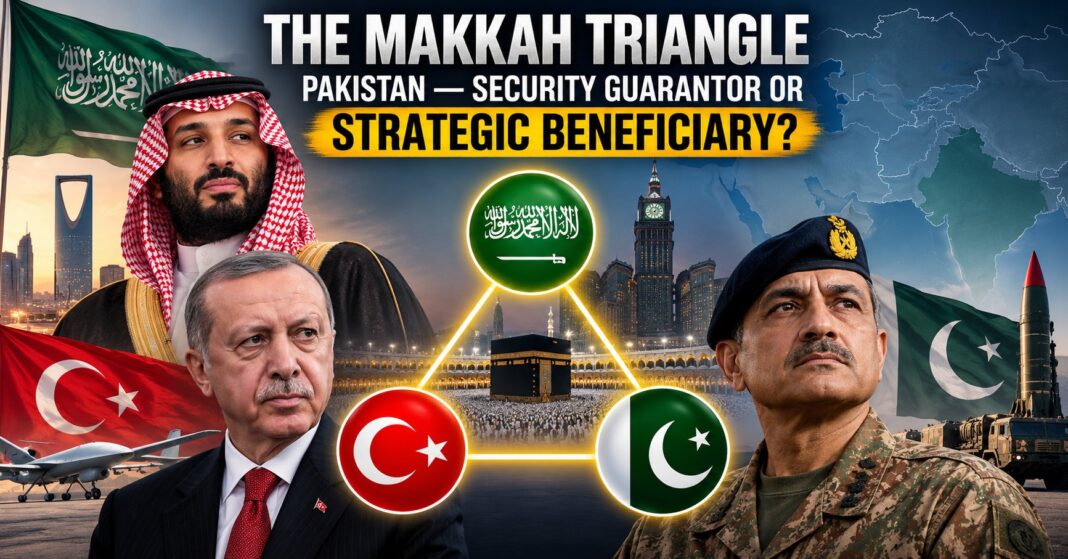
The emerging Saudi Arabia – Türkiye – Pakistan defence arrangement deserves attention not merely because three important Muslim-majority powers are drawing closer, but because of what each brings to the table: Saudi Arabia’s financial and diplomatic weight, Türkiye’s expanding defence-industrial capabilities, and Pakistan’s large armed forces and nuclear arsenal.
It is tempting to immediately describe this formation as an “Islamic NATO.”
But that may obscure a far more interesting question.
Who, exactly, is protecting whom?
Pakistan would naturally like to project itself as the military and nuclear backbone of such an arrangement, a security provider to the Islamic world.
Look beneath the rhetoric, however, and the equation becomes considerably more complicated.
Pakistan may ultimately emerge not merely as a donor of security, but as one of the biggest recipients and strategic beneficiaries of this new architecture.
And for Bharat, that possibility may be more consequential than the treaty itself.
Three Countries, Three Different Strengths
The attraction of the triangle lies precisely in the different capabilities of its participants.
Saudi Arabia brings capital, energy and diplomatic influence.
The Kingdom possesses enormous financial resources and remains one of the world’s most important energy powers. Under Crown Prince Mohammed bin Salman, Riyadh has simultaneously sought economic transformation, military modernisation and greater strategic autonomy.
Türkiye brings military technology and an increasingly formidable defence-industrial ecosystem.
Türkiye possesses NATO’s second-largest military and has developed significant capabilities in UAVs, missiles, electronic warfare, naval platforms, armoured vehicles and precision weapons.
Under President Recep Tayyip Erdoğan, Ankara increasingly seeks not simply to participate in international structures but to become a power around which new structures are constructed.
Pakistan brings manpower, geography and the nuclear factor.
Pakistan possesses one of the largest armed forces in the Muslim world and remains the only Muslim-majority state possessing nuclear weapons.
Put these ingredients together and an apparently compelling strategic formula emerges:
Saudi money. Turkish technology. Pakistani manpower and nuclear signalling.
But this formula also reveals the arrangement’s fundamental asymmetry.
Pakistan: Security Provider or Security Recipient?
Pakistan presents itself as the military pillar of the arrangement.
But Pakistan itself remains dependent upon external financing, imported or jointly developed military technologies and economic support from friendly countries.
Saudi Arabia has repeatedly assisted Pakistan during periods of economic difficulty.
Türkiye, meanwhile, has become an increasingly important source of defence technology and military-industrial cooperation.
This produces an uncomfortable question for Islamabad:
Is Pakistan underwriting the security of this emerging triangle, or is the triangle underwriting Pakistan?
For decades, Pakistan has successfully converted its strategic geography and powerful military establishment into international leverage.
The Makkah arrangement potentially institutionalises that model.
Pakistani soldiers and military assets provide Saudi Arabia additional strategic depth.
Saudi capital can help sustain Pakistan’s defence establishment and economy.
Türkiye provides technology.
Pakistan provides manpower, geography and nuclear symbolism.
Consequently, Pakistan could simultaneously be presented as the alliance’s military guarantor while becoming one of its largest material beneficiaries.
And this distinction matters enormously for Bharat.
The greater concern for New Delhi may not be Pakistani soldiers being deployed to defend Saudi Arabia.
It may instead be Saudi resources and Turkish technology strengthening Pakistan’s military capabilities closer to Bharat’s borders.
Operation Sindoor has already provided a glimpse of precisely that phenomenon.
But before examining Operation Sindoor, another episode deserves attention.
The Saudi – Iran Test: Where Was the Deterrence?
Pakistan’s claim to being Saudi Arabia’s security provider should be measured against events, not declarations.
During the 2026 confrontation involving Iran, Pakistan reportedly deployed a substantial military contingent to Saudi Arabia, including thousands of troops, fighter aircraft and air-defence assets.
Pakistani military personnel were already present in the Kingdom under longstanding defence arrangements.
Yet Saudi Arabia still faced Iranian missile and drone threats.
That produces an awkward strategic question:
If Pakistani troops, aircraft and air-defence assets were already present in Saudi Arabia, what exactly did Pakistan’s much-advertised security guarantee deter?
Deterrence is not measured by the number of soldiers stationed on somebody else’s territory.
It is measured by whether an adversary changes its behaviour because those soldiers are there.
The same applies to Pakistan’s nuclear capability.
Pakistan’s nuclear weapons inevitably cast a strategic shadow over any security arrangement involving Islamabad.
But possessing nuclear weapons and providing extended nuclear deterrence to another country are fundamentally different propositions.
Would Pakistan genuinely risk escalation with Iran, including the possibility of a major conflict between two neighbouring countries, to defend Saudi Arabia?
Would Islamabad contemplate nuclear escalation over an attack on Saudi territory?
And, most importantly: Does Tehran believe that it would?
Because deterrence ultimately exists not in the declarations of the guarantor but in the calculations of the adversary.
If an adversary remains prepared to strike despite the presence of Pakistani forces, then Islamabad’s security guarantee has already encountered its first credibility problem.
Saudi Vulnerability Is Not New
Saudi Arabia has faced this problem before.
The September 2019 attacks on the Abqaiq and Khurais oil facilities demonstrated how comparatively inexpensive drones and cruise missiles could penetrate the defensive architecture of one of the world’s largest military spenders.
The attack temporarily disrupted a significant portion of Saudi oil production.
The strategic lesson was profound.
Money can purchase sophisticated weapons. It cannot automatically purchase deterrence.
The Makkah Triangle must therefore eventually answer a question that no communiqué can resolve:
Will adversaries actually behave differently because the agreement exists?
Until that happens, calling the arrangement an “Islamic NATO” remains premature.
Operation Sindoor: When the Türkiye – Pakistan Axis Entered the Battlefield
For Bharat, however, there is another reason to take the emerging architecture seriously.
The Türkiye – Pakistan military relationship is no longer theoretical.
Bharat has already encountered its hardware on the battlefield.
During Operation Sindoor in May 2025, Pakistan launched a massive drone offensive against Bharat.
During the night of 8 – 9 May, Pakistan attempted drone intrusions at 36 locations stretching from Leh to Sir Creek, involving hundreds of drones.
Indian air-defence and counter-UAS systems responded using kinetic and non-kinetic means.
Turkish-origin systems featured prominently.
India’s official examination of recovered wreckage identified Turkish-manufactured ASISGUARD SONGAR drones.
Subsequent reporting also identified Bayraktar TB2 drones among the Turkish systems deployed by Pakistan during the confrontation.
This matters.
Türkiye’s relationship with Pakistan had moved beyond diplomatic support, defence exhibitions and military exercises.
Turkish military technology was being employed against Bharat during an actual military confrontation.
The Sialkot Question
An even more consequential allegation emerged during and after Operation Sindoor.
Reports claimed that Turkish drone personnel were operating from Pakistani territory and that two Turkish drone operators/pilots were killed during Indian action at Sialkot.
If eventually established conclusively, the implications would be substantial.
Supplying weapons is one level of defence cooperation.
Providing personnel who help operate those systems during an active military confrontation is something fundamentally different.
It potentially transforms the relationship from:
Arms supplier to an Operational battlefield partner.
The reported deaths of the Turkish personnel at Sialkot have not been formally confirmed by New Delhi or Ankara and therefore remain a reported battlefield claim rather than an officially established casualty record.
But the allegation cannot be viewed in isolation.
It emerged during a conflict in which Turkish-origin military systems were demonstrably being employed by Pakistan.
That makes the broader strategic question legitimate:
How far is Türkiye prepared to go in supporting Pakistan during a future confrontation with Bharat?
From Bayraktar to Makkah
This is where Operation Sindoor connects directly with the Makkah Triangle.
Consider the chronology.
In May 2025, Turkish-origin drones appeared in Pakistani military operations against Bharat.
In August 2026, Türkiye, Pakistan and Saudi Arabia are moving towards a wider common defence architecture.
That progression deserves serious attention in New Delhi.
The question is not simply what the arrangement contains today.
The question is what it could enable tomorrow:
Joint UAV development.
Drone swarms.
Electronic warfare cooperation.
Shared intelligence, surveillance and reconnaissance.
Integrated air-defence systems.
Precision-strike capabilities.
Joint exercises.
Common military doctrine.
Coordinated operational planning.
And perhaps eventually deeper command-and-control integration.
Those are the indicators Bharat must monitor.
Because alliances become strategically significant not when politicians sign documents, but when militaries acquire the ability to fight together.
The Real Equation for Bharat
This brings us back to Pakistan’s position within the triangle.
At first glance, Pakistan appears to be exporting security to Saudi Arabia.
But from Bharat’s perspective, the opposite flow may prove more important.
The emerging equation could increasingly resemble:

Saudi Arabia – Capital
Türkiye – Technology
Pakistan – Manpower + Geography + Nuclear Signalling
And Pakistan receives something from both partners:
money, technology, diplomatic relevance and strategic depth.
This potentially creates a multiplier effect.
Saudi capital could finance military capabilities that Pakistan’s economy would otherwise struggle to sustain.
Turkish defence technology could provide Pakistan increasingly sophisticated UAVs, electronic warfare, naval platforms, missiles and other capabilities.
Pakistan provides the manpower and operational environment in which those capabilities can be absorbed.
That is potentially more significant for Bharat than whether Pakistani troops someday defend Riyadh.
Because those capabilities do not necessarily remain in Saudi Arabia.
They can eventually appear along Bharat’s borders.
Operation Sindoor should therefore be viewed as an early warning.
The Turkish-Pakistani defence relationship had already produced battlefield consequences before the wider trilateral architecture began taking shape.
Is This Really an “Islamic NATO”?
Not yet.
NATO is far more than a mutual-defence declaration.
It possesses permanent institutions, integrated military commands, standardisation agreements, intelligence-sharing mechanisms, interoperability frameworks, common operational doctrines and decades of collective military planning.
The Makkah arrangement would have to travel a considerable distance before becoming anything comparable.
But institutions do not emerge fully developed.
They evolve.
Therefore, the correct question is not:
Has an Islamic NATO been created?
The correct question is:
Are the institutional foundations of a future collective-security architecture being laid?
Saudi Arabia Remains the Critical Variable for Bharat
Despite these concerns, Bharat should not make the mistake of viewing Saudi Arabia exclusively through the Pakistan prism.
Bharat’s relationship with Riyadh has undergone a remarkable transformation.
Energy remains important, but the partnership now extends across investment, infrastructure, counterterrorism, technology, connectivity and strategic cooperation.
Saudi Arabia has enormous stakes in maintaining strong relations with New Delhi.
Riyadh therefore has little incentive to allow its relationship with Pakistan to automatically transform into participation in Islamabad’s disputes with Bharat.
This is where Indian diplomacy becomes crucial.
New Delhi must ensure that Riyadh understands the enormous difference between defending Pakistan against genuine external aggression and allowing Pakistan to invoke collective security after initiating or escalating a confrontation with Bharat.
Türkiye Is the More Complicated Variable
Türkiye requires closer scrutiny.
Ankara has repeatedly supported Pakistan politically on Jammu and Kashmir while expanding military cooperation with Islamabad.
Naval platforms.
UAVs.
Aircraft modernisation.
Electronic warfare.
Joint exercises.
Defence-industrial cooperation.
Operation Sindoor added another dimension.
For Bharat, it is no longer enough to say that Türkiye sells weapons to Pakistan.
Turkish-origin military technology has already been employed by Pakistan against Bharat.
And the reports surrounding Sialkot raise the additional, though still unverified, question of whether Turkish involvement extended beyond equipment.
This makes one question central to New Delhi’s assessment:
Could a future Bharat–Pakistan confrontation cease to remain purely bilateral and become a battlefield on which Pakistan employs increasingly integrated Turkish technology, intelligence, training and potentially operational support?
That possibility cannot be dismissed.
Türkiye’s NATO Paradox
There is another fascinating dimension.
Türkiye remains a NATO member.
Ankara could therefore find itself positioned between two different security architectures, its longstanding Euro-Atlantic commitments through NATO and an emerging framework extending through West Asia towards Pakistan.
President Erdoğan may regard precisely these overlapping relationships as instruments of Turkish strategic autonomy.
Türkiye increasingly seeks not merely to participate in international structures but to become a power around which new structures are constructed.
That ambition should not be underestimated.
The China Dimension
And then there is China.
Saudi Arabia has dramatically expanded its economic engagement with Beijing, while Türkiye maintains a complicated but significant relationship with China.
China would not necessarily need to formally enter the Makkah Triangle to benefit from it.
A more autonomous regional security structure could reduce exclusive Western influence while creating additional strategic space for Beijing.
Operation Sindoor demonstrated another aspect of this challenge.
Pakistan’s military ecosystem increasingly combines Chinese and Turkish technologies.
If Saudi financing becomes another component of that ecosystem, Bharat could eventually confront not merely Pakistani military capability but a multinational technological architecture available to Pakistan.
That possibility deserves serious strategic planning.
Iran and Israel Will Be Watching
Iran will watch developments carefully.
Tehran maintains complicated relationships with all three participants. Saudi-Iranian relations oscillate between accommodation and rivalry. Türkiye simultaneously cooperates and competes with Iran. Pakistan shares a long and sensitive border with the Islamic Republic.
Israel will be equally attentive.
Any architecture bringing together Saudi financial resources, Turkish military technology and Pakistan’s nuclear capability inevitably enters Israeli strategic calculations, irrespective of whether the arrangement formally identifies Israel as an adversary.
The Makkah Triangle therefore cannot be viewed purely through the Bharat–Pakistan prism.
Its consequences potentially stretch across the entire region.
What Should Bharat Do?
Bharat does not need an alarmist response.
It needs a strategic one.
First, New Delhi should deepen its strategic relationship with Saudi Arabia and ensure that the bilateral partnership remains insulated from Pakistan’s attempts to internationalise disputes with Bharat.
Second, Bharat should continue engaging Türkiye while simultaneously recognising Ankara’s growing strategic convergence with Islamabad.
Engagement and strategic caution are not contradictory.
Third, Indian intelligence and defence establishments should closely monitor whether the trilateral arrangement moves from political declarations towards joint commands, integrated exercises, intelligence sharing, defence-industrial cooperation, common doctrine and coordinated operational planning.
Fourth, Bharat should closely track Turkish – Pakistani cooperation in UAVs, autonomous systems, electronic warfare, precision weapons and naval technologies.
Operation Sindoor demonstrated why.
Fifth, Bharat must accelerate indigenous counter-UAS, electronic-warfare, drone-swarm and integrated air-defence capabilities.
And sixth, New Delhi must preserve its greatest diplomatic advantage in West Asia:
strategic flexibility.
Bharat maintains valuable relationships with Saudi Arabia, the UAE, Israel, Iran, Oman and other regional actors precisely because it has increasingly avoided forcing its relationships into ideological blocs.
That approach should continue.
The Makkah Triangle’s Real Paradox
The Makkah Triangle therefore contains an extraordinary paradox.
Pakistan wants to present itself as the military protector.
Saudi Arabia possesses the money.
Türkiye increasingly possesses the technology.
Yet Pakistan may ultimately gain disproportionately from both.
The architecture could therefore transform Pakistan from an economically constrained military power into the operational centre of a wider, externally financed defence ecosystem.
That is the development Bharat should watch most carefully.
The question is not whether Pakistani soldiers will guard Saudi Arabia.
They have done so before.
The question is whether Saudi capital and Turkish technology will eventually enhance Pakistani military capability against Bharat.
Operation Sindoor demonstrated that this possibility is no longer theoretical.
Turkish-origin drones have already appeared in Pakistani military operations against Bharat.
Reports from Sialkot even raised the possibility, still requiring definitive confirmation, that Turkish personnel may have been involved alongside Pakistan’s drone operations.
Meanwhile, the Iranian challenge to Saudi Arabia demonstrated another uncomfortable reality:
having Pakistani troops on Saudi soil does not automatically equal deterrence.
Pakistan therefore occupies a curious position.
It seeks recognition as the guarantor of Saudi security while simultaneously depending upon Saudi resources and foreign military technology to strengthen itself.
Perhaps the most accurate description of the emerging arrangement is therefore not:
Saudi money + Turkish technology + Pakistani protection.
It may instead be:
Saudi money + Turkish technology + Pakistani manpower and nuclear signalling, with Pakistan emerging as one of the principal beneficiaries.
That is a very different geopolitical equation.
And for Bharat, potentially a much more consequential one.
The Makkah Triangle should therefore be neither exaggerated nor dismissed.
It should be watched.
Because in geopolitics, alliances rarely become dangerous on the day they are announced.
They become consequential when money, technology, manpower and political intent begin converging into military capability.
Operation Sindoor has already shown Bharat what one part of that convergence can look like.
The Makkah Triangle may tell us what comes next.
Jai Hind