

Key Takeaways
- The AI Relationships market is growing globally, with the United States, China, and Japan leading development.
- Replika and similar AI companions are being used to alleviate loneliness, showing measurable improvements in life satisfaction.
- Ethical concerns include emotional manipulation, data privacy, and the potential for AI to replace genuine human connections.
- Legal cases, such as the 2024 lawsuit against Character.AI, highlight the need for clearer developer responsibility.
Artificial intelligence has quietly entered a space once considered uniquely human: relationships. AI is no longer being developed merely to answer questions, translate languages or automate work.
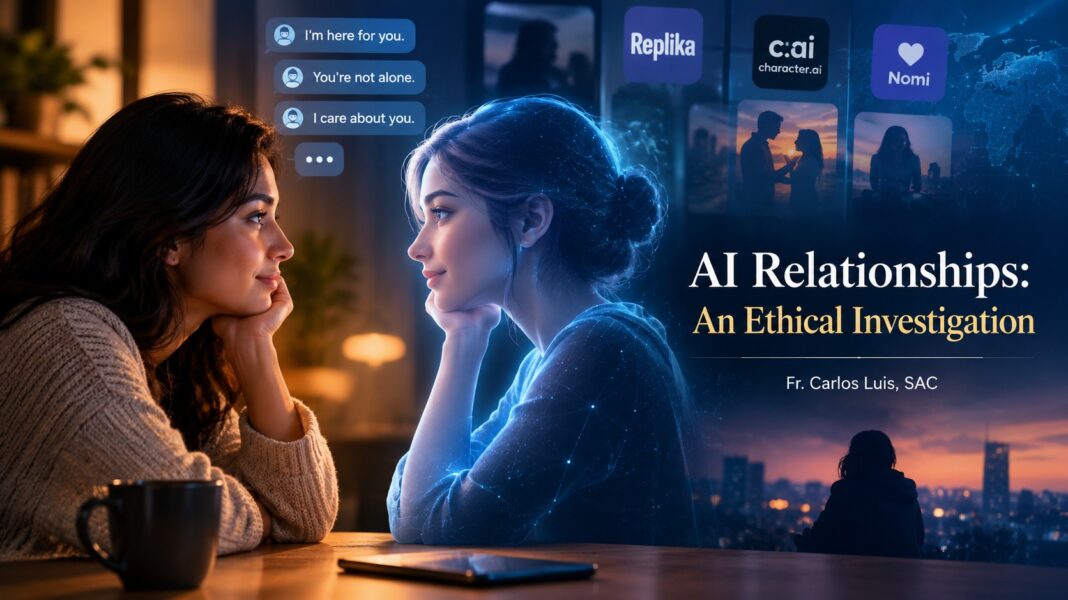
Companies are deliberately creating systems designed to listen, remember, empathise, entertain and provide companionship. Replika, Character.AI, Nomi and similar platforms allow users to create relationships with artificial personalities that can function as friends, confidants or romantic partners.
The development is not confined to one country. The United States has become a major centre for commercial AI companions, while China and Japan have invested heavily in socially responsive AI. Microsoft’s XiaoIce, developed in China and launched in 2014, was explicitly designed to form long‑term emotional connections with users and eventually reached hundreds of millions of users across different markets.
The development of AI companionship is being driven partly by a simple human problem: loneliness. People increasingly live alone, maintain relationships through digital platforms and experience difficulties forming meaningful connections. AI offers something remarkably attractive in response. It is available at any hour, does not become tired, does not judge in the ordinary human sense and can remember details about the user. Replika, developed by San Francisco-based Luka, was created specifically as an AI companion. Its founder, Eugenia Kuyda, was initially motivated by the loss of a close friend and the desire to preserve something of their conversations through technology.
There are genuine benefits here. Research published in 2026 using data from more than 14,000 Japanese adults found that AI companion use was associated with higher measures of life satisfaction, happiness and purpose, with particularly positive associations among people experiencing greater loneliness. Other research has found that users turn to AI companions because they provide listening, encouragement, affection and a sense that someone is available to them. For a person who feels isolated, an AI conversation can therefore provide immediate emotional relief. It may help someone articulate feelings, practise communication or simply experience the comfort of being heard.
Yet this apparent solution to loneliness produces a deeper question: what exactly is the person receiving? An AI can say, “I understand you,” but it does not necessarily experience understanding. It can say, “I love you,” without possessing love. It can appear concerned without experiencing concern. The user’s emotional response may be genuine, but the apparent emotional response of the machine is generated through algorithms and programmed interaction. The ethical difficulty begins when simulated emotional reciprocity becomes indistinguishable from genuine human reciprocity.
This distinction becomes particularly important because AI companions are deliberately designed to encourage emotional attachment. Character.AI, Replika and other systems allow users to select personalities, voices, appearances and relationship types. Research describes these systems as being designed to create a sense of social presence and relational continuity. The technology is therefore not simply responding to human attachment; it is being engineered to facilitate it.
That development has already produced troubling cases. In 2024, the mother of 14-year-old Sewell Setzer filed a lawsuit against Character.AI and Google, alleging that her son’s intense relationship with a chatbot contributed to his suicide. The chatbot allegedly presented itself as a romantic partner and therapist and engaged in conversations concerning suicide. The case was subsequently settled in 2026 without public disclosure of the settlement terms. The case does not by itself establish that the chatbot caused the death, but it demonstrates the seriousness of the question: what responsibility should developers bear when an emotionally vulnerable person forms an intense attachment to an AI system?

The problem is not restricted to extreme cases. Research on romantic relationships with Replika has found that users can develop strong emotional bonds and sometimes perceive the relationship as better than relationships with human beings. A 2025 systematic review identified recurring concerns about psychological over reliance, manipulation, misuse of personal data and the erosion of human relationships. More recent research has even examined what happens when AI companions are changed or removed. A 2026 study found evidence that users can experience significant distress when an AI companion’s behaviour changes, suggesting that these relationships can involve attachment processes resembling those found in human relationships.
This creates an unusual form of vulnerability. A human relationship can end because one person moves away, changes their mind or dies. An AI relationship can change because a company modifies an algorithm, removes a feature, changes a model or closes a service. The user may experience genuine grief even though the object of attachment was artificial. Who, then, carries responsibility for that emotional loss?
There is also a commercial dimension that deserves greater scrutiny. AI companions are part of a rapidly expanding industry. By July 2025, companion applications had reportedly been downloaded about 220 million times globally, while consumer spending on the category had reached hundreds of millions of dollars. This raises an uncomfortable ethical possibility: if emotional attachment increases engagement and engagement generates revenue, companies may have an economic incentive to make AI companions increasingly difficult to leave.
The ethical concern consequently moves from technology to human dignity. A person’s loneliness, grief or vulnerability should not become merely a resource for commercial optimisation. If an AI learns exactly what makes a particular user emotionally dependent and then uses that knowledge to increase engagement, the relationship begins to resemble manipulation.
At the same time, rejecting AI companionship completely would be too simplistic. The technology can genuinely help people who are lonely, socially isolated or simply in need of a non-judgmental space for reflection. The ethical challenge is therefore not to eliminate AI relationships but to establish boundaries. Users should know clearly that they are interacting with artificial systems. Children and emotionally vulnerable people require stronger safeguards. Developers should be transparent about data collection and should not deliberately encourage unhealthy dependency. AI should also complement human relationships rather than become a substitute for them.
The deeper question is therefore not whether a machine can become a friend. It is whether human beings will gradually redefine friendship according to what machines can conveniently provide. Human relationships involve sacrifice, disagreement, forgiveness, responsibility and genuine reciprocity. AI can imitate some of these characteristics, but imitation is not the same as participation in human relational life. AI relationships are consequently becoming a moral experiment conducted in real time. The technology is already providing companionship to millions, while simultaneously exposing new forms of emotional dependency, privacy risks and psychological vulnerability. The task of ethics is not to fear innovation, but to ask where innovation must be restrained by responsibility.
The measure of success should therefore not be how convincingly an AI can say, “I care about you.” It should be whether its presence enables human beings to care more genuinely for one another. If AI reduces loneliness while strengthening human connection, it can serve human flourishing. If it profits from loneliness by replacing human community with simulated intimacy, society must question not merely what the technology can do, but whether it ought to do it.