

Key Takeaways
- The Papa Yaar special proves comedy can thrive on storytelling and emotional truth, not just profanity.
- Zakir Khan uses his own childhood memories to explore the father‑son relationship, turning ordinary moments into universal humor.
- By blending cultural observation with heartfelt reflection, the show challenges narrow masculinity and highlights the power of affection.
Zakir Khan’s Papa Yaar deserves to be discussed as more than a successful comedy special. It is comedy, certainly, but it is also storytelling, cultural observation, family reflection and an invitation to reconsider what makes humour meaningful. In an entertainment landscape where laughter is sometimes pursued through relentless profanity, sexual references, humiliation or shock, Papa Yaar demonstrates that a comedian can hold an audience through recognition, affection and intelligent observation. Its achievement is that language is not its main instrument. Story, timing and emotional truth do the heavy lifting.
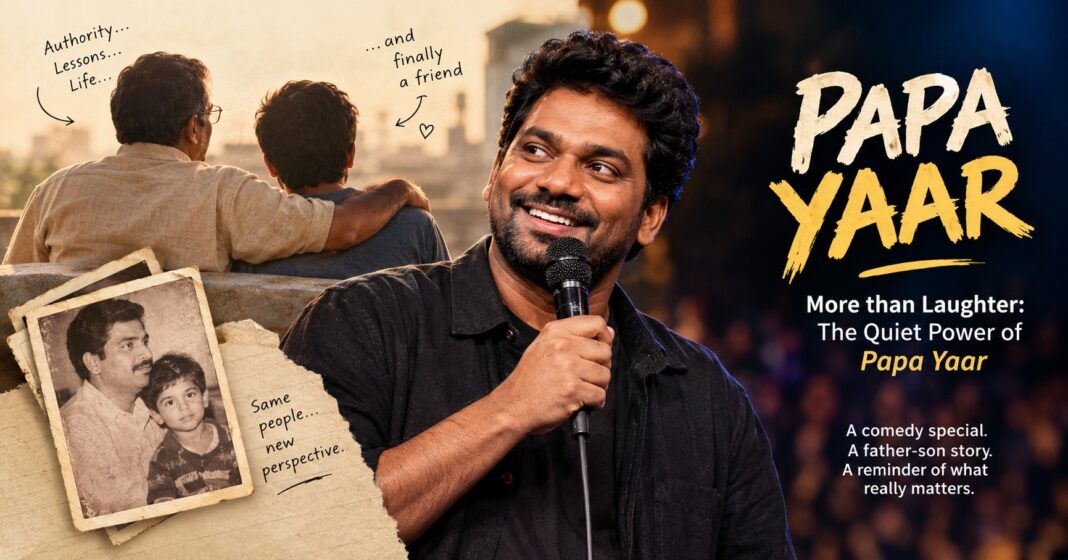
Netflix describes Papa Yaar as a personal stand-up special drawn from Zakir’s childhood memories and his relationship with his father. That description captures its foundation. The show gradually transforms the father from an authority figure into a human being. Zakir has explained that he once felt he was rebelling against what his father taught him, but later understood that the foundations of his life were built through his father’s values and lessons. The show therefore becomes an account of growing up and learning to reinterpret those who raised us.
This is where Papa Yaar acquires a strong moral dimension. Good comedy does not merely ask, “What will make people laugh?” It can ask, “What is worth laughing about, and how do we laugh without diminishing another person?” There is a difference between humour that exposes ordinary absurdity and humour that depends on degrading a person, group or relationship. The first can enlarge understanding; the second can become disposable.
Much contemporary stand-up comedy illustrates this tension. Some performers rely heavily on explicit swearing, sexual jokes and deliberately provocative language.
Such material is not automatically bad comedy, and profanity itself does not determine artistic quality. Sometimes strong language suits a story or character.
The problem arises when obscenity becomes a substitute for imagination, when a swear word is expected to generate the laugh that an observation has not earned. When every few seconds requires a vulgar intensifier, surprise gradually disappears. The audience is being told when to laugh rather than discovering humour.
Papa Yaar takes another route. Its strongest comic moments emerge from familiar experiences: the father who turns a conversation into a lecture, the exaggerated stories of his past, the child who learns to interpret his father’s behaviour, and the awkward language through which affection is expressed. The idea that one’s father can feel like a “stranger” is funny because it is recognisable, then moving because it contains an uncomfortable truth. India Today and Rediff both noted that the special leans strongly into emotion and storytelling, with laughter and poignancy repeatedly occupying the same space.
The show’s language also matters. Zakir can use colloquial expressions and occasional cuss words, as reviewers have noted, but profanity does not become the architecture of the performance. The architecture is the relationship itself. That distinction matters. A responsible approach to comedy does not mean making comedy sterile, humourless or artificially polite. It means understanding that words have consequences and that comedy can remain sharp without constantly making vulgarity the centre of attention.
The phrase “Papa Yaar” itself captures the transformation at the heart of the show. “Papa” suggests authority, distance and childhood dependence; “yaar” introduces friendship, familiarity and adult recognition. The title therefore contains an entire journey. The father whom the child once feared gradually becomes someone the adult son can understand as a fellow human being.

That movement challenges narrow masculinity. Fathers are frequently expected to be providers rather than emotionally expressive human beings. Sons are similarly trained to conceal vulnerability. Consequently, affection often travels through indirect routes: food, money, advice, discipline and practical help. Papa Yaar finds comedy in this language of love, but also gives it dignity.
The show does not present parents as flawless. Fathers can be strict, unreasonable, embarrassing or even mistaken. Gratitude does not require pretending otherwise. Mature appreciation means recognising both the limitations and the sacrifices of those who shaped us. That is more credible than sentimental idealisation.
The humour is also culturally significant because it is rooted in ordinary Indian family life. The father’s stories, the expectations surrounding education and success, childhood fear, friendship, rebellion and the eventual desire to say thank you are not extraordinary experiences. Their ordinariness is precisely what gives them power. Zakir takes private memories and turns them into a shared social vocabulary.
This explains why the special can produce an unusual reaction: laughter followed by introspection. A joke lands, the audience laughs, and then the memory behind it begins to resemble something from their own lives. The response emerges from recognition.
Of course, Papa Yaar is not beyond criticism. Some viewers have found parts predictable or less comic than Zakir’s earlier work, while others have questioned whether it should be classified primarily as stand-up. Those disagreements are legitimate. They reveal that the show is testing the boundaries of comedy. If comedy must always maximise jokes per minute, Papa Yaar may seem restrained. If comedy can also be a vehicle for memory, relationship and reflection, its ambition becomes much clearer.
For me, that is precisely why Papa Yaar stands apart. It demonstrates that clean or restrained comedy does not have to mean weak comedy, and that emotional depth does not have to eliminate laughter. Its argument is made through performance: you can make people laugh without making vulgarity the hero.
In an age of increasingly aggressive entertainment, this is worth noticing. Humour can be intelligent without being pretentious, emotional without becoming sentimental, and accessible without becoming shallow. It can challenge our assumptions while respecting the audience’s capacity to think.
Papa Yaar ultimately reminds us that the finest comedy may not be the comedy that makes us laugh the loudest. It may be the comedy that makes us laugh at ourselves, recognise our families, reconsider our parents and, when the screen goes dark, quietly reach for the phone to call our own “Papa.” That is not merely entertainment. It is humour with humanity.