


Key Takeaways
- Bangladesh occupies a unique geopolitical position in South Asia, balancing Bengali cultural identity, constitutional principles, democratic aspirations, and Islamic heritage.
- The Bangladesh Army’s direct involvement in establishing an educational network attracts strategic attention, as educational institutions shape future civil servants, military officers, business leaders, academics, and public opinion.
- Academic independence, intellectual diversity, and professional standards are crucial for institutions delivering Islamic values while maintaining their integrity.
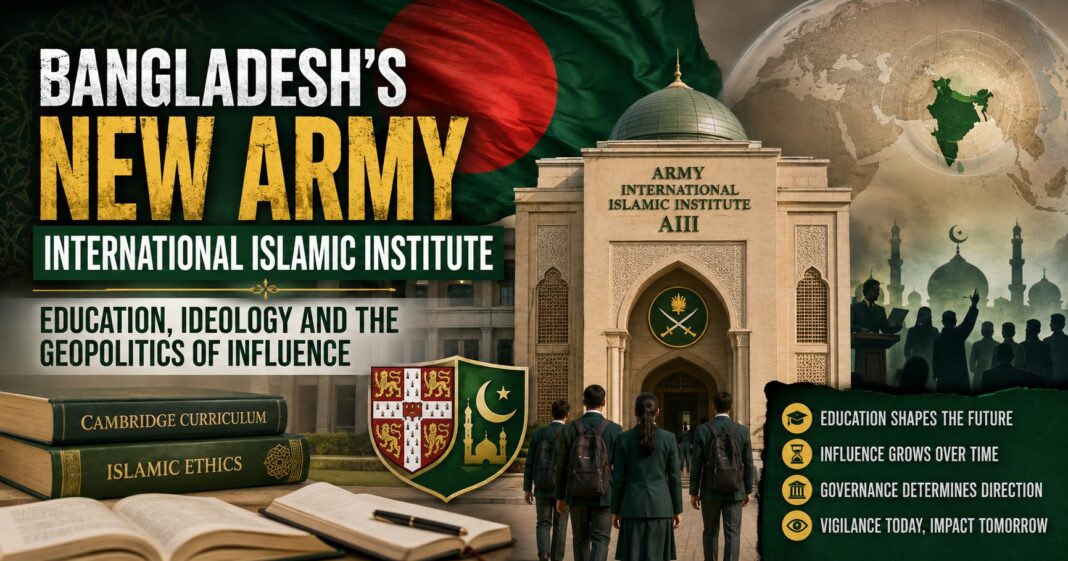
Bangladesh’s New Army International Islamic Institute has attracted regional attention for its potential impact on education, governance and South Asian geopolitics
The Bangladesh Army’s inauguration of the Army International Islamic Institute (AIII) marks more than the launch of another educational institution. It signals the military’s entry into a domain that shapes national identity, values, and future leadership. While the institute has been introduced as one that combines the Cambridge curriculum with Islamic ethical values, history suggests that the true significance of such institutions becomes apparent only over time.
It is important to state at the outset that there is no evidence that the newly established institute is controlled by hardliners or is intended to promote extremist ideology. Any assessment at this stage would be speculative. Nevertheless, history offers valuable lessons on how educational institutions can gradually become vehicles for ideological influence if robust safeguards are absent.
Change in educational institutions often occurs incrementally, influenced by factors like leadership succession, curriculum evolution, funding, and political patronage. These changes shape an institution’s identity over time.
The first critical factor is leadership succession. Founders often establish institutions with broad and moderate objectives. However, future administrators, trustees, or governing bodies may reinterpret that vision. If appointments become influenced by political or ideological considerations rather than academic merit, the institution’s direction can gradually change.
Second is the question of political influence. Across the world, governments have long recognised that education shapes national consciousness. Schools and universities influence how future generations understand history, religion, citizenship, and national identity. Consequently, educational institutions frequently become arenas where competing ideological narratives seek legitimacy.
A third factor is curriculum evolution. The most significant ideological shifts are often subtle rather than sudden. Changes in textbooks, invited speakers, faculty recruitment, extracurricular activities, or institutional priorities may appear insignificant individually but can collectively redefine an institution’s intellectual environment over many years.
Funding is another important variable. Institutions dependent upon a limited group of financial patrons may gradually adopt priorities that reflect the preferences of those benefactors. Financial influence does not necessarily produce extremism, but it can shape institutional culture and intellectual direction.
The strongest protection against ideological capture remains institutional governance. Independent governing boards, transparent leadership appointments, academic freedom, internationally recognised accreditation standards, and periodic external reviews help preserve educational integrity. Without these safeguards, institutions become more vulnerable to influence from any organised ideological movement, religious, political, or otherwise.
History provides several cautionary examples. During the 1980s, sections of Pakistan’s religious education network underwent profound ideological transformation due to a combination of state policy, foreign funding, and the geopolitical realities of the Afghan conflict. Similar patterns of political or ideological influence have been observed in educational systems across different regions. Equally important, however, are the numerous examples of faith-based educational institutions worldwide that have remained centres of academic excellence while successfully balancing religious values with modern education. Religion alone has never been the determining factor; governance has.
Why Bangladesh Matters
Bangladesh occupies a unique geopolitical position in South Asia. Since its independence in 1971, it has sought to balance its Bengali cultural identity, constitutional principles, democratic aspirations, and Islamic heritage. The country’s political trajectory has witnessed alternating periods of secular emphasis and greater public visibility of religion.
Against this backdrop, the Bangladesh Army’s direct involvement in establishing an educational network inevitably attracts strategic attention. Educational institutions shape future civil servants, military officers, business leaders, academics, and public opinion. Their influence extends far beyond classrooms.
The critical question is therefore not whether the institute teaches Islamic values. Ethical and religious instruction exists in educational institutions across the world. The more consequential question is whether the institution maintains academic independence, intellectual diversity, and professional standards while delivering those values.

What Should Be Monitored
Rather than drawing premature conclusions, analysts should monitor objective indicators:
The transparency and independence of leadership appointments.
The composition and autonomy of the governing board.
Evolution of the academic curriculum.
Faculty recruitment standards.
Sources of institutional funding.
Academic partnerships with international institutions.
The degree of intellectual openness and academic freedom maintained over time.
These indicators will provide a far more reliable assessment than the institution’s title or stated mission.
The Strategic Lesson
History repeatedly demonstrates that the ideological character of educational institutions is determined less by the vision announced at inauguration and more by the systems that govern them over decades.
For Bangladesh, the Army International Islamic Institute represents both an opportunity and a responsibility. If governed with transparency, academic excellence, and institutional independence, it could emerge as a respected model of value-based modern education. If those safeguards weaken, history suggests that any educational institution, not only religious ones, can gradually become susceptible to ideological capture.
The classroom is where nations shape their future. The real test of any institution lies not in the speeches delivered on its opening day, but in the generations it produces decades later.