


Key Takeaways
- Turkey’s Outreach to India: A New Era of Cooperation?
- Supporting Pakistan Comes at a Cost: Turkish Foreign Minister Hakan Fidan’s Warning
- India-Turkey Relations: A Complex History and Uncertain Future
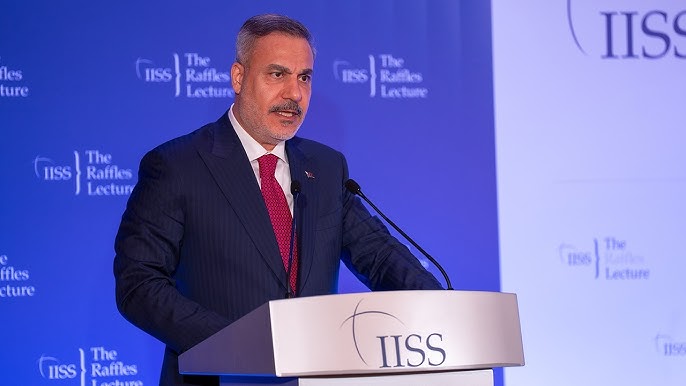
Speaking at the prestigious Raffles Lecture hosted by the International Institute for Strategic Studies (IISS) in Singapore on 2 June 2026, Turkish Foreign Minister Hakan Fidan sought to reassure New Delhi about Ankara’s intentions towards India. Declaring that Turkiye had “every good reason to have a good relationship” with India, Fidan stated, “We really would like to have excellent relations with India. We do not have any border with India, we do not have any bilateral issue with India, we do not have a bad history with India.” He further emphasised that India and Turkey had “a lot to cooperate and benefit from together” and urged India not to view Turkish relations with Pakistan through a negative prism.
At first glance, these remarks appeared to be a routine diplomatic outreach. However, viewed against the backdrop of recent events, they seem to reflect something more significant, a growing recognition within Ankara that years of consistently aligning with Pakistan on issues affecting India’s core interests have carried consequences that can no longer be ignored.
The interaction between the Indian subcontinent and Anatolia predates the modern states of India and Turkey by several centuries. Trade, culture and intellectual exchanges connected the peoples of the two regions long before the emergence of contemporary nation-states. One of the most frequently cited examples of historical goodwill is the Khilafat Movement of the early twentieth century, when sections of Indian society mobilised in support of the Ottoman Caliphate following the First World War.
The interaction between the Indian subcontinent and Anatolia predates the modern states of India and Turkey by several centuries. Trade, culture and intellectual exchanges connected the peoples of the two regions long before the emergence of contemporary nation-states.
One of the most frequently cited examples of historical goodwill is the Khilafat Movement of the early twentieth century, when sections of Indian society mobilised in support of the Ottoman Caliphate following the First World War. However, portraying the Khilafat Movement simply as an expression of India-Turkey friendship overlooks a far more complex reality.
While its stated objective was the preservation of the Ottoman Caliphate, the movement became a vehicle for religious mobilisation within British India. Critics have long argued that it encouraged pan-Islamic political sentiments that were detached from India’s broader national interests and contributed to growing communal divisions.
The subsequent Moplah Rebellion of 1921 remains one of the most contentious chapters of that period. What began as resistance against colonial authority soon witnessed violence, forced conversions, killings and attacks against sections of the Hindu population. For many observers, these events demonstrated the dangers of allowing external religious causes to shape domestic political movements.
The irony was striking. While supporters of the Khilafat cause in India were striving to preserve the Caliphate, Mustafa Kemal Atatürk abolished it in 1924 and transformed Turkey into a secular republic, effectively ending the very institution that the movement sought to save.
Consequently, the Khilafat Movement cannot be viewed merely as a symbol of historical friendship between India and Turkey. For many Indians, it also serves as a cautionary reminder that emotional attachment to foreign causes should never supersede national interests, social cohesion or strategic clarity.
India’s Support During Turkey’s Difficult Times
Despite differing political trajectories, independent India maintained cordial relations with Turkey for decades. India repeatedly extended support during humanitarian crises and natural disasters affecting the Turkish people.
The most notable example came after the devastating earthquakes that struck Turkey in 2023. Bharat launched Operation Dost, dispatching rescue teams, medical personnel, field hospitals and humanitarian assistance. Indian teams worked alongside Turkish authorities during one of the country’s darkest moments, reflecting India’s civilisational ethos of extending assistance to those in need.
Many Indians viewed Operation Dost as an act of goodwill that transcended political disagreements and reaffirmed the potential for constructive engagement between the two nations.
The Erdogan Era and the Pakistan Factor
Despite these positive foundations, relations began experiencing strain under President Recep Tayyip Erdogan.
Over the past decade, Ankara increasingly positioned itself as one of Pakistan’s most vocal international supporters. Turkish leaders repeatedly raised the Kashmir issue at international forums, often echoing Islamabad’s narrative despite India’s consistent position that Jammu and Kashmir is an internal matter and that all outstanding issues must be addressed bilaterally.
From New Delhi’s perspective, this was particularly disappointing because Turkey was involving itself in a dispute that neither affected its national security nor directly concerned its national interests.
The divergence became even more pronounced following the Pahalgam terror attack and India’s subsequent Operation Sindoor. Turkish statements were widely perceived in India as sympathetic to Pakistan at a time when New Delhi was responding to terrorism directed against its citizens.
From Diplomatic Support to Security Concerns

What transformed Indian concern into strategic unease was the growing evidence of defence cooperation between Ankara and Islamabad.
Reports that Turkish-origin drones were employed by Pakistan during Operation Sindoor raised serious questions about the extent of Turkey’s involvement. Those concerns intensified when senior Pakistani military officials were seen paying homage to two Turkish nationals killed during an Indian strike in the Sialkot sector. The two individuals were associated with Pakistan’s drone programme, and the public tribute accorded to them by Pakistan’s military establishment attracted significant attention within defence and strategic circles.
For many observers in Bharat, the episode provided a rare glimpse into the depth of military and technical cooperation between Turkey and Pakistan. It reinforced the perception that Ankara’s support for Islamabad extended beyond diplomatic rhetoric and political statements into areas with direct security implications for India.
In international affairs, actions often speak louder than declarations. At a time when India was responding to cross-border terrorism and safeguarding its national security interests, the presence of Turkish personnel linked to Pakistan’s drone ecosystem in an operational environment inevitably influenced public opinion and strategic calculations in New Delhi.
The Emergence of Consequences
What Turkey appears to have underestimated was the transformation of Bharat’s strategic posture.
Modern Bharat increasingly employs a comprehensive approach that combines diplomacy, economics, technology and strategic partnerships. Public sentiment shifted. Indian tourists increasingly chose alternative destinations. Commercial engagements involving Turkish firms came under greater scrutiny. New Delhi simultaneously deepened engagement with Greece, Cyprus and Armenia, countries that have their own longstanding disagreements with Ankara.
These developments conveyed a simple but unmistakable message: support for Pakistan on issues that directly affect Bharat’s security interests would inevitably influence the broader trajectory of India-Turkey relations.
Why Turkey is Reaching Out Now
It is in this context that Hakan Fidan’s remarks in Singapore assume greater significance.
Turkey today seeks greater economic engagement, investment opportunities and technological partnerships with emerging powers. India, one of the world’s largest and fastest-growing economies, represents an opportunity that Ankara can ill afford to ignore.
The reality confronting Turkish policymakers is straightforward. By repeatedly choosing Pakistan’s side on issues affecting India’s sovereignty and security, Ankara gained little tangible strategic advantage while risking goodwill with a nation of more than 1.4 billion people and one of the world’s most dynamic economies.
Fidan’s remarks appear to acknowledge this reality. They suggest an understanding that India is not a nation that can be pressured into compromising on its core interests. Modern Bharat responds through diplomacy, economic leverage, strategic partnerships and calibrated statecraft.
The Road Ahead
History demonstrates that India and Turkey possess far more reasons for cooperation than confrontation. Both are major civilisational states with strategic geographic locations, dynamic populations and aspirations for greater global influence.
Yet history alone cannot sustain a partnership. Modern international relations are governed not by sentiment but by choices.
Turkey’s recent outreach suggests an appreciation of this reality. The challenge now lies in translating diplomatic statements into policies that respect each other’s core interests and sensitivities.
Perhaps Ankara is beginning to understand what many nations already have: constructive engagement with a confident and rising Bharat creates opportunities, while repeatedly undermining its strategic interests carries costs.
The lesson is neither complicated nor new. Nations are free to choose their friends and allies. But those choices inevitably shape the quality of their relationships with others. Turkey’s recent recalibration suggests that it is finally recognising the consequences of its own choices.