


Key Takeaways
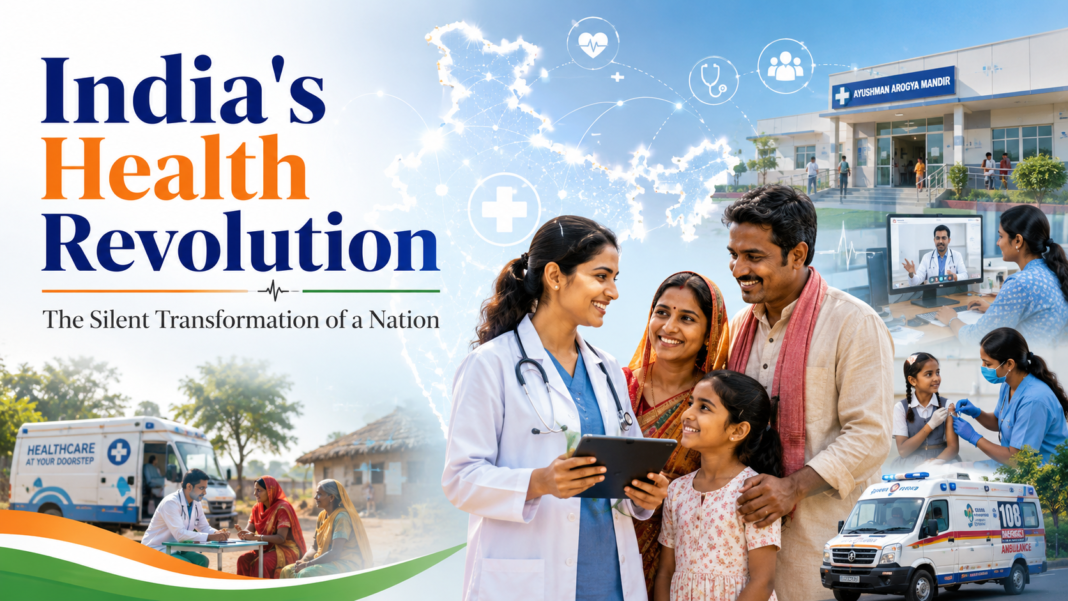
- India’s Health Revolution is a transformative movement in the nation’s healthcare landscape, driven by initiatives like Ayushman Bharat.
- Ayushman Bharat is India’s largest publicly funded health assurance programme, providing health insurance to vulnerable families.
- Key achievements include a significant reduction in maternal and child mortality rates, a decline in communicable diseases, and the expansion of healthcare infrastructure.
In the political noise that dominates headlines, some of the most significant transformations in India often go unnoticed. Over the last 12 years, while debates raged over elections, ideology and personalities, a quiet revolution was unfolding across India’s healthcare landscape. It is a revolution measured not in slogans but in lives saved, diseases prevented, hospitals built, and families protected from financial ruin.
The story of India’s healthcare transformation since 2014 is fundamentally a story of inclusion. It is the story of a nation attempting to ensure that healthcare is no longer a privilege reserved for the wealthy, but a right available to every citizen.
The numbers are staggering.
More than 44 crore Ayushman cards have been issued. Over 12 crore hospitalisations have been covered under Ayushman Bharat. Treatment worth over ₹1.8 lakh crore has been provided to vulnerable families. More than 1.86 lakh Ayushman Arogya Mandirs are now operational across the country, bringing healthcare closer to people’s homes than ever before.
For decades, a medical emergency could push an Indian family into poverty. A heart surgery, a cancer diagnosis, or a serious accident often meant selling land, taking loans, or falling into lifelong debt. Ayushman Bharat has changed this reality for millions, becoming the world’s largest publicly funded health assurance programme.
The true impact of this scheme cannot be measured merely in statistics. It can be seen in families like that of Soni Kahtoon from Bihar, who received a life-saving heart valve replacement surgery without the crushing burden of medical debt. Such stories are being replicated across India every day.
Yet healthcare is not merely about treating illness. It is about preventing it.
This is where the Ayushman Arogya Mandirs have emerged as game changers. These centres are not just clinics. They are community health hubs providing preventive care, disease screening, mental health support, teleconsultation services, diagnostics, and essential medicines.
The transformation of the Lalmati health centre in Assam illustrates this shift perfectly. Once limited to basic maternal services, it now offers comprehensive healthcare support. The result? Zero maternal and child mortality from preventable causes since 2024 and a significant reduction in disease burden within the community.
Perhaps one of the most remarkable achievements of the past decade has been India’s progress in maternal and child health.
Through initiatives such as Pradhan Mantri Surakshit Matritva Abhiyan, Janani Suraksha Yojana, Janani Shishu Suraksha Karyakram and Mission Indradhanush, maternal and infant mortality rates have steadily declined. More than 7.47 crore pregnant women have received quality antenatal care. Millions of mothers and children have benefited from free healthcare services and vaccinations.
The success of Mission Indradhanush is particularly noteworthy. Over 5.46 crore children and 1.32 crore pregnant women who had previously missed vaccinations have now been immunised. India’s achievement in eliminating maternal and neonatal tetanus stands as a testament to what focused public health interventions can accomplish.
India’s battle against communicable diseases has also produced encouraging results.
Tuberculosis, once considered one of the country’s most persistent public health challenges, is witnessing a faster decline than the global average. More than 20 crore individuals have been screened through community-led campaigns, while thousands of Nikshay Mitras have supported patients with nutrition and care.
Malaria mortality has fallen dramatically by 78 percent. Progress against HIV/AIDS, Kala-Azar, Japanese Encephalitis, Dengue, Lymphatic Filariasis and Leprosy demonstrates the effectiveness of sustained, targeted interventions under the National Health Mission.

The COVID-19 pandemic tested every healthcare system in the world. India’s response was far from perfect, but the scale of mobilisation remains unprecedented. From administering over 220 crore vaccine doses to rapidly expanding ICU beds, oxygen infrastructure, testing facilities and indigenous vaccine production, India demonstrated resilience under extraordinary pressure.
More importantly, the lessons learned from COVID have led to stronger future preparedness through the Pradhan Mantri Ayushman Bharat Health Infrastructure Mission. Investments in disease surveillance, critical care facilities, laboratories and biosecurity infrastructure are helping build a healthcare system capable of confronting future pandemics.
Healthcare today is increasingly driven by technology, and India is embracing this transformation.
The Ayushman Bharat Digital Mission is creating a digital health ecosystem that empowers citizens through the Ayushman Bharat Health Account. Health records are becoming portable, accessible and secure. More than 20 crore registrations on the ABHA platform indicate growing public acceptance of digital healthcare.
The success of eSanjeevani has been extraordinary. More than 47 crore telemedicine consultations have been delivered, making specialist healthcare available even in remote villages. A patient no longer needs to travel hundreds of kilometres to consult a doctor. Healthcare is reaching citizens wherever they are.
Artificial Intelligence is adding another layer to this transformation. AI-assisted tuberculosis screening, diabetic retinopathy detection and clinical decision support systems are improving accuracy, speed and accessibility of care.
Equally important is affordability.
More than 18,000 Jan Aushadhi Kendras are making quality generic medicines available at prices 50 to 90 percent lower than market rates. AMRIT pharmacies have delivered savings worth thousands of crores to patients requiring expensive medicines and implants. Free diagnostics and expanded ambulance services are reducing out-of-pocket expenditure for ordinary Indians.
No healthcare system can function without trained professionals. Recognising this reality, India has more than doubled its medical education capacity. New AIIMS institutions, medical colleges and nursing colleges are expanding the healthcare workforce required for a nation of 1.4 billion people.
At the same time, the formal integration of AYUSH systems reflects India’s attempt to combine traditional knowledge with modern healthcare infrastructure, creating a more holistic model of wellness.
The significance of these achievements extends beyond healthcare.
A healthier population is a stronger economy. Families protected from medical bankruptcy can invest in education and enterprise. Children protected through vaccination can achieve their full potential. Workers free from preventable disease contribute more productively to national development.
The journey towards universal healthcare is far from complete. Challenges remain. Rural healthcare gaps persist. Non-communicable diseases continue to rise. Healthcare quality must improve further. Yet it would be unfair to ignore the scale of progress that has been achieved.
The healthcare transformation of the last 12 years represents one of the most consequential nation-building efforts in independent India. It is not merely about hospitals, insurance cards or digital platforms. It is about dignity. It is about ensuring that illness does not become a sentence to poverty. It is about giving every Indian, regardless of income or geography, a fair chance at a healthy life.
As India marches towards Viksit Bharat 2047, this silent health revolution may well prove to be one of the strongest foundations upon which that vision is built.