



Key Takeaways
- Bharat’s next missile revolution could redefine modern warfare with technologies not seen before in the world.
- The Long-Range Anti-Ship Hypersonic Missile and Project Kusha are expected to transform maritime warfare and air defence capabilities.
- Aatmanirbhar Bharat is steadily moving from being one of the world’s largest defence importers to becoming an exporter of advanced strategic technologies.
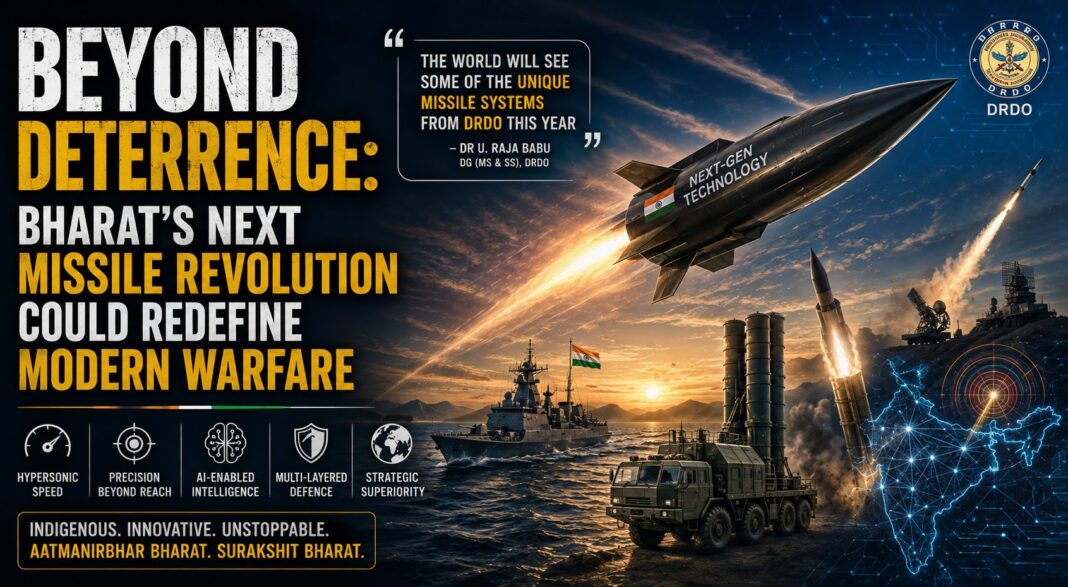
On 24 July 2026, the Indian defence community received a tantalising glimpse into what could be the next chapter of Bharat’s strategic evolution. During a public address, Dr U. Raja Babu, Director General (Missiles & Strategic Systems), DRDO, remarked that “the world will see some of the unique missile systems from DRDO this year that are not contemporary in the world.” It was a brief statement, but one carrying enormous strategic significance.
For those familiar with the guarded nature of India’s strategic programmes, such words are rarely spoken lightly.
This was not merely an announcement of another missile. It was an indication that Bharat may be preparing to unveil technologies capable of altering the very grammar of modern warfare.
From Technology Denial to Technology Leadership
India once struggled under technology denial regimes, where critical defence technologies were withheld, forcing scientists to innovate under severe constraints. Bharat’s scientists had to work under severe constraints to develop their own technologies.
Today, the narrative has changed dramatically.
From the Agni series and Akash to BrahMos, Pralay, Rudram and the Ballistic Missile Defence programme, DRDO has steadily transformed Bharat into one of the world’s foremost missile powers. Indigenous design has replaced dependence, and innovation has replaced imitation.
Operation Sindoor demonstrated that India’s precision-strike capabilities are no longer theoretical. They are operational, credible and capable of delivering strategic effects while maintaining escalation control.
The next generation of missile systems is expected to take this capability several steps further.
What Could Be Coming?
While DRDO has understandably maintained complete secrecy, ongoing programmes provide some clues.
The Long-Range Anti-Ship Hypersonic Missile (LRAShM) promises to transform maritime warfare. Travelling at hypersonic speeds over ranges exceeding 1,500 kilometres, such a weapon would compress enemy reaction times to mere minutes while enabling the Indian Navy to dominate vast stretches of the Indian Ocean Region.
Project Kusha, India’s indigenous long-range air defence system, represents another transformational capability. Designed to complement the S-400, it is expected to become the backbone of the country’s future multi-layered air and missile defence architecture.
The evolution of the BrahMos family continues unabated, with next-generation variants expected to feature longer ranges, enhanced survivability, improved precision and greater operational flexibility.
Yet Raja Babu’s words suggest something beyond these known programmes.
When he says these systems are “not contemporary in the world,” he hints at technologies that may have no direct operational equivalent today.
The New Battlefield
Future wars will not be decided merely by possessing missiles.
Victory will belong to nations that combine speed, artificial intelligence, autonomous target recognition, electronic resilience, multi-domain integration and precision into a single weapon system.
The distinction between offensive and defensive missiles is steadily blurring.
Missiles are becoming intelligent combat systems capable of adapting during flight, coordinating with other platforms and surviving increasingly sophisticated electronic warfare environments.
If Bharat has indeed achieved breakthroughs in these domains, the implications extend far beyond South Asia.

The China Factor
China has invested heavily in hypersonic glide vehicles, anti-access/area-denial systems, long-range precision strike capabilities and integrated missile forces.
Pakistan, meanwhile, continues to modernise its missile inventory with substantial external assistance.
India cannot afford technological parity. It must seek technological superiority.
History demonstrates that strategic stability is best preserved when potential adversaries are uncertain about their ability to neutralise your capabilities.
Technological surprise is itself a powerful deterrent.
Aatmanirbhar Bharat Comes of Age
The significance of these developments extends beyond military capability.
Every indigenous missile designed, developed and manufactured in Bharat represents technological sovereignty.
Thousands of scientists, engineers, MSMEs, private industries, public sector enterprises and start-ups are now contributing to a defence ecosystem that scarcely existed two decades ago.
The country is steadily moving from being one of the world’s largest defence importers to becoming an exporter of advanced strategic technologies.
This transformation reflects not merely industrial growth but national confidence.
The Road Ahead
Strategic programmes are cloaked in secrecy for good reason.
Capabilities are revealed only when governments believe disclosure itself enhances deterrence. That is precisely why Raja Babu’s statement deserves careful attention.
If the promised systems are unveiled this year, they may not simply add another missile to India’s inventory.
They could redefine how future conflicts are fought, how deterrence is maintained, and how the world perceives Bharat’s scientific and military capabilities.
For decades, the world watched Bharat emerge as a missile power.
The next unveiling may establish Bharat as the nation setting the benchmark for the next generation of missile warfare.
The age of catching up is over. The age of leading may well have begun.
#MayankSays