


Key Takeaways
- Bawris and Jhalras are traditional stepwells and water reservoirs found in western Rajasthan, India.
- Water Revitalization is a program aimed at bringing back the life and lost glory of water in these stepwells.
- Cultural Heritage of India is at risk due to neglect and disrepair of these stepwells and water reservoirs.
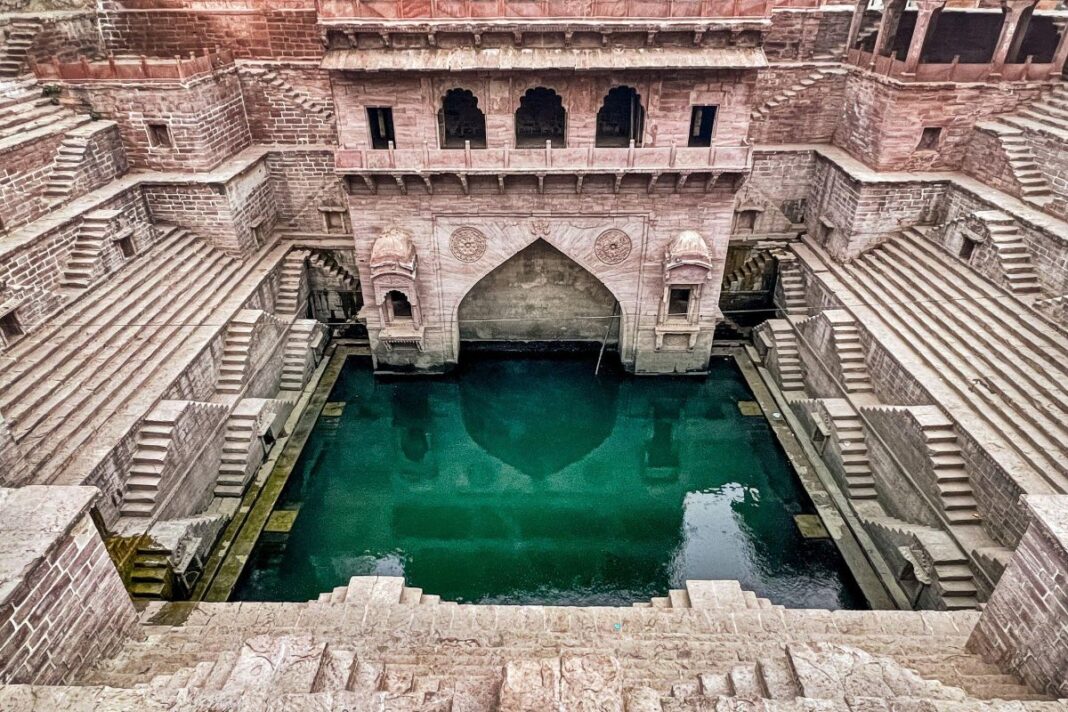
For centuries, stepwells and stepped water reservoirs, traditionally called ‘Bawris’ and ‘Jhalras’ in western Rajasthan’s Jodhpur, have been the backbone of the civilisation’s everyday life, being traditional drinking water sources for its people, as scarce rainfall has always been one of the biggest survival challenges for the semi-arid region of western Rajasthan.
Not only have these Bawris and Jhalras been crucial water collection and storage sources, the magnificent architectural marvels that they are made them become Rajasthan’s heritage and cultural identity. Historically, not only was the requirement of drinking water fulfilled by these stepwells and reservoirs, they also became exquisite places where the community came together to meet up, relax, and socialize.
While these historical architectural and utilitarian spectacles of generational struggle and talent hold huge potential to become nodal attractions for the tourism industry in Rajasthan; reality on ground-zero is quite the opposite. The air around these beautiful structures fell into an eerily quiet despair after modern water supply technologies entered the scene; and not only has the utilitarian angle been overlooked for a long time now, this cultural heritage kept falling deeper into the abyss of ignorance, and now stands at a place where it is in its worst possible condition.
The places where communities flourished and were bound together, have now turned into garbage-filled ruins, crying out for help and the right kind of attention.
To understand what the issue is and how it unfolded, Sonakshi Datta of GoaChronicle spoke with Rajesh Joshi, the founder and president of a Jodhpur-based NGO called ‘Grow Sansthan’, founded in 2012.
The body looks into addressing issues concerning the environment and the future of coming generations. Rajesh has contributed into raising the topic of maintenance and the restoration of these bawris and jhalaras of the city. He has been working for the revitalization of water, giving the water its lost glory, that is ensuring the availability of clean and safe water for humans, aquatic beings, birds and animals.
His niche domain of work involves sustainability inside and outside, solid waste management, water revitalization, plantation, and transplantation of trees, and educating kids about environment and ecology.
Throw some light on the social, cultural, and environmental significance and importance of the Bawris of Jodhpur.
For centuries, stepwells and stepped water reservoirs, traditionally called ‘Bawris’ and ‘Jhalras’ in western Rajasthan’s Jodhpur, have been the backbone of the civilization’s everyday life. These magnificent architectural marvels have been crucial water collection and storage sources, and now, after years of neglect, they are on their last legs. The common English term, ‘stepwell’ encompasses two main types of water impounding structures and their hybrids: The Bawdi (Baoli) is typically a sheltered stepped well where a deep well spilling into a rectangular tank is reached by descending levels of steps from one side, like an escalator; and the Jhalra is a square open structure closer in shape to a stepped pond, with staggered stairs reaching down to the water from three or four sides.
A stepwell collects underground rainwater. They are particularly important in the western part of Rajasthan, where water is scarce and small rainfall is a big problem.
Water is life. Every drop of this sacred ‘blue blood’ is conserved throughout this part of Rajasthan. Getting enough water for survival and household use has always been a big challenge for women, because they often have to walk many miles with massive matkas or ‘degadas’ on their heads.
Interestingly, most stepwells in western Rajasthan were built by queens, inspired by the needs of ordinary women.
Somehow, we wanted to create utility out of these structures and in doing so, I designed a program for water called ‘Water Revitalization’ that aims to bring back the life and lost glory of water. The aim is to utilize the water and make it so useful that it has all the properties and potency to regenerate and revitalize the life inside as well as outside the water.
These places are architecturally excellent buildings with beauty and finesse of the highest order, and have the potential to be places that can be visited and explored by Indians or by foreign visitors.
While cleaning these water bodies, we kept in mind that no bird is hurt, no fish dies, and the visitors to these places enjoy the beauty of nature full of plants, birds, and fishes.
We cleansed water bodies which are sometimes even 150 feet deep, having different flights, filling up buckets with muck, and dragging them out, and no machinery is involved except draining the excess water to reach out to the muck.

These stepwells, bawris, or ponds should be considered as small ecosystems themselves, and the life around these should be protected and habitats conserved.
How will you describe the current condition of these Bawris, and what factors do you think led to such circumstances?
All these water bodies are within themselves, examples of a perfect ecosystem where fishes, birds, turtles, algae, snakes, invertebrates, and billions of microorganisms live. But their habitat has been challenged, somehow to a big extent, by human activities and neglect.
These places like ponds and step-wells used to contain fresh water, and the ecosystem of these water bodies was very well-preserved in olden days; with time, and water supply coming right into the houses, people started ignoring these places and these water bodies became terribly dirty, broken, trashed, vandalized, rubbish pits, and nearly septic tanks.
We experienced thousands of fishes dying, turtles’ breeding places destroyed; and kingfishers, cormorants, and even migratory birds moved to some unknown places.
You might remember the recent example of demoiselle cranes (Kurja) dying of a virus called ‘Avian botulism’, which is only one of the examples people could notice.
What role has governments played over the years for the preservation of these bawris? What more do you believe should be done?
No matter what political party comes to power, governments have never done anything. They are just watching people doing something. They have no roadmap or strategy for the betterment of these bawris and jhalras.
What role do you think local citizens of Jodhpur must play to conserve the bawris?
It is very clear that our forefathers kept them in an immaculate condition, but now, we are not doing enough. Though sporadically, some people do come forward to work towards this cause, but they have no clear vision beyond just cleaning the steps or hanging posters.
What future prospects do you think the bawris hold to sustain the water requirements and what all has to be done for this full potential to be reached?
This is a good question.
My idea is that these water bodies should be cleaned along with all the water catchment areas; and the water should be clean enough to be used in case of an emergency.
Also, these structures are beautiful and big enough to hold events like music concerts and the stepped reservoirs can also be used as amphitheaters.
If we pay attention to these structures, carve out the right utility, and wake up to the cultural and social significance they hold for our society, they can be pulled out of ignorance and can be respected the right way, as they deserve.