
Key Takeaways
- The Arnab Goswami interview highlighted diplomatic pressure that aided VanDyke’s release.
- VanDyke’s case shifted from UAPA to immigration charges, enabling a default bail.
- The National Investigation Agency kept the probe open despite the bail.
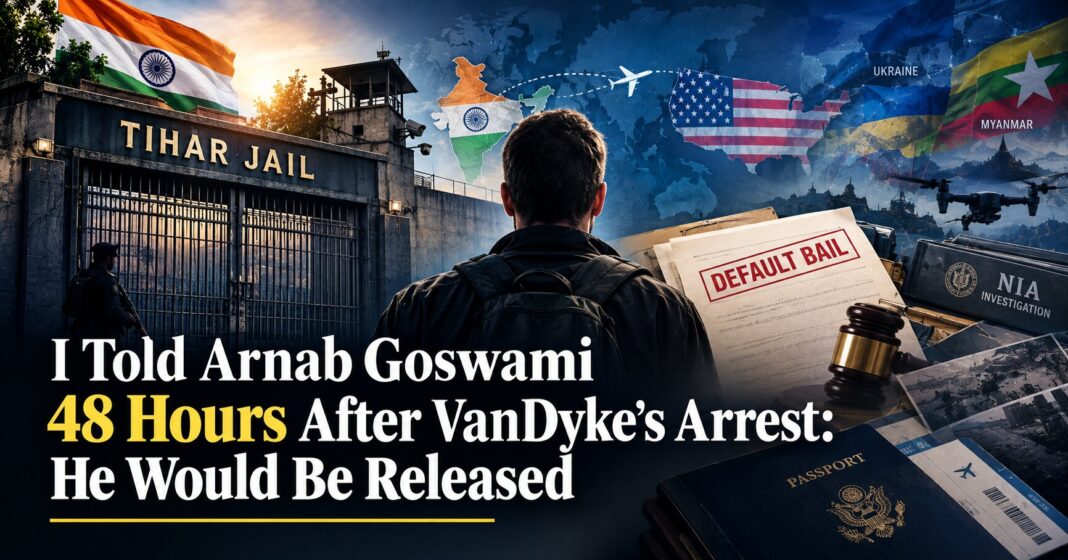
Forty-eight hours after the arrest of Matthew Aaron VanDyke in India, I told my close friend Arnab Goswami, Editor-in-Chief, Republic TV that I believed VanDyke would eventually be released. My assessment at that time was not based simply on the legal circumstances surrounding his arrest. It was based on the geopolitical architecture surrounding the case, the profile of the man India had arrested, the international networks connected to him and, above all, my assessment that powerful interests in Washington would push the right buttons in India to ensure that the matter did not end with VanDyke remaining indefinitely in an Indian prison.
Today, VanDyke has walked out of Tihar Jail and has been permitted by a Delhi court to travel to the United States for a month. The court has not acquitted him of the allegations under investigation, nor has the National Investigation Agency closed its investigation. But the sequence of events is significant enough to revisit the assessment I made almost six months ago.
VanDyke, a 46-year-old American national, was arrested by the NIA on March 13, 2026. Six Ukrainian nationals were arrested in the same investigation. The case arose from allegations concerning travel through Mizoram into Myanmar and alleged involvement in drone-warfare and military training for Myanmar-based ethnic armed groups. The NIA had initially registered the case under the Unlawful Activities (Prevention) Act, including Section 18 concerning conspiracy to commit terrorist acts.
That alone made the arrest extraordinarily serious.
But VanDyke was not an ordinary foreign national who happened to be caught violating Indian immigration regulations. His background is important to understanding why his detention generated international attention. He had previously participated in the Libyan conflict, was captured by forces loyal to Muammar Gaddafi, later became involved in fighting against Islamic State in Iraq and subsequently became involved in military training activities connected to Ukraine. He is also associated with Sons of Liberty International, an organisation involved in security and military training.
The NIA’s investigation alleged that VanDyke and the other accused had links with Myanmar-based ethnic armed organisations and that drone warfare, drone assembly, drone operations and jamming technology were among the areas of training allegedly provided. Investigators also examined consignments of drones and electronic equipment. The NIA, however, had not established conclusive evidence that the accused were acting against India or had trained Indian insurgent groups. The investigation remained open.
This distinction is crucial.
There is a tendency in national-security cases to assume that an arrest itself establishes guilt. It does not. An investigation is an investigation; an allegation is an allegation; and a court determines criminal liability according to law.
But there is another question that cannot be ignored: why did the legal trajectory of this case change so dramatically?
The NIA initially investigated the matter under UAPA. Because UAPA investigations can, under specified circumstances, receive an extension of the ordinary investigation period to as much as 180 days, VanDyke remained in custody for approximately six months. He was arrested on March 13, and September 8 became the critical statutory date. On that date, however, the NIA filed a chargesheet that invoked Sections 21 and 23 of the Immigration and Foreigners Act, 2025, rather than the UAPA provisions under which the case had initially been registered.
That was the turning point.
The NIA maintained that its investigation into the UAPA allegations was continuing and that further evidence could result in supplementary charges. In other words, the September chargesheet did not represent the final closure of the national-security investigation. But the immediate chargesheet before the court concerned immigration-related offences.
VanDyke’s lawyers then sought default bail.
On September 18, Special NIA Judge Prashant Sharma granted him default bail on a personal bond of ₹1 lakh and a surety of ₹1 lakh. The court found that the chargesheet was, in effect, incomplete in relation to the UAPA investigation and that the statutory conditions for default bail had been triggered. The court also observed that the six Ukrainian co-accused could claim similar relief.
This is where the phrase “Deep State” enters my argument.
I have used that expression to describe the broader ecosystem of permanent or semi-permanent institutions, intelligence networks, security establishments, defence interests, political actors and foreign-policy networks that can operate beyond the immediate electoral cycle of any one administration. That is an analytical description of how I view the ecosystem – not a claim that a particular clandestine organisation has been proven to have ordered VanDyke’s release.
But there is evidence of something else: VanDyke’s case had acquired international dimensions. His family had appealed to the administration of US President Donald Trump, while US officials had raised the matter with Indian authorities through consular channels. Reporting at the time also noted that such diplomatic engagement did not determine the NIA’s investigation.
That is precisely why I made my prediction.
I was looking at the convergence of law, diplomacy, geopolitics and the profile of the individual involved.
The subsequent developments are striking.
On September 22, VanDyke sought permission to travel to the United States. On September 24, the Delhi court allowed him and the six Ukrainians to travel to their respective countries for one month, subject to conditions. They were required to provide their overseas addresses and contact details and remain available to the investigation. The court also emphasised that the right to travel abroad is connected to fundamental rights under Article 21 and that a balance must be maintained.
There is another interesting detail.
The six Ukrainians had paid ₹5.5 lakh each in compounding charges to the Foreigners Regional Registration Office for the immigration violations. VanDyke also paid ₹5.5 lakh in compounding charges. The court subsequently allowed the accused to leave India temporarily.
So, what happened to the frightening national-security case with which this saga began?

It has not disappeared.
The NIA continues to investigate the alleged UAPA dimension. The agency has indicated that if evidence emerges, supplementary chargesheets could be filed. The court has not declared VanDyke innocent of the allegations under investigation.
But the man who was arrested under a terrorism-related investigation is now outside India.
That is the fact.
And this is precisely why I believe my original observation deserves to be revisited – not as a declaration that I had some secret information, but as an example of geopolitical reading.
Sometimes, national-security cases cannot be understood purely through the criminal-law lens. Foreign nationals involved in conflict zones can become nodes in much larger international networks. Their governments, families, diplomatic establishments, intelligence communities, military institutions and political constituencies can all become interested in what happens to them.
India must therefore ask difficult questions.
Did the NIA have sufficient evidence to sustain the original UAPA allegations? Why was the first chargesheet limited to immigration offences? Why did the UAPA investigation remain open? What evidence has been collected regarding the alleged Myanmar connections? What exactly was the role of the drones allegedly brought from Europe? Were there connections with Indian insurgent organisations? And, most importantly, does VanDyke’s departure from India compromise any future investigation?
These are legitimate questions. They should be answered through evidence, not speculation.
My larger concern is strategic.
India is no longer a peripheral player in global geopolitics. It sits at the intersection of the Indo-Pacific, West Asia, the Russia-Ukraine conflict, the Myanmar crisis and the evolving competition between the United States and China. Foreign actors operating across these theatres can eventually intersect with India’s national-security interests.
The VanDyke case therefore deserves to be studied beyond the immediate headlines.
I told Arnab Goswami, 48 hours after VanDyke’s arrest, that I believed he would be released because I believed the international machinery surrounding him would eventually become too significant to ignore.
Six months later, the legal facts have taken us to precisely that point: default bail, a chargesheet without UAPA provisions, continuing investigation, payment of immigration compounding charges and, finally, judicial permission to leave India for the United States.
Was this the result of some hidden American operation?
There is insufficient public evidence to establish that.
Was there American diplomatic interest?Yes, that has been reported.
Was VanDyke’s release achieved through a secret political intervention?That remains unproven, even though I believe so.
But geopolitics is often about recognising the pressure points before they become visible to everyone else.
The lesson for India is not that foreign pressure will always defeat Indian sovereignty. The lesson is that whenever India arrests a foreign national with a history spanning multiple conflict theatres, military networks and international connections, New Delhi must understand the entire geopolitical ecosystem surrounding that individual.
Because sometimes the most important battle is not fought in a courtroom.
It is fought quietly – in diplomatic rooms, intelligence channels, strategic networks and geopolitical calculations.
And that is why, 48 hours after Matthew VanDyke was arrested, I believed that his story in India would not end in an Indian prison.