

Key Takeaways
- India’s transition from a defensive air posture to an offensive doctrine was predicted by the CIA in the 1980s.
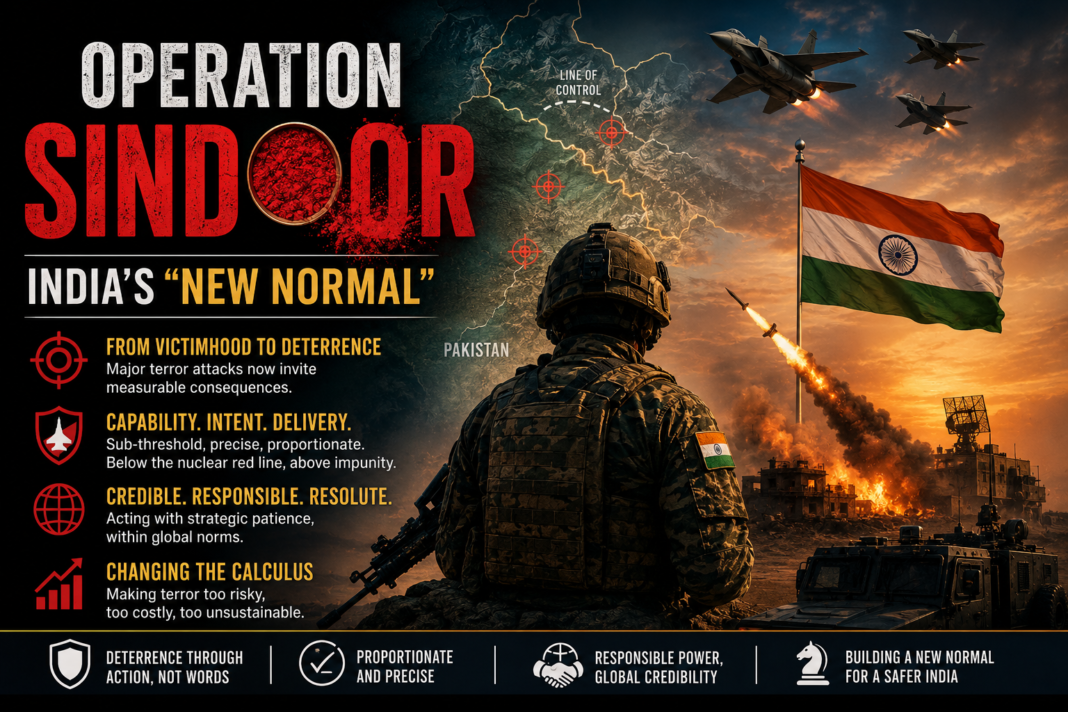
- Operation Sindoor demonstrated the integration of various capabilities, including ISR dominance, drone warfare, and precision-guided munitions.
- The CIA’s assessment of India’s air power was accurate, and the country’s military capabilities have continued to evolve and mature.
There are moments in history when a nation’s military evolution becomes impossible for the world to ignore. For Bharat, one such moment quietly unfolded inside the corridors of the Central Intelligence Agency during the Cold War.
Long before Rafale debates, Balakot discussions, drone warfare, or the emergence of network-centric battlefields, American intelligence analysts had already begun writing detailed assessments about a rising force in South Asia, the Indian Air Force.
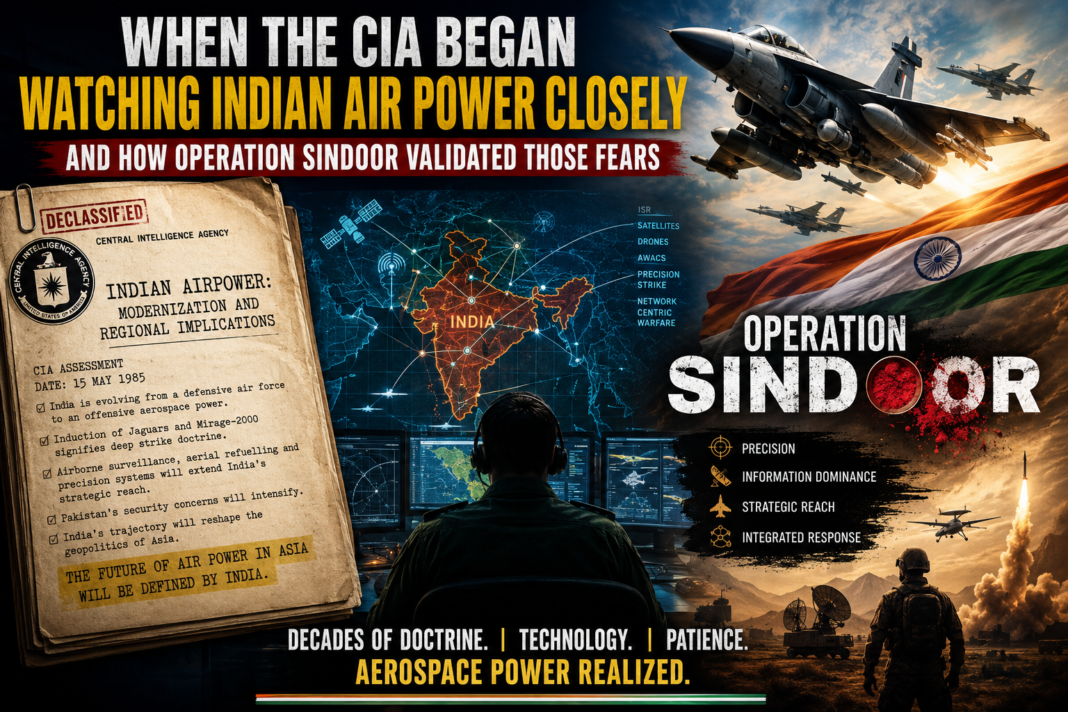
One declassified CIA paper titled “Indian Airpower: Modernization and Regional Implications” now reads almost like a prophecy.
Because decades before the world saw precision strikes, integrated surveillance systems, and long-range aerospace operations conducted by Bharat, the CIA had already concluded something remarkable:
India was no longer building merely a defensive air arm. It was preparing an aerospace force capable of shaping the geopolitics of Asia.
And many years later, Operation Sindoor would prove just how accurate that assessment had been.
The Long Shadow of Earlier Wars
Military doctrines are rarely born overnight. They emerge from trauma, lessons, humiliation, and eventual transformation.
The 1962 war with China exposed serious gaps in India’s preparedness. The conflict left deep scars within the strategic psyche of Bharat.
Then came 1971.
The Indian Air Force played a decisive role during the Bangladesh Liberation War. Air superiority accelerated victory and crippled Pakistani military movement. For Indian planners, the lesson became permanent: Future wars would not merely be fought on land.
They would be decided in the skies.
The CIA document repeatedly references this transition in Indian thinking.
The report observed that Bharat was gradually shifting from a defensive air posture toward an offensive doctrine centred on mobility, reach, and strategic strike capability.
That transformation would continue for decades.
And eventually, it would culminate in operations like Sindoor.
The Birth of Deep Strike Thinking
One of the most important parts of the CIA assessment discusses the induction of Jaguar strike aircraft.
To civilians, aircraft acquisitions often appear routine.
But to military strategists, platforms reveal doctrine.
The Jaguar represented something revolutionary for Bharat at that time: deep penetration strike capability.
It meant Indian aircraft could hit:
• enemy command centres,
• logistics hubs,
• supply chains,
• radar stations,
• and strategic infrastructure deep inside hostile territory.
The CIA immediately understood the implications. This was no longer about protecting Indian airspace.
This was about offensive reach.
It was the beginning of India’s transition from tactical air defence to strategic aerospace power.
The same doctrinal thinking would later evolve into:
• Balakot,
• stand-off precision strikes,
• and ultimately the integrated aerospace framework visible during Operation Sindoor.
Mirage-2000 and the Precision Revolution
The document also highlighted the Mirage-2000 acquisition as a transformational leap.
Decades later, the Mirage would become globally famous during the Balakot strikes.
But the CIA had already identified its importance long before that.
The aircraft brought:
• advanced avionics,
• precision strike capability,
• better radar,
• and superior air combat performance.
More importantly, it represented India’s entry into the era of precision warfare.
And precision warfare is exactly what defined Operation Sindoor.
Operation Sindoor: The Maturity of a Doctrine
Operation Sindoor was not merely a military operation. It was the visible manifestation of decades of doctrinal evolution.
What the CIA feared in the 1980s became reality in the 2020s.
During Operation Sindoor, Bharat demonstrated the integration of:
• ISR dominance,
• drone warfare,
• satellite-enabled targeting,
• precision-guided munitions,
• electronic warfare,
• and real-time battlefield awareness.
This was no longer the air force of the 1971 era. This was an aerospace ecosystem. The operation showcased how Bharat had fused:
• air power,
• intelligence,
• cyber capability,
• space assets,
• and network-centric command structures
into a single synchronized military response.
The CIA document had predicted precisely this direction.
From Aircraft to Information Dominance
One of the most fascinating sections of the CIA assessment concerned airborne surveillance systems and battlefield awareness. The report noted that future wars would increasingly depend on:
• who sees first,
• who tracks first,
• and who reacts first.
That insight lies at the heart of Operation Sindoor.

The operation reflected the power of:
• AWACS,
• drones,
• satellites,
• secure communications,
• and integrated ISR architecture.
Indian military planners understood that modern wars are no longer won merely through numbers. They are won through information dominance.
In Operation Sindoor, Bharat demonstrated the ability to maintain situational awareness across multiple domains simultaneously.
That is the hallmark of a mature aerospace power.
The Sky Is No Longer the Limit
The CIA assessment also paid close attention to aerial refuelling capability. To ordinary observers, aerial refuelling may appear technical. But strategically, it changes geography itself.
It allows aircraft to:
• remain airborne longer,
• strike deeper,
• and sustain operations far from home bases.
This philosophy became central to modern Indian military planning. By the time Operation Sindoor unfolded, the Indian military was no longer thinking merely in terms of borders.
It was thinking in terms of strategic reach.
That is a profound doctrinal transformation.
Pakistan’s Anxiety and the Nuclear Shadow
The CIA document repeatedly discussed Pakistan’s concerns over India’s modernization.
The assessment warned that overwhelming Indian conventional superiority could eventually lower Pakistan’s nuclear threshold.
Even today, this remains one of South Asia’s central strategic realities.
Operations like Sindoor reinforce an uncomfortable truth for Islamabad:
Bharat’s growing precision strike capability complicates traditional deterrence calculations.
Because when a nation can conduct:
• rapid,
• precise,
• intelligence-driven,
• stand-off operations,
without necessarily escalating into full-scale war, the strategic balance changes dramatically.
The CIA saw this trajectory decades ago.
China Was Watching Too
The report also noted Chinese concerns regarding India’s aerospace ambitions. At the time, China was focused primarily on larger Cold War dynamics. Yet Beijing carefully monitored Indian modernization.
Today, that rivalry has evolved into:
• advanced fighter competition,
• border airbase expansion,
• ISR races,
• missile deployment,
• drone warfare,
• and space-based military capability.
Operation Sindoor demonstrated that Bharat had moved decisively into the league of nations capable of integrated multi-domain operations.
And China certainly noticed.
Operation Sindoor Was More Than an Operation
For many observers, Operation Sindoor appeared as a tactical or operational success. But strategically, it represented something much larger. It marked the arrival of Bharat as a technologically mature military power capable of integrating:
• air,
• land,
• space,
• cyber,
• and intelligence assets into a unified response architecture.
In essence, it validated decades of military modernization that began long before most people realized. The CIA document serves as a fascinating historical mirror.
Because hidden inside those Cold War assessments was an early recognition that Bharat’s military trajectory would eventually reshape South Asian geopolitics.
Operation Sindoor proved that prediction correct.
The Silent Rise of Indian Aerospace Power
Perhaps the most striking aspect of this story is its quietness. India did not build aerospace capability through loud declarations.
It evolved through:
• doctrinal learning,
• technological absorption,
• operational experience,
• indigenous innovation,
• and strategic patience.
From Jaguars to Rafales.
From MiGs to integrated drones.
From radar coverage gaps to real-time ISR dominance.
From tactical air defence to network-centric warfare.
The journey has been long.
But history now reveals something remarkable: While many still underestimated Bharat’s military transformation, foreign intelligence agencies had already begun documenting it decades ago.
And today, operations like Sindoor show that those early assessments were not exaggerations.
They were warnings.
#MayankSays