


Key Takeaways
- Beijing is emerging as a key player in the new great game, with the US and Russia seeking its support and cooperation.
- The relationship between China and Russia is increasingly asymmetrical, with China securing discounted energy and strategic depth, while Russia needs Chinese markets and diplomatic cover.
- The absence of a final deal on the Power of Siberia-2 gas pipeline agreement revealed the true nature of the relationship between China and Russia, with China supporting Russia on its own terms.
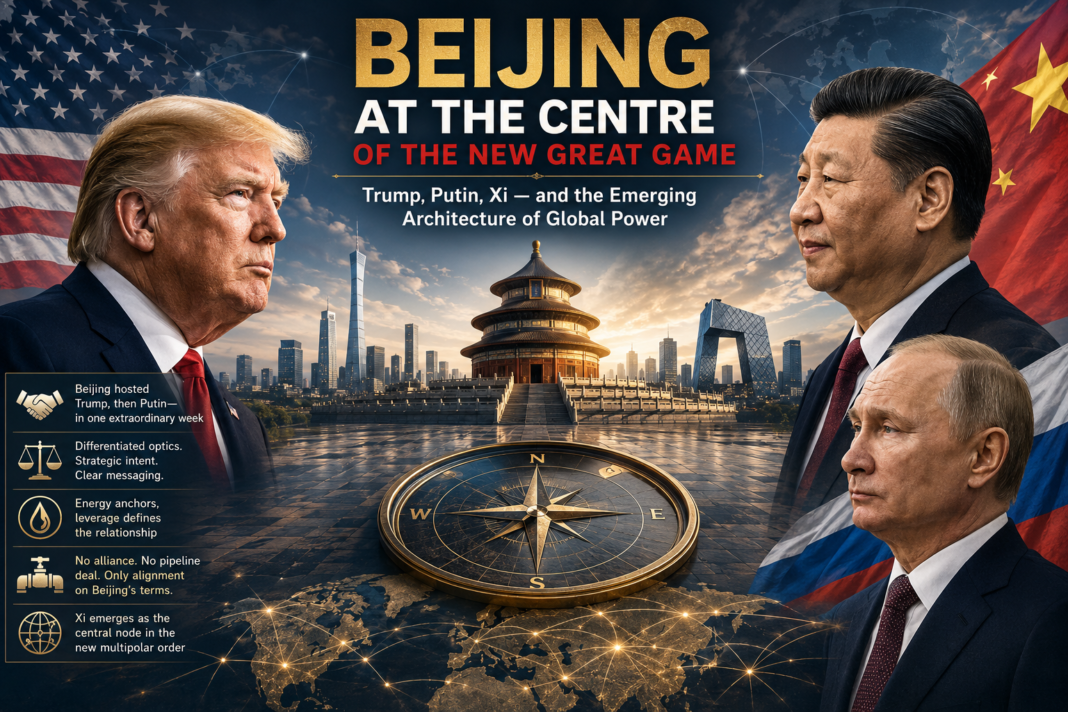
Beijing played host to two high-profile visits in May 2026: US President Donald Trump and then Russian President Vladimir Putin. The sequencing was deliberate. The sequencing was deliberate.
Trump visited China from 13–15 May 2026. His engagements were publicly framed around trade and technology, but the discussions almost certainly extended to Gulf stability, energy security and concerns over the Strait of Hormuz amid continuing West Asian tensions.
Barely four days later, Putin arrived on the night of 19 May for a two-day state visit, focused overwhelmingly on strategic coordination, energy, security architecture and long-term geopolitical alignment.
The symbolism was unmistakable: within one week, both Washington and Moscow came to Beijing seeking something from Xi Jinping. That alone marked a profound shift in the architecture of global power.
The Optics: A Revealing Protocol Difference
Trump was received at the airport by Chinese Vice President Han Zheng. Putin, by contrast, was received by Chinese Foreign Minister Wang Yi. Some interpreted this as a downgrading of Putin, though the reality is more nuanced.
In China’s political hierarchy, the vice presidency is largely ceremonial, whereas Wang Yi is one of the most powerful figures in China’s foreign policy establishment and a key Politburo-level strategist. The message was subtle but deliberate: Trump received ceremonial state optics. Putin received strategic engagement. Yet the protocol variation was prima facie striking.
Beijing was signalling differentiated relationships: The US remains China’s principal systemic rival and economic counterpart. Russia is increasingly China’s strategic operating partner. This distinction matters enormously.
Putin’s Visit: Strategic Signalling More Than Breakthrough Diplomacy
The Putin visit produced no earth-shattering announcements. Yet its geopolitical significance was substantial. Xi and Putin jointly emphasized resistance to Western unilateralism; opposition to bloc politics; support for a “multipolar order”; and strategic coordination against expanding US-led security architectures.
The language was carefully crafted. It stopped short of announcing a formal alliance, yet unmistakably conveyed long-term geopolitical alignment.
The 2001 China–Russia Treaty of Good-Neighbourliness and Friendly Cooperation was ceremonially renewed and elevated.
This was important because Beijing increasingly seeks institutional (CCP) continuity beyond individual leaders. China is preparing for prolonged strategic rivalry with the West and wants Russia embedded within its long-term continental security framework.
Energy Still Anchors the Relationship
Energy cooperation remained the backbone of the visit. Russia reaffirmed its role as China’s major long-term supplier of oil, gas and nuclear energy, while China expanded cooperation in technology, AI and industrial sectors.
But beneath the rhetoric lies an increasingly asymmetrical relationship. Today, Russia needs Chinese markets, electronics, finance and diplomatic cover. China secures discounted energy, strategic depth and a permanently dependent northern partner.
The balance of leverage is visibly shifting towards Beijing.
The Most Important Thing That Did NOT Happen
The most consequential absence was the failure to finalize the Power of Siberia-2 gas pipeline agreement.
For Moscow, the pipeline is economically critical after Europe’s long-term energy decoupling. For Beijing, delay increases bargaining leverage. China understands that Russia has few alternatives. Beijing can therefore afford patience while extracting better pricing and strategic concessions.

The absence of a final deal revealed the true nature of the relationship: China supports Russia — but strictly on Chinese terms.
No Alliance. No Ukraine Breakthrough.
Equally revealing was what Beijing carefully avoided. There was no NATO-style defence pact; no explicit military alliance; no major Ukraine peace initiative; and no dramatic anti-Western escalation. China continues to avoid fully inheriting Russia’s geopolitical liabilities.
Beijing wants Russia strong enough not to collapse; weak enough to remain dependent; and useful enough to distract NATO and divide the West. That balancing act remains central to Chinese grand strategy.
Trump’s Visit: Transactional, Not Transformational
Trump’s visit to Beijing the previous week had an entirely different character. The officially declared agenda centred on tariffs, trade stabilization, aircraft purchases, technology access and broader economic recalibration. But beneath this lay a more pressing strategic concern: Iran and the Strait of Hormuz.
Trump appears to have arrived hoping Xi would use China’s leverage with Tehran to moderate Iranian obduracy and facilitate movement toward a ceasefire — naturally on terms favourable to Washington. The outcome was rather underwhelming. Both leaders merely reiterated positions they already broadly shared even before the summit: Iran must not acquire nuclear weapons; and the Strait of Hormuz must remain open. This reflected continuity rather than breakthrough. There was no visible indication that Xi agreed to actively pressure Tehran in support of American objectives. There was no operational alignment.
So, whilst Trump arrived seeking deals and strategic assistance, Putin arrived seeking reassurance and geopolitical alignment. Trump’s visit was tactical; Putin’s was structural. China handled both with calculated precision. To Washington, Xi offered limited economic stabilization and calibrated strategic convergence; to Moscow, visible political solidarity and long-term reassurance — while conceding decisive advantage to neither.
The Deeper Chinese Strategy
China is executing a dual-track grand strategy: stabilize relations with the United States sufficiently to prevent economic rupture; while simultaneously deepening strategic convergence with Russia. This gives Beijing maximum flexibility.
China does not want a direct Cold War binary; nor a rigid alliance system. Instead, it seeks to become the indispensable balancing power between rival blocs. That objective was on display this week.
Why Xi Emerged as the Real Winner
In the space of days, the Presidents of the United States and Russia both came to Beijing. Xi Jinping became a central geopolitical actor. For decades, major powers travelled to Washington seeking outcomes. Increasingly, they now travel to Beijing.
That does not mean China has replaced the United States globally. But it does mean that China increasingly sees itself — and is increasingly seen by others — as the pivotal node of the emerging multipolar order.
Key Takeaways for India
1. India’s Strategic Space Is Expanding.
As US-China rivalry intensifies and Russia becomes more dependent on China, India’s value to all major poles rises. The US sees India as a balancing power in Asia. Russia sees India as one of the few remaining major autonomous partners outside China. China sees India as both a competitor and a necessary stabilizer. This enhances India’s diplomatic leverage.
2. Russia’s Dependence on China Creates Long-Term Risks for India.
Historically, India benefited from a relatively autonomous Russia. A Russia structurally dependent on China may become less strategically flexible, and gradually align more closely with Chinese geopolitical preferences. That is a serious long-term concern for New Delhi.
3. India’s Multi-Alignment Strategy Stands Vindicated.
This week reinforced the wisdom of India’s current foreign policy approach: engage the US; retain Russia ties; manage China competitively; deepen Global South leadership; and avoid alliance entrapment. The emerging order is not bipolar. It is fluid, transactional and multipolar. India is structurally better positioned in such a system than many formal alliance states.
The Strategic Bottom Line
Beijing now believes it can simultaneously engage Washington, stabilize Moscow, influence Eurasia, and shape the emerging world order — from a position of growing centrality, confidence and leverage.