








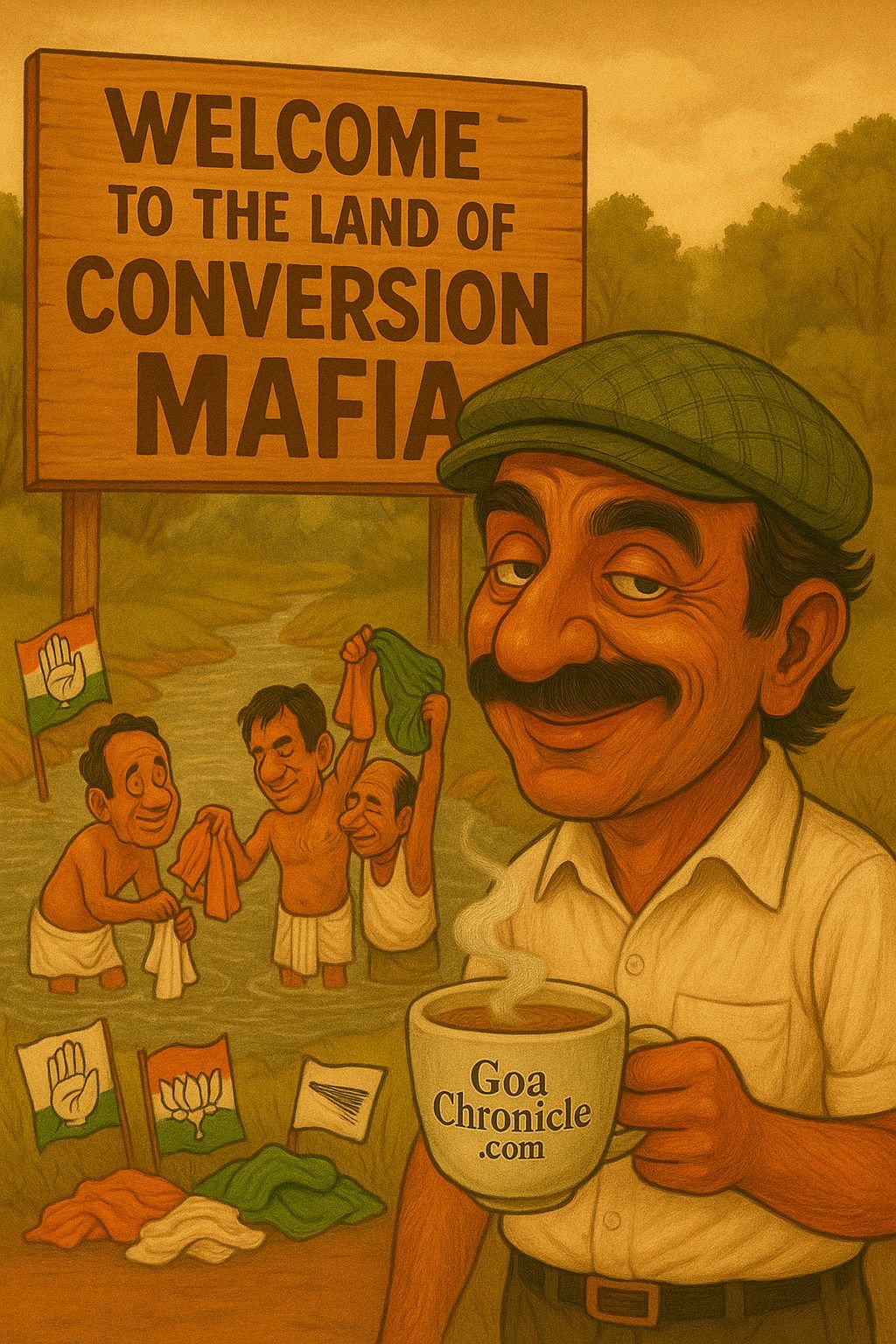







At a time when India is navigating complex questions of identity, faith, and national cohesion, the statement by Dattatreya Hosabale, Ma. Sarkaryavah (General Secretary) of RSS during the ‘100 Years of Sangh Journey – New Horizons, New Direction’, commemorating the centenary year of the Sangh in Goa draws a necessary and long-overdue distinction. His words cut through the noise with clarity: India has no issue with voluntary religious conversion, but organised efforts to alter the country’s demographic fabric through coercion or inducement pose a serious threat to national security.
This is not an argument against religious freedom. In fact, it is a defence of it.
The Indian Constitution guarantees every citizen the right to practice, profess, and propagate their faith. This freedom is fundamental to the idea of India – civilisation that has, for centuries, embraced multiple paths to spiritual truth. From ancient traditions to more recent faiths, India’s diversity has been its strength precisely because belief has largely remained a matter of personal conviction, not organised coercion.
But the distinction Hosabale highlights is critical. There is a world of difference between an individual choosing a faith after introspection and a system that targets vulnerable communities with inducements, misinformation, or pressure. When conversion becomes less about spirituality and more about strategy, it ceases to be an exercise of freedom – it becomes an act of influence.
Across various parts of the country, concerns have been raised about structured conversion efforts. These are not isolated instances of personal choice but often involve coordinated outreach, financial incentives, and narratives designed to alienate individuals from their cultural and social roots. When such activities are backed by organised networks, sometimes even with external funding, the issue moves beyond religion and enters the domain of national security.
A nation’s security is not defined solely by its borders or military strength. It is equally determined by its internal stability, social cohesion, and cultural continuity. Any systematic attempt to engineer demographic change – especially through coercive or deceptive means – creates fault lines within society. Over time, these fault lines can deepen into divisions that weaken the nation from within.
This is precisely the concern Hosabale has articulated. It is not about opposing any particular religion. It is about recognising that faith, when weaponised as a tool for demographic engineering, can have consequences that extend far beyond individual belief systems.
Critics often frame this debate as an attack on minority rights or religious freedom. But that framing is both simplistic and misleading. The real issue is not about restricting anyone’s right to believe. It is about ensuring that belief is not manipulated, purchased, or imposed.
True religious freedom requires that an individual’s choice be made without pressure, without inducement, and without fear. If economic vulnerability, social isolation, or misinformation becomes the driving force behind conversion, then the very essence of that freedom is compromised.

At the same time, India must also confront an uncomfortable truth – conversion often finds fertile ground where there is neglect, inequality, or lack of opportunity. Communities that feel excluded or marginalised are naturally more susceptible to external influence. This means that the response cannot be limited to legal or political measures alone. The answer must also lie in inclusive development, social reform, and empowerment.
When people have access to education, economic opportunity, and social dignity, they are far less likely to be influenced by inducement-based conversion efforts. Strengthening communities from within is as important as safeguarding them from external pressures.
However, acknowledging internal gaps should not become an excuse to ignore organised strategies. Globally, there is increasing evidence of religious conversion being used as a means of expanding influence – sometimes linked to geopolitical interests. India, with its vast and diverse population, becomes an obvious target for such efforts.
This is why the conversation must move beyond political correctness and confront the issue with honesty. Who is funding these activities? What methods are being used? Are vulnerable populations being deliberately targeted? These are legitimate questions that any responsible nation must ask.
As the RSS marks 100 years, the larger message emerging from its leadership is not confined to ideology – is about national awareness. The need of the hour is a balanced approach: one that protects genuine freedom of religion while firmly opposing any attempt to misuse that freedom for strategic or coercive purposes.
India as a secular nation has never meant passive acceptance of all actions carried out in the name of religion. It has always meant equal respect for all faiths, coupled with a commitment to justice and fairness. Allowing coercive or inducement-driven conversions under the guise of freedom would be a betrayal of that principle.
The question before India is not whether people should be free to choose their faith – they absolutely should. The real question is whether the nation should remain silent when that choice is distorted by pressure, money, or organised agendas.
Faith must remain sacred. It must remain personal. And above all, it must remain free from manipulation. Because when belief is no longer a matter of conscience but a product of strategy, it stops being faith altogether – and becomes a tool of power.
Safeguarding the integrity of that faith is not just a religious concern. It is, as Hosabale rightly points out, a matter of national security.