

Key Takeaways
- The RBI maintained its neutral stance on repo rate, citing a benign inflation outlook and resilient domestic growth.
- The current repo rate remains unchanged at 5.25%.
- The RBI’s growth projections for the Indian economy are 7.4% for 2025-26, driven by robust private consumption and fixed investment.
New Delhi: The Reserve Bank of India’s Monetary Policy Committee (MPC) on Friday unanimously decided to keep the key policy repo rate unchanged at 5.25 per cent, citing resilient domestic growth, a benign inflation outlook and rising global uncertainties.
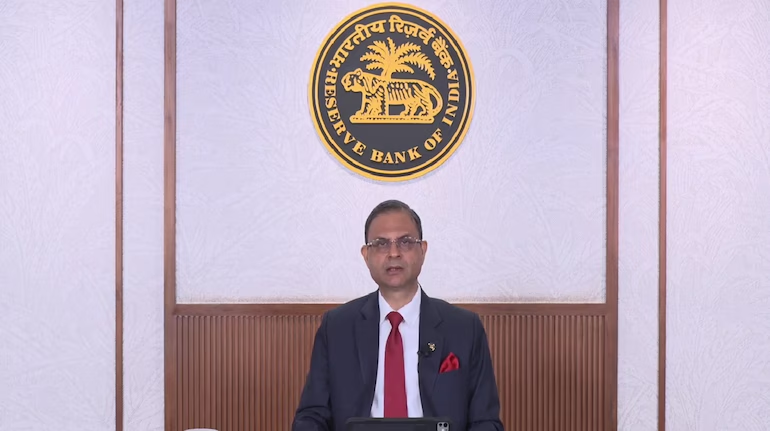
The decision was taken at the MPC’s 59th meeting held from February 4-6, under the chairmanship of RBI Governor Sanjay Malhotra.
Consequently, the standing deposit facility (SDF) rate remains at 5.00 per cent, while the marginal standing facility (MSF) rate and the Bank Rate continue at 5.50 per cent. The MPC also opted to retain its neutral policy stance, indicating a calibrated approach going forward.
The global economy showed notable resilience in 2025, supported by front-loaded trade activity and fiscal stimulus. Additionally, accommodative monetary policies across major economies played a significant role.
However, rising geopolitical tensions, fiscal pressures and divergence in monetary policies continue to inject volatility into global financial markets.
On the domestic front, India’s real GDP growth for 2025-26 is estimated at 7.4 per cent, according to the First Advance Estimates. Growth has been largely driven by robust private consumption and fixed investment, even as net external demand remained a drag due to higher imports.
On the supply side, real gross value added (GVA) is projected to grow at 7.3 per cent, supported by buoyant services activity, a resilient agriculture sector and signs of revival in manufacturing.
Looking ahead, the RBI expects domestic demand to remain strong, aided by healthy rabi prospects, GST rationalisation, monetary easing and a benign inflation environment.
Investment activity is likely to maintain momentum on the back of high capacity utilisation, robust credit growth and the government’s continued thrust on capital expenditure.

The MPC also highlighted that merchandise exports could benefit from the prospective India–US trade deal, while recent trade agreements with the European Union, New Zealand and Oman are expected to diversify exports and strengthen the external sector.
Taking these factors into account, the RBI revised its real GDP growth projections for the first two quarters of 2026-27 upwards to 6.9 per cent and 7.0 per cent, respectively, with risks evenly balanced.
On inflation, headline CPI remained exceptionally low at 0.7 per cent in November and 1.3 per cent in December 2025. Food prices continued to remain in deflation, while fuel inflation stayed moderate. Core inflation also remained benign despite an increase in precious metal prices. Excluding gold, core inflation stood at 2.6 per cent in December.
The near-term inflation outlook remains favourable, supported by healthy food supply conditions, adequate buffer stocks and stable core inflation.
However, the RBI cautioned that geopolitical tensions, volatile energy prices and adverse weather events pose upside risks. CPI inflation for 2025-26 has been projected at 2.1 per cent, with Q4 inflation expected to rise to 3.2 per cent due to unfavourable base effects.
For Q1 and Q2 of 2026-27, inflation is projected at 4.0 per cent and 4.2 per cent, respectively.
Explaining the rationale behind the policy decision, the MPC said that while external headwinds have intensified, the overall domestic growth and inflation outlook remains positive. Most members agreed that the current policy rate is appropriate, though one member, Prof. Ram Singh, reiterated his preference for a shift from a neutral to an accommodative stance.
The RBI said future policy actions would be guided by evolving macroeconomic conditions and data from the new GDP and CPI series, based on 2024 as the base year. The minutes of the MPC meeting will be released on February 20, 2026, while the next policy meeting is scheduled for April 6–8, 2026.