



Key Takeaways
- The US Iran conflict poses significant global economic risks, with the Hormuz Strait remaining a key choke point for oil shipments.
- The conflict’s impact is far-reaching, affecting Europe, India, and China, with increased oil prices, shipping insurance, and freight costs.
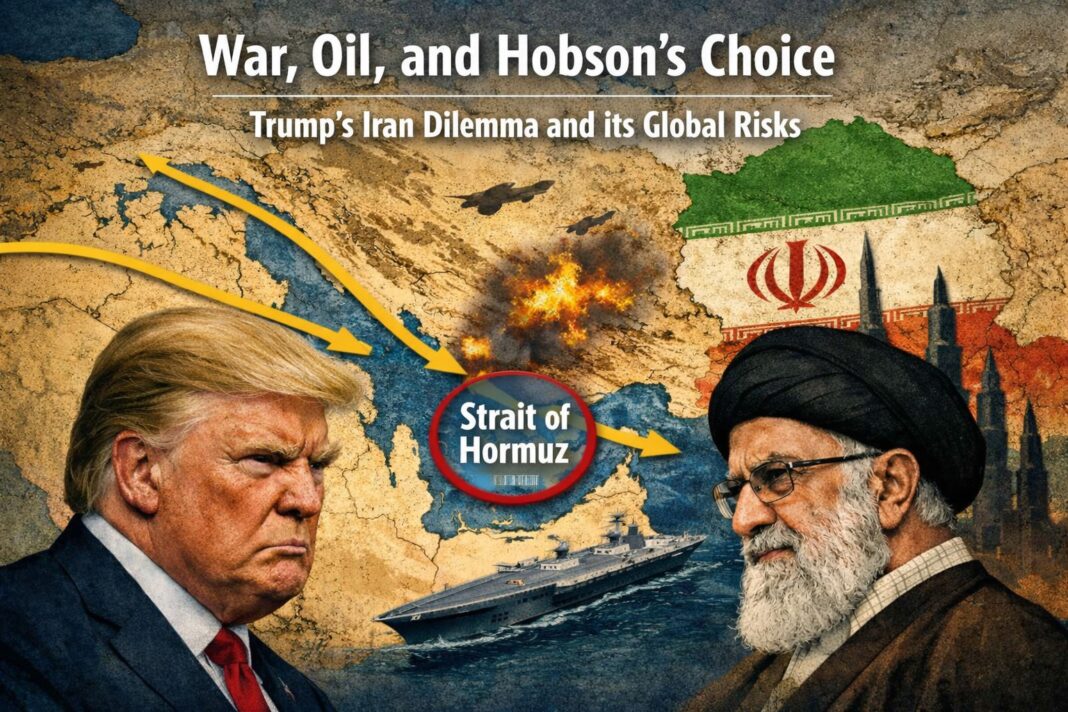
- President Trump faces a three-dimensional dilemma: escalate militarily, withdraw or de-escalate, or delay and manage the conflict.
President Trump’s latest ceasefire extension is not a breakthrough; it is a pause inside a conflict that is still active at sea, still politically unresolved, and still dangerous for the global economy.
What makes this moment important is not just the war itself, but the widening gap between military pressure and political closure. The United States is enforcing a naval blockade posture. Iran is retaliating. The Strait of Hormuz remains exposed. And Trump now faces choices, none of which have clean outcomes.
Snapshot
• The war has entered a legal and political deadline phase, with the May 1 war powers clock forcing Washington to explain whether it is ending, extending, or redefining the conflict.
• At sea, the conflict remains unresolved: the US exclusion zone posture continues, and the seizure of the Iranian-flagged Touska has become part of the wider bargaining environment.
• The UAE has said Iran cannot be trusted to manage Hormuz unilaterally, underscoring the collapse of confidence around any Tehran-led maritime arrangement.
• Russia and Iran continue strategic diplomacy, but the latest Putin–Araghchi meeting did not produce a visible breakthrough that changes the war’s trajectory.
• The balance of the conflict remains one of coercion without closure: no side has forced a decisive settlement, and the battlefield has shifted further into legality, navigation, and alliance politics.
Ceasefire and Reality
• The latest ceasefire extension by Trump looks less like peace and more like paralysis.
• The conflict continues through maritime pressure, seizures, warnings, and retaliatory signaling.
• This is managed instability, not stability.
• Both sides are avoiding full-scale war, but neither is stepping away from escalation risk.
Military Operations
• The conflict’s central operational dynamic remains maritime: Iranian shipping, the Strait of Hormuz, and the US interdiction posture.
• The most consequential incident remains the US interception and boarding of the Iranian-flagged civilian vessel Touska.
• Iran calls it piracy. Washington calls it blockade enforcement.
• There is no new large strike package today that changes the military balance. Just continuing the interdiction regime.
The Strait that Can Shake the World
• Hormuz remains the key global choke point because nearly a third of the world’s seaborne oil passes through or near it.
• Any disruption there can quickly push up oil prices, shipping insurance, and freight costs.
• Europe is vulnerable. India is vulnerable. China is vulnerable.
• That is why Trump’s dilemma is not only a Washington problem. It is a global economic problem.
A Blockade that Escalates Without Controlling
• The US blockade is central to strategy, but it is also politically provocative and operationally incomplete.
• Under international norms, blockade logic is treated as an act of war.
• In practice, however, US vessels remain forced to operate at safer distances because of missile threats.
• Denial is easier than dominance. Iran does not need to win outright; it only needs to prevent a decisive US win.
The Shadow War Expands the Battlefield
• This is not a bilateral conflict alone.
• Iran’s proxy network widens the battlefield through Hezbollah, the Houthis, and militias in Iraq and Syria.
• That means every escalation can spread rather than settle the conflict.
• For the US, this creates an adverse war without boundaries.
Technology Has Changed the Rules
• Iran’s missile and drone arsenal gives it a low-cost, high-volume, saturation model.
• This can stress even advanced defenses.
• Traditional naval superiority is more vulnerable in a missile-dominated battlespace.
• The Gulf is now an environment where even a superpower must operate cautiously.
The Unseen Hand of Israel
• Israel remains a decisive variable.
• For Israel, Iran is still an existential threat.
• Israel may act independently, push for stronger US intervention, or trigger escalation through pre-emptive strikes.
• That means Washington may not fully control the escalation ladder.
China, Russia, and the Multipolar Constraint
• China and Russia are not passive observers.
• Both want energy flows protected, US dominance constrained, and influence expanded in a post-Western order.
• China wants de-escalation, but not at the cost of Iranian sovereignty.

• Russia’s diplomacy with Iran has so far reinforced alignment more than it has delivered a breakthrough.
Trump’s Three-Dimensional Dilemma
• Escalate militarily: No guarantee of decisive success, but high probability of regional war and global economic shock.
• Withdraw or de-escalate: Risk of appearing weak, provoking domestic backlash, and damaging credibility.
• Delay and manage: Buys time, but increases uncertainty and the risk of accidental escalation.
• Every option is costly AND has a low chance of clear success. That is why this is a trap, not a strategy.
The Global South Pays the Price
• Higher energy prices and disrupted fertilizer supply chains. They threaten food security across Africa and Asia.
• Fragile economies are exposed to Gulf instability.
• Those least responsible for the conflict often bear the biggest indirect costs.
• This is not just a Middle East crisis. It is a global distribution crisis.
Markets Fear Uncertainty
• Markets are reacting to uncertainty, not just to war.
• Oil volatility is up.
• Shipping and insurance premiums are rising.
• Capital is moving into safe havens.
• Prolonged ambiguity is itself becoming an economic weapon.
India-Specific Implications
• India’s immediate exposure is oil supply, freight costs, and the safety of Indian crews in Gulf shipping lanes.
• The UAE’s position matters because it reflects how Gulf states now view the route: not as a trusted Iranian-controlled channel, but as a zone requiring international enforcement.
• If Washington’s deadline politics reshape the conflict, India will need to watch whether that stabilizes or destabilizes logistics and insurance.
• The indirect energy and shipping risk for India remains high even without a fresh major strike.
BRICS and De-dollarisation
• The war continues to feed de-dollarisation rhetoric.
• But the immediate reality is control of sea lanes, not payment systems.
• Russia–Iran diplomacy remains important symbolically, but it has not created a practical financial alternative.
• BRICS is still more political signal than crisis-management mechanism.
Legal and Norm-Setting Implications
• The war powers deadline makes the legality of continued US military activity a live issue in Washington. The constitutional constraint is that US Forces must be withdrawn within 60 days (plus 30-day extension) unless Congress authorises continuation.
• The UAE’s statement strengthens the argument that freedom of navigation in Hormuz cannot be left to unilateral Iranian control.
• The crisis is now generating precedent in both domestic US constitutional politics and international maritime law.
• The Touska case remains a key test of blockade, interdiction, and seizure rules.
Technology and EW Lessons
• Naval interdiction and ship-control measures can now have strategic impact without a major kinetic strike.
• The conflict highlights the value of ISR, command-and-control, and maritime surveillance.
• Legal authority, force posture, and sea control now matter as much as missiles and bombs.
• Sea denial can be politically decisive even when it is not militarily total.
Possible endgames
• Managed de-escalation: Fragile stability through negotiation.
• Prolonged stalemate: Continued low-intensity conflict.
• Regional war: Multi-front escalation involving proxies and Israel.
• Economic shock without full war: Markets spiral even if battlefield intensity does not.
• There are no clean exits.
Conclusion
The Iran crisis is now a test of power under constraint.
Trump’s dilemma is stark: escalate and risk wider war, withdraw and risk political damage, or delay and risk losing control. None of those options is comfortable. None is cost-free. And none offers a guaranteed win.
These are the real lessons of this conflict. A clear exit plan must exist. Control of the escalation ladder (matrix now) must be analysed in detail before operations commence. Brinkmanship has its credibility gaps and pitfalls. In a world shaped by interdependence, proxy warfare, missile saturation, and multipolar rivalry, even the strongest powers are forced into difficult trade-offs.