

Key Takeaways
- Bharat’s diplomatic move in West Asia showcases its commitment to strategic autonomy and independent foreign policy.
- Bharat respects Iran while maintaining its own interests and relationships with regional stakeholders.
- Strategic autonomy is a key factor in Bharat’s diplomatic success, allowing it to maintain relationships with multiple countries and regions.
In diplomacy, every invitation carries a message. More importantly, every response sends one.
Iran’s invitation to Prime Minister Narendra Modi to attend the state funeral of Ayatollah Ali Khamenei was more than a ceremonial courtesy. It presented Bharat with a complex diplomatic decision at a time when West Asia remains deeply polarised and global alignments are under constant scrutiny.
Had the Prime Minister attended personally, many international observers could have interpreted it as Bharat visibly tilting towards Tehran, potentially complicating its carefully nurtured relationships with the United States, Israel, the Gulf states and Europe. Equally, declining the invitation outright could have been perceived as a diplomatic snub to a country with which Bharat shares centuries of civilisational ties, strategic connectivity interests and important energy linkages.
New Delhi chose neither extreme.
Instead, it demonstrated why Bharat’s foreign policy is increasingly defined by strategic autonomy rather than strategic ambiguity.
The Government decided to send Gen Syed Ata Hasnain (Retd), Governor of Bihar, and Minister of State for External Affairs Pabitra Margherita to represent Bharat.
At first glance, this may appear to be a routine diplomatic delegation. It was anything but.
Gen Hasnain brings far more than protocol. A distinguished military commander, respected strategic thinker and constitutional authority, he possesses an exceptional understanding of regional security dynamics and the geopolitical complexities of West Asia. His experience lends credibility, gravitas and strategic reassurance. His presence conveyed that Bharat was paying its respects to the Iranian nation while remaining firmly anchored in its independent foreign policy.
Pabitra Margherita’s participation ensured that Bharat’s presence was backed by the institutional authority of the Ministry of External Affairs. Together, the two representatives struck the perfect balance between diplomatic respect and political restraint.
The symbolism was unmistakable.
Bharat respects Iran.
Bharat honours centuries-old civilisational ties.
Bharat values dialogue with all major regional stakeholders.
But Bharat’s foreign policy will never be dictated by the geopolitical expectations of any one nation.
This is strategic autonomy in action.
Bharat has maintained its independence in international relations, refusing to be bound by the expectations of rival camps. During the Cold War, it pursued an independent course despite immense pressure from competing superpowers. In the decades that followed, it built strong defence ties with Russia while simultaneously expanding strategic cooperation with the United States. It deepened its partnership with Israel without weakening its engagement with the Arab world. It remains a valued partner of the Gulf monarchies while preserving longstanding ties with Iran.
Bharat’s multi-vector diplomacy has proven to be a key factor in its strategic success, allowing it to maintain relationships with multiple countries and regions.
Iran remains important for Bharat, not merely because of history, but because of geography. The development of the Chabahar Port provides Bharat with vital connectivity to Afghanistan and Central Asia while bypassing Pakistan. Energy security, regional stability, maritime cooperation in the Arabian Sea and engagement with the International North-South Transport Corridor all make Iran an important strategic partner.

At the same time, Bharat’s ties with Israel have expanded dramatically in defence technology, intelligence cooperation, agriculture and innovation. Relations with Saudi Arabia and the UAE have evolved into comprehensive strategic partnerships encompassing energy, investment, infrastructure, security and the welfare of millions of Bharatiya expatriates. Simultaneously, the United States has emerged as one of Bharat’s closest strategic partners in the Indo-Pacific.
These relationships are complementary, not contradictory.
That is the essence of Bharat’s diplomacy.
Some observers may describe Iran’s invitation as an attempt to place Bharat in a diplomatically uncomfortable position. Whether or not that was Tehran’s intention, New Delhi’s response ensured that no such dilemma materialised.
Instead of choosing between attendance and absence, Bharat chose calibrated representation.
Instead of making the story about personalities, it made it about institutions.
Instead of sending a political signal, it sent a strategic one.
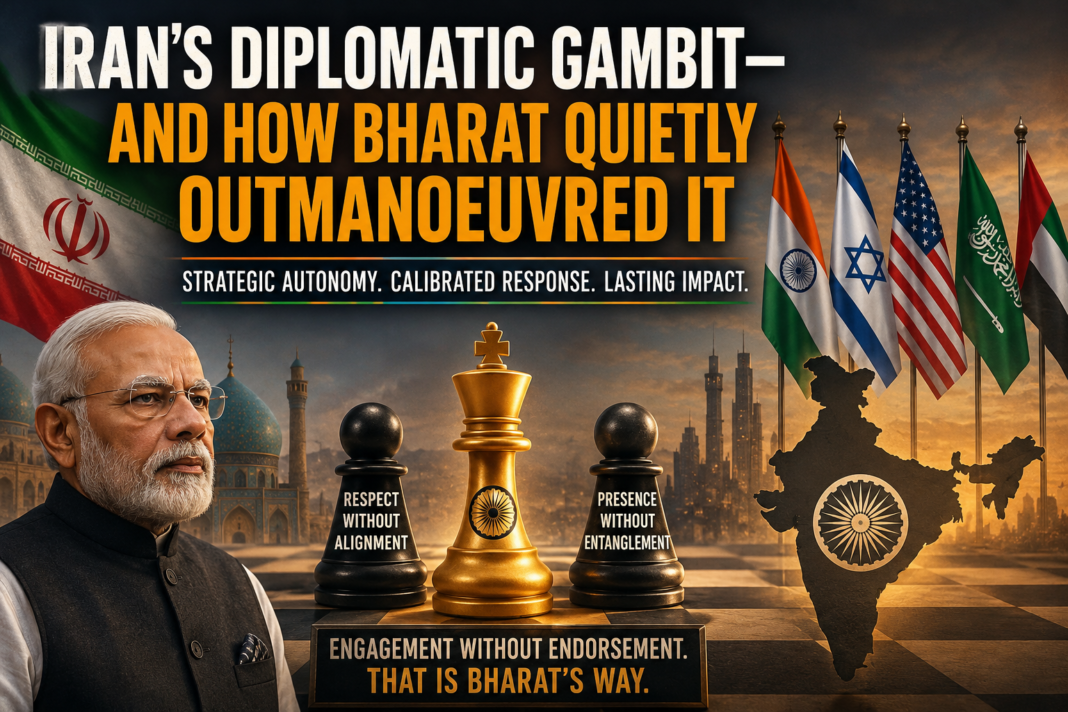
In chess, experienced players rarely search for spectacular checkmates. They quietly make the move that preserves initiative, protects long-term interests and denies their opponent the opportunity to dictate the game.
That is precisely what Bharat achieved.
Respect without alignment.
Presence without entanglement.
Engagement without endorsement.
This is not diplomatic ambiguity.
It is strategic clarity.
As global power competition intensifies and regional conflicts become increasingly interconnected, Bharat’s ability to maintain productive relations with competing powers will remain one of its greatest diplomatic assets. Rather than choosing sides, Bharat is steadily shaping an independent role as a credible interlocutor, trusted partner and responsible global power.
#MayankSays
The true measure of a rising power is not how loudly it declares neutrality, but how skilfully it protects its national interests while retaining the confidence of all sides. In a world of competing alliances, Bharat’s greatest strength lies in remaining confidently, consistently and unapologetically Bharat.