

Sometimes, a single photograph tells a story that decades of conflict cannot silence.
I recently came across an image on social media that made me pause and reflect.
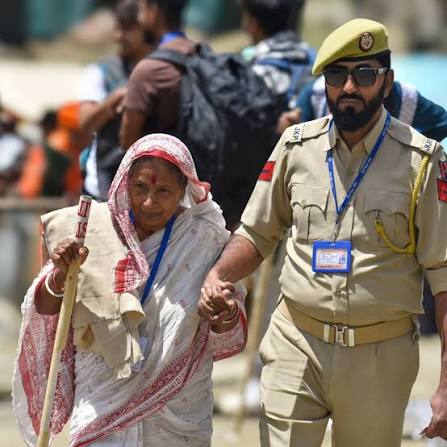
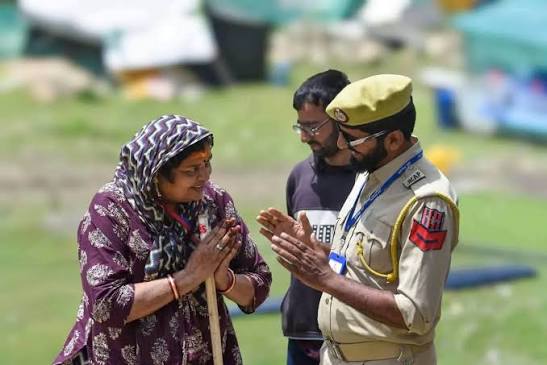
At first glance, it appeared to be an ordinary photograph, an elderly Hindu woman undertaking the sacred Shri Amarnath Ji Yatra, her weathered hands gently held by a Kashmiri Muslim police officer of the Jammu & Kashmir Police as he guided her over the difficult terrain leading to the holy cave shrine. It was an image of compassion, duty and trust. Yet, the longer I looked at it, the more I realised that it represented something much larger than a policeman helping an elderly pilgrim.
It was, in many ways, a portrait of Kashmir itself.
For over three decades, Kashmir has been viewed almost exclusively through the lens of terrorism, separatism, cross-border infiltration and geopolitical rivalry. Television screens have been filled with encounters, stone-pelting, ceasefire violations, terrorist attacks and political confrontations. Every development in the Valley is analysed through the prism of security and strategy.
That narrative is not without reason. Kashmir has paid an enormous price for terrorism. Thousands of civilians, security personnel and innocent citizens have lost their lives. Families have been destroyed, generations have grown up amidst violence, and the scars of conflict remain visible even today.
Yet, if conflict is the only story we tell about Kashmir, we miss an equally important truth.
The Valley is also home to countless acts of quiet humanity that seldom attract attention. They are neither dramatic nor politically useful. They do not trend on social media or dominate prime-time debates. Yet they continue to occur, year after year.
The annual Shri Amarnath Ji Yatra is one such example.
Every year, lakhs of devotees undertake one of the most demanding pilgrimages in the Hindu faith. Their safety depends upon a massive logistical effort involving the Armed Forces, the Central Armed Police Forces, the Jammu & Kashmir Police, civil administration, disaster response agencies and local residents.
Among those ensuring the success of the Yatra are thousands of Kashmiri Muslims, police personnel, government officials, doctors, nurses, drivers, pony owners, porters, shopkeepers and volunteers, who perform their duties with professionalism despite the difficult security environment.
The photograph I saw captures precisely this reality.
The police officer is not making a political statement. He is simply performing his duty with compassion. The elderly pilgrim, in turn, trusts him completely. In that fleeting moment, there is neither suspicion nor fear. There is only humanity.
That trust is significant because trust has perhaps been the greatest casualty of Kashmir’s modern history.
No discussion on Kashmir can ignore the tragedy that unfolded during the late 1980s and early 1990s. The targeted killings, intimidation and terror campaign against the Kashmiri Pandit community forced the overwhelming majority of this ancient indigenous community to leave the Valley. Homes were abandoned, temples fell silent and an uninterrupted civilisational continuity stretching back centuries suffered a devastating rupture.
The exodus of the Kashmiri Pandits was not merely a demographic event. It represented the breakdown of the social equilibrium that had defined Kashmir for generations. A society that had evolved through centuries of coexistence suddenly found itself fractured by fear and violence.
That wound has never truly healed.
Even today, thousands of displaced families continue to carry memories of homes they were compelled to leave behind. Any meaningful conversation about Kashmir’s future must begin by acknowledging their suffering and ensuring conditions for a safe, dignified and sustainable return.
However, acknowledging this tragedy should not lead us towards another error, the temptation to reduce an entire society to the actions of extremists.
History teaches us that terrorism succeeds when it convinces societies to see one another only through the actions of the most radical among them.
That would be an injustice to reality.
Thousands of Kashmiri Muslims have served, and continue to serve, the Republic with distinction. They wear the uniform of the Army, the Jammu & Kashmir Police, the Central Armed Police Forces and other public institutions. Many have laid down their lives fighting the very terrorism that sought to destabilise the Valley.
Their contribution deserves equal recognition.
The image of the police officer assisting the pilgrim is therefore important because it quietly challenges the simplistic narratives that often dominate public discourse.
It reminds us that identities are rarely as binary as political slogans suggest.
It also reminds us that institutions matter.
The Jammu & Kashmir Police has borne one of the heaviest burdens in the fight against terrorism. Its personnel have faced targeted attacks, intimidation and personal loss while continuing to discharge their constitutional responsibilities. The officer in the photograph represents countless others who serve not merely as law enforcement officials but as guardians of public confidence.

His gesture towards the elderly pilgrim symbolises something fundamental.
Security is not only about protecting territory.
It is also about protecting faith.
It is about ensuring that every citizen can practise his or her religion freely and without fear.
The Amarnath Yatra itself has repeatedly been targeted by terrorists precisely because it represents India’s plural civilisational character. Every successful Yatra therefore becomes more than a religious event. It becomes a reaffirmation that terrorism cannot dictate the rhythm of national life.
This is why the photograph carries such profound significance.
It demonstrates that while terrorism can create fear, it cannot extinguish compassion.
While violence can displace communities, it cannot erase memory.
While propaganda can deepen divisions, it cannot completely destroy the instinct of ordinary people to help one another.
The road ahead for Kashmir lies not in perpetuating competing victimhoods but in restoring balance.
That balance demands justice for the displaced Kashmiri Pandits.
It demands uncompromising action against terrorism.
It demands equal constitutional protection for every law-abiding citizen irrespective of faith.
It demands opportunities for young Kashmiris to choose education, enterprise and national integration over radicalisation.
Above all, it demands rebuilding trust, patiently, consistently and honestly.
The image I saw on social media reminded me that history is not always shaped by dramatic events. Sometimes it is shaped by small acts of decency that reaffirm our shared humanity.
An elderly Hindu pilgrim.
A Kashmiri Muslim police officer.
One extending support.
The other accepting it with trust.
In that simple moment lies a vision of the Kashmir that countless terrorists failed to destroy.
That is the Kashmir that endured.
That is the Kashmir worth preserving.
That is the Kashmir that extremism could not erase.
Shri Amarnath Ji Yatra Mubarak.
May Baba Barfani bless every pilgrim with strength and safety. May the people of Jammu & Kashmir continue their journey towards justice, reconciliation, security and lasting peace. For only when balance is restored can the Valley truly reclaim the harmony that has always been its greatest strength.