

Key Takeaways
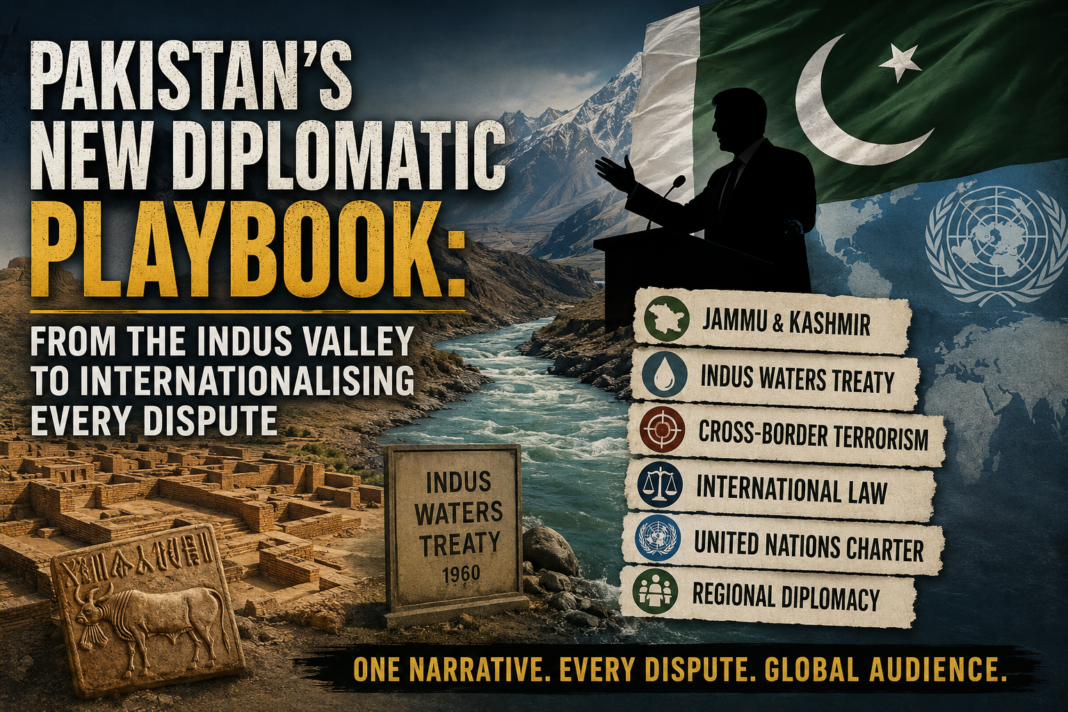
- Pakistan’s new diplomatic playbook seeks to internationalise every dispute with Bharat, redefining regional narratives and historical symbolism.
- Pakistan is attempting to translate its narrative into diplomatic capital by combining Jammu & Kashmir, water security, terrorism, and international law into one diplomatic package.
- The contest is no longer confined to diplomacy, military preparedness, or treaty interpretation. It is increasingly a battle of narratives, with nations competing through the stories they tell about their history, legitimacy, and role in shaping the international order.
Diplomacy often reveals its intentions not through dramatic announcements but through carefully chosen words. Pakistan’s latest statement by its Foreign Office, expressing openness to international efforts to promote peace and security between Bharat and Pakistan, is one such example. Beneath the language of peace lies a sophisticated diplomatic strategy that seeks to reshape regional narratives and repackage old disputes for a global audience.
The statement brings together Jammu & Kashmir, the Indus Waters Treaty, cross-border terrorism, international law, the United Nations Charter and regional diplomacy into a single framework. This is not accidental. It reflects an evolving Pakistani strategy to internationalise every major bilateral issue with Bharat under one overarching narrative.
For those who have followed Pakistan’s recent political discourse, this development comes as no surprise.
In an earlier article published in Goa Chronicle, I analysed how Pakistan’s political leadership had begun invoking the Indus Valley Civilization to justify its claims over the Indus River system. Senior leaders argued that Pakistanis are the “children of the Indus,” attempting to establish a civilisational connection between the ancient Indus Valley Civilization and the modern Pakistani state.
At first glance, such statements seemed like rhetorical flourishes, but they were actually laying the groundwork for a much larger diplomatic campaign.
The objective was to shift the conversation away from the legal framework of the Indus Waters Treaty and towards a broader claim based on history, identity and civilisational inheritance. If a country can convince the world that it is the natural heir to an ancient civilisation, it becomes easier to portray control over associated resources as a matter of historical justice rather than legal obligation.
The latest Foreign Office statement demonstrates that this transition is now underway.
Pakistan is no longer relying solely on historical symbolism. It is attempting to translate that narrative into diplomatic capital.
By combining Jammu & Kashmir, water security, terrorism and international law into one diplomatic package, Islamabad seeks to persuade the international community that South Asia’s challenges are inseparable and therefore require external mediation.
This approach directly challenges Bharat’s long-standing position that all outstanding issues with Pakistan must be addressed bilaterally under the Simla Agreement and the Lahore Declaration. New Delhi has consistently rejected third-party mediation, maintaining that bilateral engagement remains the only acceptable framework.
Pakistan, however, appears determined to move the discussion into multilateral forums.
Its repeated references to the United Nations Charter and international law are carefully calibrated to appeal to a global audience. Equally significant is its assertion that it has “nothing to hide,” an attempt to project transparency and responsibility despite continuing international concerns regarding terrorism emanating from Pakistani soil.
The emphasis on the Indus Waters Treaty is equally revealing.
The treaty has survived wars, political upheavals and decades of mistrust, making it one of the world’s most enduring water-sharing agreements. Yet Pakistan increasingly frames the treaty not merely as a legal document but as a reflection of historical and civilisational rights. This subtle shift seeks to strengthen its diplomatic position by combining legal arguments with historical narratives.
Another noteworthy aspect of the statement is Pakistan’s effort to portray itself as a constructive regional player. By highlighting cooperation with Qatar in supporting the implementation of the Islamabad Memorandum of Understanding between Iran and the United States, Islamabad seeks to showcase its relevance beyond South Asia and position itself as a facilitator of regional dialogue.

This messaging serves a dual purpose. It enhances Pakistan’s international image while reinforcing its broader appeal for external engagement in South Asian affairs.
For Bharat, this development carries important lessons.
The contest is no longer confined to diplomacy, military preparedness or treaty interpretation. It is increasingly a battle of narratives. Nations compete not only through economic strength or military capability but also through the stories they tell about their history, legitimacy and role in shaping the international order.
Pakistan has recognised this reality and is constructing a layered narrative that combines civilisational identity, historical symbolism, legal language and diplomatic messaging into a coherent strategic framework.
Bharat possesses a far stronger civilisational foundation and an uninterrupted historical continuity stretching back millennia. It also enjoys the credibility of a nation that has consistently honoured international agreements while firmly defending its sovereignty and territorial integrity.
However, history alone does not win the battle of narratives.
It must be articulated, documented and communicated with clarity, confidence and consistency.
Pakistan’s latest diplomatic statement should therefore be viewed not as an isolated press release but as another milestone in a long-term information strategy. The references to the Indus Valley Civilization were never merely about archaeology or cultural identity. They were the opening chapter of a larger campaign aimed at reshaping international perceptions of South Asia’s strategic landscape.
Today, that campaign has entered its diplomatic phase.
Tomorrow, it may find expression in international forums, academic discourse, think tanks and global media.
Bharat’s response must therefore extend beyond rebuttal. It should proactively present its own historical continuity, legal position and strategic vision, ensuring that facts, not manufactured narratives, shape international opinion.
The struggle over the Indus is no longer just about water.
It is about history. It is about identity. It is about legitimacy.
Above all, it is about who succeeds in shaping the global narrative of South Asia in the twenty-first century.