
Key Takeaways
- Cyber slavery is a form of modern slavery that involves forcing individuals into cybercrime and exploitation.
- The practice is often fueled by deceptive job advertisements and coercion.
- Cyber slavery has severe consequences for individuals and society, including loss of freedom and dignity.
In August 2026, two men from the Mancherial and Nirmal districts of Telangana reportedly sent an SOS from Myanmar, claiming that about 400 Indians were trapped in a cyber scam network after being lured by promises of lucrative jobs. Authorities began efforts to verify the claims and secure their return. Days earlier, a Rajasthan investigation had led to arrests in a network allegedly sending Indians to Cambodia, where recruits were reportedly coerced into online scams. These cases expose a criminal economy in which the employment search can become a pathway into forced cybercrime.
Official Indian figures reveal the scale. On 1 June 2026, Foreign Secretary Vikram Misri said that India had repatriated 2,411 citizens from cyber scam compounds in Myanmar during the preceding year and a half, while slightly more than 150 were still believed to be trapped. Cyber slavery has become a transnational trafficking problem requiring diplomatic, police and humanitarian responses.
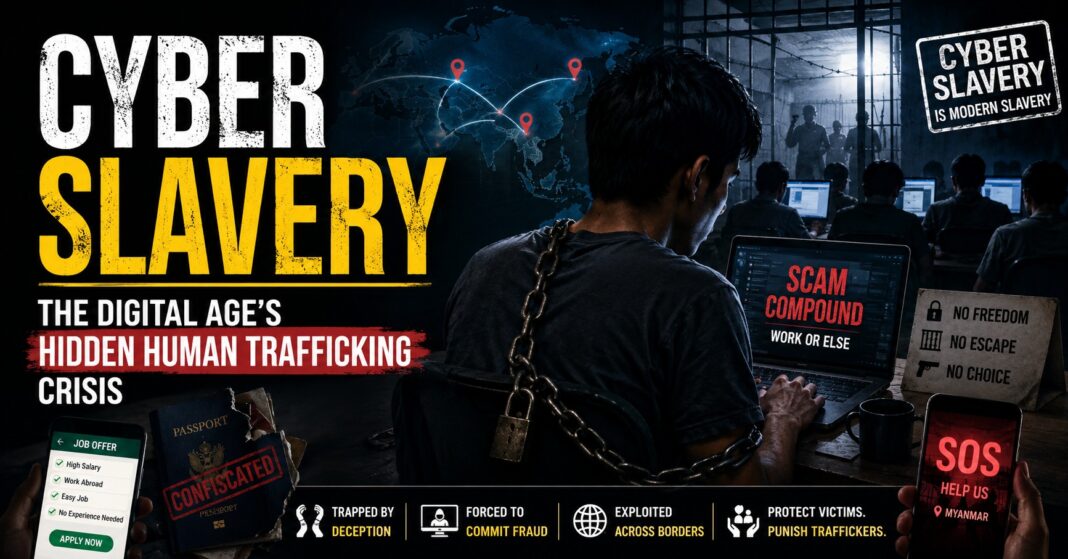
The Central Bureau of Investigation (CBI) provided further evidence in May. After searches at nine locations across four states, the CBI announced that an organised network was trafficking Indians to Southeast Asia under the pretext of high-paying employment. Victims were taken primarily to scam compounds in Myanmar and Cambodia. According to the CBI, passports were often confiscated and movement severely restricted. Inside these compounds, trafficked people were forced to participate in cyber-enabled fraud. The agency itself described such facilities as hubs of “cyber slavery”.
What Is Cyber Slavery?
The deception starts with fake job advertisements on social media, messaging apps, and employment networks. These ads promise attractive salaries and respectable jobs, such as data entry or digital marketing. However, once the workers arrive abroad, the promised employment disappears, and their documents are confiscated. The workers are then restricted from leaving and forced into cyber slavery.
How Fake Job Offers Lead to Cyber Slavery
The problem extends beyond India. On 28 July 2026, the International Organization for Migration (IOM) warned that scam centres in Myanmar, Cambodia and Laos could involve as many as 300,000 workers. Victims from more than 80 countries have been identified. Many were recruited through fake online job advertisements, often targeting educated people with English language skills. According to the report, people trapped inside compounds have faced threats, violence, sexual abuse, solitary confinement and confiscation of documents. The IOM also warned that rescued victims can themselves face criminalisation after being forced to commit fraud.
When Trafficked Victims Are Forced to Commit Cybercrime
This creates a difficult ethical question: who is the criminal when a trafficked person is forced to scam another human being? A person who voluntarily joins fraud bears responsibility. Someone deceived into travelling abroad, imprisoned and compelled to commit fraud is also a victim. Treating both persons identically ignores coercion and can result in the trafficked person being punished for crimes imposed upon them.
At the heart of the issue is human dignity. A person possesses worth independent of productivity, income or usefulness. Yet scam compounds reduce people to instruments of profit. Their language skills, intelligence and ability to manipulate digital communication become resources for generating money. The individual is valued by the number of victims deceived.
That is ethically wrong because a human being must never be reduced to a means for another person’s financial end. The trafficker turns the victim into a commodity, while the organisation extracts value from coerced labour. The computer becomes an instrument through which exploitation is multiplied across borders.

Freedom is violated as well. Genuine employment requires voluntary consent. Consent obtained through deception is fundamentally compromised; consent maintained through threats, confinement or violence is not genuine consent at all. Cyber slavery is therefore forced labour concealed behind the language of employment and facilitated by digital technology.
Truth is another casualty. The system begins with a lie about employment and continues through deception. A trafficked worker may be ordered to impersonate a bank official, romantic partner or investment adviser. The worker becomes trapped in deception, harming people who may never know that the person deceiving them is also exploited.
How Scam Compounds Turn Technology Into a Tool of Exploitation
The uncomfortable question is not only who traffics these people, but also how an entire digital ecosystem allows such exploitation to become profitable. A recruiter can advertise a fictitious job through social media, communicate through messaging applications, move the victim across borders and then place that person before a computer to defraud strangers thousands of kilometres away. Money can subsequently move through bank accounts, digital wallets and cryptocurrency channels. Institutions can detect suspicious patterns, yet intervention often comes only after victims disappear or losses occur.
Ethical responsibility therefore becomes unavoidable. Technology companies cannot indefinitely argue that they merely provide platforms when those platforms repeatedly become entry points for organised exploitation. Recruitment agencies cannot hide behind paperwork when the “employee” they supplied ends up imprisoned in a scam compound. Financial institutions cannot treat every suspicious transaction as a compliance issue when their infrastructure is being used to finance human exploitation. Governments cannot treat every rescued Indian as an isolated diplomatic case while recruitment networks continue to operate. Responsibility must extend beyond individual incidents to disrupting the systems that make exploitation possible.
Protecting Victims of Cyber Slavery
The rescued victims therefore need protection rather than automatic suspicion. Justice should pursue the traffickers, recruiters, financiers and organisers who profit from coercion. Those forced into criminal activity require legal assessment that recognises the reality of duress, together with psychological care, rehabilitation and opportunities for dignified reintegration. Otherwise, victims face a second injustice: being treated as though they freely chose crimes imposed upon them.
Cyber slavery reveals a disturbing paradox of the digital age. Technology has expanded opportunities, yet criminal networks use the same infrastructure to conceal trafficking and industrialise deception. Traditional slavery had visible chains. The chains of cyber slavery may be a confiscated passport, a locked compound, a threat, surveillance, debt or a computer screen that a victim is forced to face for hours each day.
The chains may be invisible to the person receiving the scam message. But they are real. Behind every fraudulent message may be a criminal seeking profit, but behind some messages there may also be a frightened person who has lost the freedom to stop sending them.
Cyber slavery is therefore not merely a cybercrime problem. It is a crisis of human dignity, freedom, truth and justice. Technological progress cannot be measured only by faster communication, greater connectivity or higher profits. Its test is whether technology serves the human person or turns human beings into instruments of exploitation. When a computer becomes a prison without walls, society must have the moral courage to look beyond the screen and recognise the human being trapped behind it.