
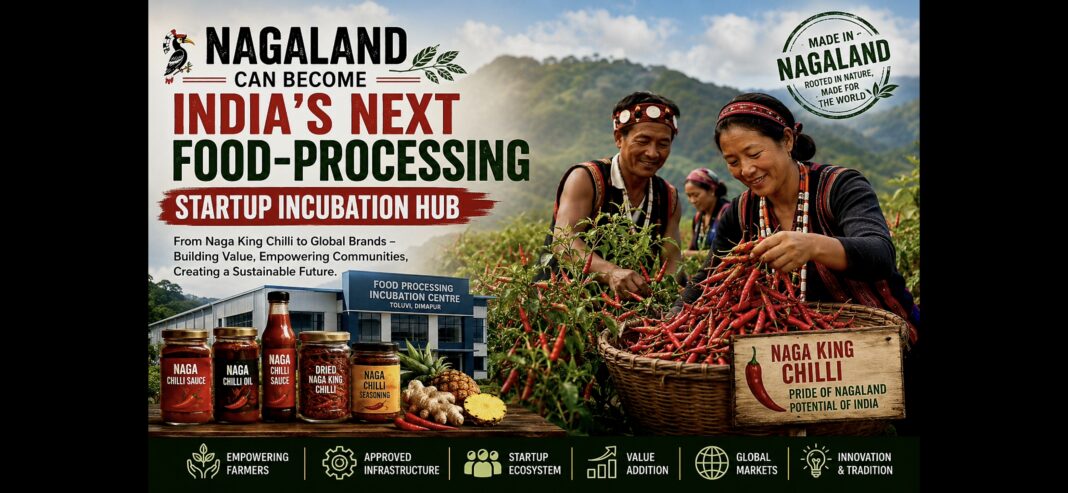

Nagaland stands at an interesting economic crossroads. A state where nearly 70 per cent of the population depends on farming for its livelihood also possesses a remarkable portfolio of agricultural and horticultural products – from Naga King Chilli, ginger and pineapple to oranges, bamboo shoots, spices, honey and a wide range of indigenous foods. Yet much of the economic value of these products is realised outside the state. The opportunity before Nagaland is therefore not simply to produce more, but to process more, brand more and sell more from within Nagaland.
The current government under Chief Minister Dr. Neiphiu Rio has begun building precisely the kind of infrastructure that could allow this transformation. In June 2026, Rio inaugurated the Food Processing Incubation Centre at Toluvi, Dimapur, while food-processing incubation infrastructure was also inaugurated at Tuensang. An Incubation Centre for Entrepreneurs and Infrastructure Development was inaugurated at the Industrial Growth Centre at Ganeshnagar, Chumoukedima. These projects were developed under Special Assistance to States for Capital Investment and PM Gati Shakti.
The significance is bigger than the buildings themselves. If Nagaland connects its incubation centres with farmers, startups, universities, investors, banks, logistics companies and national retailers, the state can create a distributed food-processing startup ecosystem across all districts.
From raw produce to high-value products
Nagaland’s greatest opportunity lies in value addition. A farmer selling fresh pineapple receives income only from the raw commodity. A startup that converts that pineapple into juice, dried fruit, jam, concentrate, nutraceutical ingredients or premium packaged snacks can potentially create several layers of economic value.
The same principle applies to Naga King Chilli. Instead of selling chilli as an agricultural commodity, entrepreneurs can develop sauces, seasonings, chilli oils, dehydrated products, ready-to-cook products and internationally marketable gourmet brands.
The state’s official economic development platform identifies pineapple, oranges, ginger and Naga King Chilli among its important products and notes that pineapple alone contributes about 5.4 per cent of national output. It also identifies agro-processing and food processing as focus sectors for Nagaland.
This creates the foundation for a new category of enterprise: the Naga food-tech startup.
The government has already created important building blocks
The Rio government’s recent initiatives suggest that Nagaland is moving beyond the traditional approach of simply distributing subsidies.
The Department of Industries & Commerce has identified food processing and startups as separate focus areas. Its startup ecosystem currently reports 366 registered startups, five incubation centres and ₹58 crore in combined annual revenue generated by Nagaland startups. Food processing is explicitly identified as one of the sectors supported under Startup Nagaland.
The state also has the Nagaland Food Processing Industries Policy, 2024, notified by the Industries & Commerce Department, alongside the broader Nagaland Trade, Investment and Industrial Policy, 2025. The latter provides a five-year policy framework for industrial development and calls for a comprehensive incentive mechanism.
Another major pillar is the Prime Minister Formalisation of Micro Food Processing Enterprises programme. Nagaland’s implementation architecture provides support for individual entrepreneurs, FPOs, SHGs and cooperatives, including credit-linked subsidy, seed capital, common infrastructure, branding, marketing and capacity building.
The numbers demonstrate that this is already moving beyond policy documents. According to the Nagaland Economic Survey 2025-26, as of February 2, 2026, 443 applicants had been sanctioned credit-linked subsidy, while another 208 applications were under consideration by lending banks. A total of 2,683 beneficiaries had been trained. The state had also established a Common Incubation Centre at the School of Agricultural Sciences, Nagaland University, Medziphema.
That centre is particularly important because it provides actual processing capabilities – including beverage processing, canning, dehydration, pickle making, primary processing, a 5-tonne walk-in cold room and a food-testing laboratory.
The next step: turn incubation into a startup factory
Nagaland should now move from incubation infrastructure to incubation outcomes.
Every incubation centre should operate as a food entrepreneurship laboratory where a young entrepreneur can arrive with a product idea and leave with a commercially viable business.
That means providing access to machinery, food scientists, packaging designers, FSSAI guidance, laboratory testing, intellectual-property assistance, financial modelling, digital marketing and e-commerce support.
The government’s own leadership has recognised this requirement. Advisor for Industries & Commerce Hekani Jakhalu has argued that the food-processing model should be replicated across all districts, with each district developing facilities based on its agricultural strengths and local produce. She has also stressed that infrastructure alone is insufficient: successful food-processing ecosystems require raw-material supply, trained workers, working capital, packaging, branding and market linkages.
This is exactly the right approach.
Create a district-wise food startup map
Nagaland should consider developing a District Food Startup Mission, with each district specialising in products where it possesses a competitive advantage.
One district could become a hub for spices and chilli products; another for fruits and beverages; another for honey; another for meat and livestock processing; another for bamboo-based food products; and another for traditional fermented foods.
The objective should not be to make every district produce everything.
It should be to create specialised clusters connected to a common statewide market, logistics and branding platform.

The government has already begun moving in this direction. The Economic Survey records Common Facility Centres for a Honey, Spices & Food Processing Cluster at Longkhim Chare in Tuensang and a Food Processing Cluster at Mukalimi in Pughoboto, Zunheboto. Together with other MSME cluster investments, these projects represent more than ₹32 crore in approved project costs.
Build the “Made in Nagaland” food brand
Infrastructure must ultimately lead to consumers.
Nagaland needs a powerful common brand – something equivalent to a “Made in Nagaland” premium food identity – under which individual startups can sell globally while retaining their own brands.
The government’s Nagaland Food Connect initiative offers a useful beginning. During Hornbill Festival 2025, the third edition promoted 20 local food brands through exhibition and sale, generating approximately ₹28.5 lakh in income. The state also participated with local food processors at World Food India 2025.
The next logical step is to move from exhibitions to permanent market access: Amazon and other e-commerce platforms, modern retail, airports, hotels, restaurants, institutional buyers and export markets.
From agriculture to intellectual property
Nagaland’s indigenous food knowledge is another underdeveloped economic asset.
The Food Processing Department’s “Six P’s” – Production, Processing, Preservation, Packaging, Pricing and Patenting – is a particularly useful framework.
The final “P” could become extremely important. Traditional recipes, indigenous ingredients and unique processing methods can become intellectual property, geographical brands and premium consumer products.
The objective should be to transform “Naga food” from something consumed locally into something recognised globally.
The opportunity is larger than food
A successful food-processing startup ecosystem would create an economic chain extending far beyond factories.
It would create demand for farmers, food technologists, packaging designers, logistics companies, cold-chain operators, digital marketers, accountants, exporters and technology companies. It could also provide new opportunities for women-led enterprises, SHGs and young entrepreneurs.
Most importantly, it would help address one of the structural problems identified by Chief Minister Rio: Nagaland remains heavily dependent on products imported from outside the state. He has argued that food processing and small-scale industries can create employment, encourage entrepreneurship and reduce this dependence.
The strategic opportunity
Nagaland does not need to compete with Punjab, Maharashtra or Gujarat in mass food manufacturing. Its advantage is different.
It can become India’s premium, indigenous and innovation-driven food-processing laboratory for the Northeast.
The combination already exists: extraordinary biodiversity, distinctive food traditions, agricultural communities, a growing startup ecosystem, government-backed incubation infrastructure, PMFME support, district-level clusters, Nagaland University and an increasingly business-oriented policy environment.
The next five years should therefore be about connecting these pieces.
If the government can ensure that every incubation centre has entrepreneurs, every entrepreneur has access to technology and finance, every farmer has a market, every product has professional packaging and every successful product has access to national and international consumers, Nagaland can move from being a producer of raw agricultural commodities to becoming a creator of globally recognised food brands.
The real measure of success should not be the number of incubation centres built.
It should be the number of Naga startups created, farmers integrated, jobs generated, products commercialised, patents secured and global consumers reached.
Nagaland has begun building the infrastructure. The next step is to build the companies.
That is how a food-processing incubation programme can become an economic transformation – and potentially make Nagaland the food-processing startup hub of Northeast India.