

Key Takeaways
- A mysterious bank locker theft in Faridabad has raised questions about accountability and trust.
- The bank branch and police are investigating the case, but no one has been held accountable yet.
- The case highlights the need for banks to take responsibility for their actions and ensure the safety of customers’ valuables.
A mysterious case in Faridabad’s Punjab National Bank has left victims with despair and a long struggle for justice. The bank branch is not taking accountability seriously, and the police are not helping.
A safe deposit locker at the Punjab National Bank, Railway Road, Old Faridabad, is jointly held by Ashish Kapur and his 74-year-old mother, Sudesh Kapur. The locker was allotted to them back in the year 2013, and the original key to it never left their custody. Between 2013 and 2026, this locker was operated by the holders approximately 40 times, using the same original key itself, and as is policy, the bank branch’s locker visit history recorded each operation.
Now, in a drastic and bizarre turn of events, on July 21, 2026, when the holders went to operate the locker as usual, while the bank’s own master key turned normally, hinting that the lock mechanism was functioning normally, the customers’ side rejected their key, with which the locker was being operated since 2013. Hence, the locker could not be opened. Following this, the branch manager said that a technician would be called, for which the holders submitted a written application the same day.
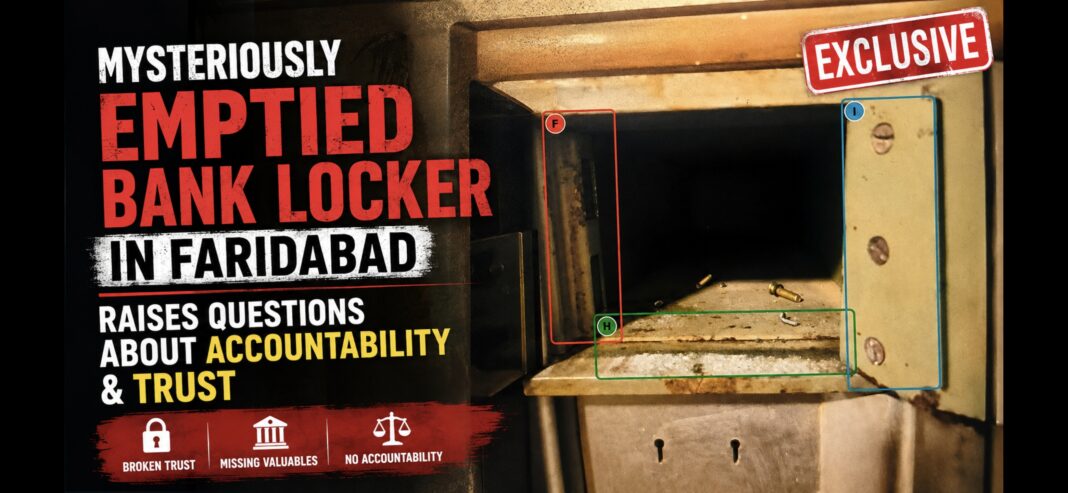
Next, on the morning of July 28, 2026, based on the written application, the bank locker was broken open by a technician in the presence of the bank officials. The locker door was opened in under one minute after the technician drilled six screws.
Once the locker was opened, the customers found it to be completely empty! Approximately 148.5 grams of gold ornaments and 7 antique silver coins, dating back to the year 1904, inherited from Ashish’s grandmother to his mother, were all missing, valued at Rs. 18,02,000.
On the same day, after the locker was found in such a condition, the bank issued a letter, signed by the branch manager, which itself recorded that the bank locker was found empty, and listed the missing ornaments. The photographs that were taken right after the locker was broken open show scrape marks on the front-left frame, the opposite side from the drilled lock, which drilling could not produce. The photographs also captured damage on the adjacent locker.
Then, it took two days of persistent effort by the victims to get the police writing an FIR in the matter. The FIR was registered on July 30, 2026, in the Old Faridabad police station. Under Section 305 of the BNS. The victims are also pursuing the addition of sections 303, 316(5), and 318(4) of the BNS.

Speaking with Sonakshi Datta of GoaChronicle regarding this matter, Namrata Kapur, Ashish’s wife and Sudesh’s daughter-in-law, said, ‘Right after the bank locker was found empty, the bank manager started persuading us to not go to the police or take the matter outside the bank, including to the media. Even the police were not eager to help us initially. We went to the police station to get the FIR registered on the same night, but they did not file the FIR. I had to speak with the DCP of Faridabad, after which the police came into action.’
She continued, ‘In the meantime, the bank branch did not deem it fit to contact us or inform us about recent developments, if any, we were the only ones to contact them time and again. The bank staff also said absurd things like it was possible that we ourselves took out all our ornaments and coins from the locker earlier. Even the bank circle head called us last week and said we should check for the missing gold in our house itself.’
As a matter of fact, this is not the only case where such a shocking thing has happened. In Faridabad itself, in Sector 15, it was in January 2026 that the Economic Offenses Wing arrested two bank managers and a locksmith, in a similar case. In Solan, police invoked the banker’s breach-of-trust provision after a PNB locker was found open, in Chandigarh, a consumer commission ordered PNB to pay Rs. 1 crore; similar complaints are reported from Delhi’s Kirti Nagar, UP’s Gorakhpur and Kanpur, and Karnataka’s Bengaluru.
Despite such cases being reported, the government told Parliament that public-sector banks recorded only 40 ‘established’ locker-theft cases in five years, and zero in FY 2025-26, against roughly 1.11 crore operational lockers. That figure counts only cases the banks themselves admit.
Every disputed complaint, including this particular case, is counted nowhere. Meanwhile, the RBI caps the bank’s liability at 100 times the annual rent, roughly ₹1.5–2 lakh against generations of gold.
Bank lockers are considered the safest option for people to keep their valuables, and most people choose the same. But cases like this highlight the underlying rot that nobody talks about- banks not taking responsibility if such things happen, a lack of accountability, the lack of fair liability on the banks’ shoulders, and beyond this, a lack of coordination and swift action at the police’s part.
All these obstacles prove to be gigantic mountains for common people to cross, showcasing how justice becomes a distant dream for many, even impossible to fulfil; the road to which is filled with struggles, unfair treatment, and a grim despair.