



Key Takeaways
- Nagaland must shift from a gun culture to an enterprise culture to create a prosperous future.
- The state has the potential to grow its economy through bamboo production, processing, and entrepreneurship.
- Nagaland’s pineapple industry has the potential to create high-value products and generate employment opportunities.
There comes a moment in the life of every society when it must ask itself a difficult question: What do we want our children to inherit from us – the memory of conflict, or the opportunity to build?
For Nagaland, I believe that moment is now.
I say this with deep respect for the Naga people. I came to Nagaland as a visitor, but I leave with an admiration for a people whose hospitality, intelligence, cultural confidence and natural warmth are impossible to miss. I have travelled through Dimapur, Chümoukedima, Kohima and other parts of the state, and what stayed with me most was not the political history of Nagaland. It was the people.
The smile. The hospitality.The talent.The extraordinary ability to preserve identity while engaging with a changing India.
And therefore, I believe Nagaland has a choice before it: continue carrying the psychological baggage of a gun culture, or replace the gun with something far more powerful – enterprise, education, agriculture, technology and entrepreneurship.
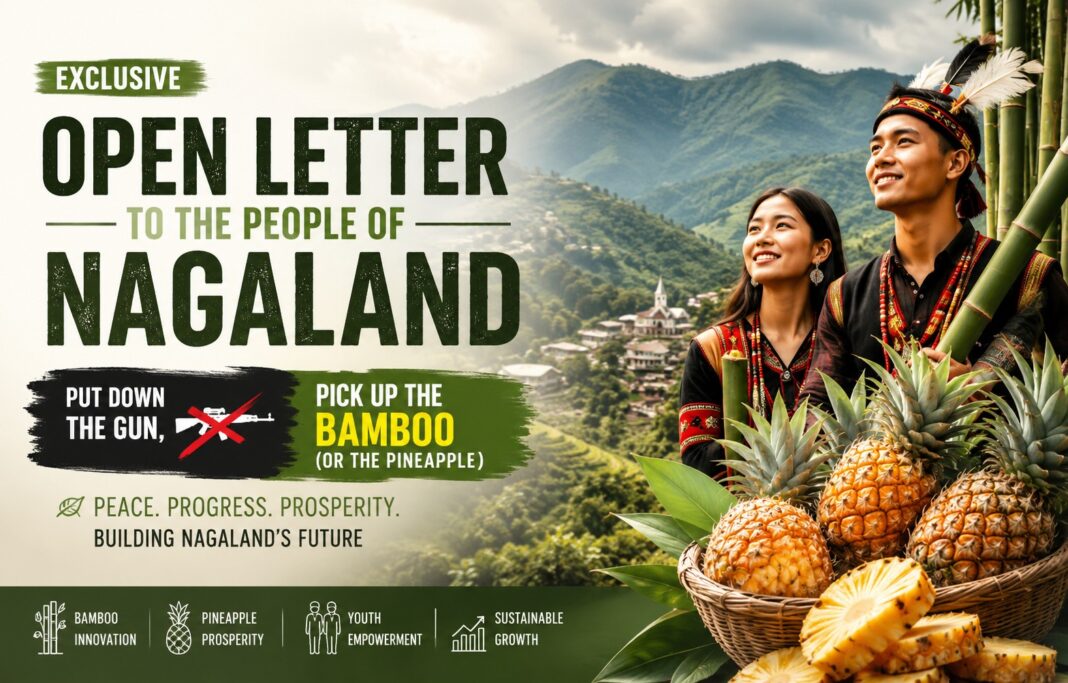
Put down the gun.Pick up the bamboo.Or better still, pick up the pineapple. Because in those two simple symbols lies a remarkable economic future.
Nagaland does not suffer from a shortage of talent. It suffers from a shortage of sufficient economic scale and value addition. The state has young people, natural resources, agricultural wealth, cultural capital and a strategic location connecting India with Southeast Asia. What it needs now is to convert these advantages into enterprises, jobs and wealth.
The numbers tell us why this transformation is urgent.
According to the Nagaland Economic Survey 2025-26, the state’s economy is estimated to grow by 10.33 percent in real terms in 2025-26 and 13.03 percent at current prices. Its nominal GSDP is projected to rise from about ₹45,133 crore in 2024-25 to ₹51,014 crore in 2025-26. Yet the state’s secondary sector accounts for only about 10.60 percent of the economy, while services contribute 66.64 percent.
That tells us something important. Nagaland must not merely consume more. Nagaland must produce more.
The future cannot depend on government expenditure or employment. We must create products that can travel from Nagaland to other cities and countries, like Delhi, Mumbai, Bengaluru, Dubai, Singapore, and beyond.
And this is where the bamboo becomes more than bamboo.
Nagaland has more than 43 bamboo species. The Nagaland Bamboo Development Agency has already established plantations covering 1,506 hectares, trained more than 200 entrepreneurs and artisans, and created two Common Facility Centres that generate employment for more than 500 people. The state is also developing a Cane and Bamboo Technology Park.
Imagine what happens if we stop thinking of bamboo merely as a traditional material and start thinking of it as an industrial opportunity.
Bamboo furniture. Bamboo flooring. Bamboo boards. Bamboo textiles. Bamboo packaging. Bamboo construction.Bamboo composites. Bamboo charcoal.Bamboo bio-products. Bamboo-based tourism infrastructure.
The government itself is already moving in this direction. Nagaland’s Industries & Commerce Department has supported technologies for bamboo tiles, bamboo plywood and composite bamboo furniture.
The opportunity is therefore not theoretical. It is sitting in the soil. It is growing on the hills.
And it is waiting for Naga entrepreneurs to turn it into wealth.
Then there is the pineapple.
The 2025 Statistical Handbook records 123,285.78 metric tonnes of pineapple production in Nagaland in 2023-24, making it one of the state’s significant horticultural crops.
But here is the question we must ask: How much of that pineapple is converted into high-value products?
Pineapple juice. Pineapple wine. Pineapple jam. Dried pineapple.Pineapple fibre. Pineapple vinegar. Pineapple-based confectionery. Pineapple ingredients for food manufacturers.
Why should Nagaland sell only the fruit when it can sell the brand?
Why should a farmer receive the smallest portion of the value chain while someone elsewhere makes the larger margin through processing, packaging, branding and distribution?
The pineapple must travel from the farm to the factory, from the factory to the marketplace, and from the marketplace to the world.
That is the economic revolution Nagaland needs.
The state has already begun building the ecosystem. In 2026, the government inaugurated food-processing incubation infrastructure at Tuensang, an entrepreneurs’ incubation centre at the Industrial Growth Centre in Ganeshnagar, Chümoukedima, and a modern aggregation centre at Longnak, Mokokchung. The state’s food-processing roadmap speaks of the “Six Ps”: Production, Processing, Preservation, Packaging, Pricing and Patenting.
That is precisely the direction Nagaland should take. But infrastructure alone will not transform Nagaland. Mindset will.

The biggest economic revolution has to happen inside the imagination of the young Naga.
A young person should be able to look at a hill and see an agroforestry enterprise.
Look at bamboo and see a global manufacturing company. Look at pineapple and see a food-processing brand. Look at traditional weaving and see a global fashion label. Look at Naga cuisine and see a premium food brand.Look at music and see an entertainment industry. Look at tourism and see an international hospitality business.Look at technology and see a startup.
That is how a society moves from subsistence to prosperity.
Nagaland already has evidence that this can happen. Startup Nagaland currently lists 366 registered startups collectively employing about 1,200 people.
And the state has more than 31,000 Udyam-registered MSMEs, according to Nagaland’s Basic Facts 2025. The government has also sanctioned hundreds of applications under the PM Formalisation of Micro Food Processing Enterprises programme and trained hundreds of self-help-group beneficiaries.
This is the beginning of something much larger. But there is another transformation Nagaland must embrace.
The transformation from a culture of confrontation to a culture of creation.
Let me be clear: acknowledging the damaging consequences of gun culture is not an accusation against the Naga people. Nagaland’s political history is complex, and the sacrifices, grievances and aspirations that shaped that history cannot simply be erased.
But history must inform the future, not imprison it.
A gun may command fear. An enterprise commands opportunity. A gun can destroy a life. A factory can employ a hundred. A bullet can end a conversation. A successful business can begin one. A gun creates insecurity. A thriving economy creates confidence.
The real power of Nagaland in the 21st century will not be measured by who carries the biggest weapon. It will be measured by who creates the biggest opportunity.
The Naga warrior spirit does not have to disappear. It needs to be redirected. Let the warrior become an entrepreneur.Let courage become innovation. Let tribal solidarity become cooperative enterprise. Let community become the foundation of economic development. Let the incredible hospitality of the Naga people become the foundation of a world-class tourism industry. Let the intelligence of Naga youth become the foundation of technology companies. Let the hands that once carried weapons build furniture, food-processing units, textiles, homes and enterprises. Let the hills produce not just crops, but companies.
The state government’s 2026-27 budget already recognises this direction. It includes allocations for bamboo development, entrepreneurship, skill development, food processing, coffee, green-economy initiatives and the Nagaland Innovation Hub. It also seeks to strengthen local economies and create employment and entrepreneurial opportunities for youth and women.
So the foundations are being laid. Now the people must build upon them.
My message to Nagaland is therefore simple: Believe in Nagaland. Believe in your people. Believe in your young. Believe in your farmers. Believe in your artisans. Believe in your entrepreneurs. And above all, believe that the future of Nagaland does not have to be defined by the conflicts of its past.
The world is searching for authenticity. Nagaland has it.
The world is searching for sustainable materials. Nagaland has bamboo.
India is searching for premium food products. Nagaland has pineapple, spices, coffee, honey, vegetables and an extraordinary culinary heritage.
India is searching for tourism experiences that are genuine rather than manufactured. Nagaland has culture, festivals, landscapes, music and people who know the meaning of hospitality.
What Nagaland needs now is value addition, investment, market access, logistics, technology, branding and the confidence to think bigger.
The bamboo is already growing. The pineapple is already growing. The talent is already here. The hospitality is already here. The intelligence is already here.
The only thing that needs to grow faster is the ambition.
So perhaps the most powerful image for the Nagaland of tomorrow is not a young man holding a gun. It is a young Naga holding a bamboo shoot in one hand and a smartphone in the other – using technology to build a global business from the soil of his village.
That is the Nagaland I believe in. A Nagaland that does not merely ask what India can do for it, but asks what it can contribute to India. A Nagaland that becomes a gateway to Southeast Asia. A Nagaland that feeds markets beyond its borders. A Nagaland that exports products, ideas, culture and talent. A Nagaland that creates wealth without losing its soul. A Nagaland where the warrior spirit survives – but the weapon changes.
Put down the gun. Pick up the bamboo. Pick up the pineapple. Pick up the tools of enterprise, education, innovation and opportunity.
Because the greatest battle Nagaland must fight now is not against another Naga. It is against poverty, unemployment, underdevelopment and the belief that the past must determine the future.
And that is a battle worth winning. For Nagaland.For Northeast India. And for the India we are building together.