
Key Takeaways
- Northeast Indians are Indian, not Chinese, and deserve to be recognized as such.
- Racial abuse and stereotyping are persistent issues in India, particularly against Northeast Indians.
- Education, awareness, and a commitment to recognizing and respecting the identity and culture of Northeast Indians are crucial to addressing the issue of Indian racism against Northeast Indians.
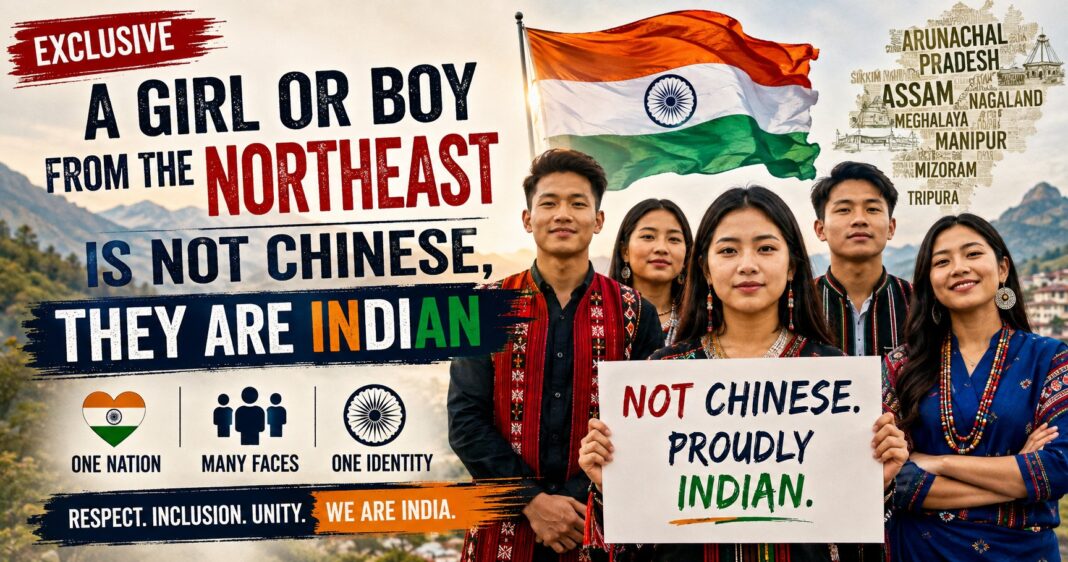
There are some things that should never have to be explained in a country like India. One of them is this: a girl or boy from the Northeast is not Chinese. They are Indian. It sounds obvious. It sounds almost ridiculous that we should have to say it. Yet the experiences of Northeastern Indians in cities across our country tell us that this simple truth still needs to be spoken, loudly and without apology.
India is a civilisation of many faces. The face of India is not necessarily fair, dark, round, sharp, tall, short, South Indian, North Indian or Northeastern. India has always been a civilisation where difference was not supposed to be a threat. Yet somewhere along the way, we began turning physical appearance into an identity card. If a young man from Manipur, Nagaland, Mizoram, Arunachal Pradesh or Tripura has East Asian features, someone thinks it is acceptable to call him ‘Chinese’. If a young woman from Assam or Meghalaya looks different from what someone imagines an Indian should look like, she is subjected to a joke, a stereotype or a racial slur. And when she objects, she is sometimes told that she is being too sensitive.
That is not humour. That is prejudice.
The last five years alone have given us enough examples to know that this is not an isolated problem. In July 2021, after Manipuri weightlifter Mirabai Chanu won India’s silver medal at the Tokyo Olympics, Assamese woman Ankita Konwar spoke publicly about the racism experienced by people from the Northeast. Her point was painfully simple: Northeastern Indians are celebrated as Indians when they win medals for India, but outside those moments they can be reduced to words such as “Chinese”, “Nepali”, “Chinky” and, during the pandemic, “Corona”.
That should make every Indian uncomfortable.
Imagine the absurdity of it. A young woman has to win an Olympic medal before some people are willing to recognise her as Indian. We cheer when she stands on the podium, wave the Tricolour and sing the national anthem. But when the same young person returns to an Indian city to study, work or build a life, her appearance can suddenly become an excuse to question whether she belongs.
In November 2021, another controversy brought the issue into public view when television personality Raghav Juyal faced criticism over remarks directed at a young dance participant from Guwahati. The incident triggered accusations of racist stereotyping and prompted public condemnation, including from the girl’s father. The lesson was not simply about one television programme or one inappropriate comment. It was about how easily stereotypes can become entertainment when the person being mocked belongs to a community that is already treated as “different”.
And that is where racism often begins – not with a fist, but with a joke. It begins when we laugh at someone’s eyes. It continues when we imitate their accent. It becomes normal when we call them “Chinese”. It becomes institutional when people begin believing that Northeastern Indians are outsiders. And it becomes dangerous when violence follows.
The most disturbing recent example came in Dehradun in December 2025, when 24-year-old Anjel Chakma, an MBA student from Tripura, died after a violent assault. His brother Michael, who witnessed the incident, said racial slurs including “Chinese” and “momo” were used before the attack. Police subsequently arrested accused persons and investigated the killing, although the police leadership said at the time that there was no prima facie evidence establishing racial motivation, making it important not to prejudge the final legal determination.
But regardless of what a court ultimately determines about motive, there is something that cannot be ignored: the victim was a young Indian from Tripura, and the controversy surrounding his death once again exposed the fear and frustration Northeastern communities feel when racial abuse accompanies violence.
His brother’s words reportedly captured the essential point: we are Indians, not Chinese or outsiders.
How heartbreaking is that?
An Indian citizen should never have to explain to another Indian that he is Indian.
The tragedy of Anjel Chakma therefore needs to be viewed not merely as an individual crime but as a moment for national introspection. We must be careful not to declare every crime against a Northeastern person a racial crime without evidence. That would itself be irresponsible. But we must also be equally careful not to dismiss racial discrimination whenever it appears simply because acknowledging it makes us uncomfortable.
There is a difference between investigating a crime fairly and pretending that racism does not exist.
The Northeast has repeatedly told the rest of India that it exists.
It has told us through students who have spoken about discrimination in universities and cities. It has told us through athletes such as Mirabai Chanu, Mary Kom and countless others who have represented India with extraordinary distinction. It has told us through soldiers who have defended India’s borders. It has told us through entrepreneurs, doctors, musicians, civil servants and professionals who have built their lives far away from their home states.
And yet, too often, the Northeast is still treated as if it is India’s exotic neighbour rather than an integral part of India by some Indians. That mindset has consequences.
A 2025 academic study examining the experiences of Northeast Indians in Hyderabad found that racial difference and cultural difference shaped how Northeastern residents experienced the city and their relationship with the wider Indian society. The research involved interviews with people from the Northeast and examined how their identities were confronted in an urban environment outside the region.
This is why the conversation cannot stop at condemning individual incidents.
We need to ask a larger question: Why does an Indian from the Northeast sometimes feel more like a foreigner in another Indian city than a foreigner actually does?

The answer is uncomfortable.
Many Indians simply know very little about the Northeast. We know its borders but not necessarily its people. We know its geography but not its history. We know that it exists but do not always understand how deeply it is woven into the Indian national story.
That ignorance creates stereotypes. And stereotypes create distance.
A young student from Nagaland should be able to walk into a college in Delhi without being asked whether she is Chinese. A boy from Mizoram should be able to rent a house in Bengaluru without having his nationality questioned. A woman from Arunachal Pradesh should be able to travel through Mumbai without becoming the subject of jokes about her eyes.
They are not guests in India. They are India.
And perhaps this is where our idea of nationalism needs to mature. Patriotism cannot simply mean waving the Tricolour. Patriotism means recognising the person standing beside you as equally Indian.
It means understanding that the Indian identity is large enough to contain hundreds of communities, languages, traditions, cuisines and physical appearances.
It means that when a person from the Northeast wins a medal, we should celebrate not because “someone from that region” has finally become Indian, but because one of our own has made India proud.
The same person should receive exactly the same dignity when she loses a competition, fails an examination, searches for a job or simply walks down a street.
India cannot become Viksit Bharat while some Indians still have to prove that they belong.
Economic development without social confidence is incomplete. Infrastructure without dignity is incomplete. Growth without inclusion is incomplete. And nationalism without equality is merely a slogan.
So perhaps we should teach our children something very simple.
If you see a boy or girl from the Northeast, do not ask, “Are you Chinese?”
Ask, “Which part of India are you from?”
And when they tell you – Manipur, Nagaland, Mizoram, Meghalaya, Arunachal Pradesh, Assam, Tripura or Sikkim – do not hear the name of a distant place.
Hear the name of your India.
Because the Indian who looks different from you is not less Indian. The Indian who speaks a different language is not less Indian. The Indian whose food is different from yours is not less Indian. The Indian whose eyes look different from yours is not less Indian.
And the Northeast is not India’s periphery.It is part of India’s heart.
A girl from Manipur is Indian. A boy from Nagaland is Indian. A student from Mizoram is Indian. A young professional from Arunachal Pradesh is Indian. A child from Tripura is Indian.
They do not need to look like us to belong to us. We need to learn to look beyond their faces and recognise our own flag in their hearts.
They are not Chinese. They are not outsiders. They are not foreigners. They are Indian. And it is time every Indian behaved like it.