
Key Takeaways
- Organ trafficking is a growing concern globally, with thousands of cases reported annually.
- The case highlights the commodification of human life, where a person’s body is viewed as a source of profit.
- The involvement of juveniles in organ trafficking is a worrying trend, with potential long-term consequences for their mental and emotional well-being.
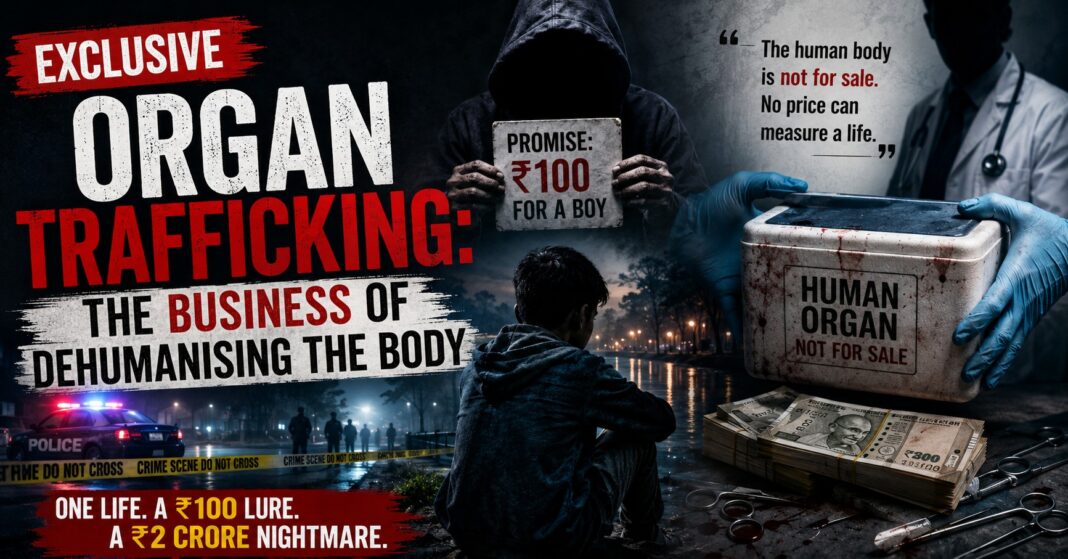
A 17-year-old boy went missing from Bhopal’s Iqbal Maidan on August 6 after being lured with the promise of receiving ₹100. Four days later, his body was found near Dhobighat at Chhota Talab. Investigators uncovered a sinister plan to sell an organ for ₹2 crore. Five people, including three juveniles, have been arrested, while investigators continue to examine whether the killing was connected to a larger organ trafficking network. The alleged organ trafficking angle, however, remains under investigation and should not be treated as established fact until the evidence is fully examined.
Yet even before the investigation reaches its conclusion, the circumstances of the case force us to confront an unsettling question: What happens to a society when the human body begins to be imagined as a source of profit? According to the police account, the teenager was told that he would be paid ₹100 to accompany the group to settle a dispute with some boys near Khattapura. He apparently had no reason to suspect that he was being led into a deadly trap. The group eventually reached the Dhobighat area, where the teenager was allegedly killed and a body part removed. Investigators say the accused subsequently tried to find a buyer but, failing to do so, discarded the body part in the lake. Police have not recovered it and are continuing their search. The chilling contrast is difficult to ignore: the victim was allegedly enticed with ₹100, while those behind the plan reportedly imagined earning ₹2 crore. One human life was treated as an inconvenience; the human body was treated as an asset.
That contrast exposes something deeper than greed. It reveals a dangerous form of commodification in which the worth of a human being is separated from the person himself. Once the body is viewed primarily as something that can be bought, sold, extracted or exchanged, the person can gradually disappear from consideration. The teenager ceases to be someone’s son, friend, classmate and a person with hopes and a future. He becomes, in the imagination of those allegedly responsible, a potential source of financial gain. That is perhaps the most disturbing dimension of the entire case. Murder is already a grave violation of life, and to generate money from it, introduces another level of degradation, not just deprived of life but degraded into a commodity.
The alleged involvement of a man who presented himself as a doctor makes the story even more disturbing. Police say he met the juveniles approximately a month before the murder, dressed like a medical professional, showed them a video and explained a plan through which they could supposedly make around ₹2 crore. If established, this would demonstrate how easily professional authority can be manufactured and exploited. A person wearing a white coat can appear trustworthy even when he possesses no legitimate medical authority. For adolescents, especially those attracted by the promise of sudden wealth, such a performance can create an illusion of credibility that makes an otherwise absurd proposition appear plausible.
This is where the case intersects with one of the most serious challenges of the digital age: the transformation of misinformation into action. A false claim circulating online is not necessarily harmless simply because it is ridiculous or scientifically implausible. Its consequences depend upon who encounters it, what they already believe, how vulnerable they are and whether anyone is present to challenge it.
The involvement of juveniles deserves serious attention. Their alleged participation cannot be dismissed, and accountability must follow due process. At the same time, society must ask how young people could be persuaded to participate in something so profoundly destructive. Adolescence is a period in which identity, belonging, ambition and judgment are still developing. Young people can be particularly susceptible to individuals who offer them money, status, excitement or a sense of belonging. This does not remove personal responsibility, but it does force us to look beyond the immediate perpetrators towards the environments in which such manipulation becomes possible.

There is a tendency to explain crimes of this kind simply through the language of greed. But a person who can seriously contemplate killing another human being for the possibility of making crores has already crossed an internal boundary in which another person’s life no longer possesses an inviolable value. Money has become the measure by which everything else is evaluated. Once that happens, the question is no longer whether something is right or wrong, but whether it is profitable or unprofitable.
That mentality is particularly dangerous when it enters the medical sphere. Medicine exists fundamentally for healing and care. The doctor is entrusted with the vulnerability of the human body precisely because patients place an extraordinary degree of trust in medical professionals. Organ transplantation itself can be one of the most remarkable expressions of solidarity between human beings when conducted lawfully, voluntarily and with proper safeguards. The tragedy begins when organs become objects of exploitation, especially when vulnerable people are deceived, coerced or killed to obtain them. The difference between donation and trafficking is not merely a legal technicality. It is the difference between respecting a person and using a person.
India has witnessed cases involving illegal organ trade before; in June 2026, for example, the Enforcement Directorate announced searches in Kerala as part of a money laundering investigation linked to an illegal organ trafficking racket, demonstrating that the broader problem of illicit organ trade is not imaginary. But the Bhopal case would present an especially horrifying variation because the alleged source of the organ was not a person persuaded to sell one but a teenager whose life was allegedly taken for it.
Is this a work of individuals acting upon a bizarre and dangerous scheme, or are there some others behind them? Who created the plan? Who supplied the information? Who was expected to purchase the organ? Were there intermediaries? Was money promised to anyone? Were other young people approached? Did digital platforms play a role in recruitment or persuasion? The answer to these questions, only the investigation and time will tell.
But there is another investigation that society itself must undertake. We need to examine the culture that makes the promise of ₹2 crore attractive enough to suspend ordinary judgment. We live in an age fascinated by sudden wealth. Social media frequently celebrates luxury without revealing the labour, privilege or circumstances behind it. The Bhopal teenager was allegedly offered ₹100. The people behind the scheme reportedly imagined ₹2 crore. Between those two figures lies the terrible distance between poverty, manipulation, greed and human dignity. The ultimate question is therefore not simply how much an organ is worth. It is whether a human being can ever be assigned a price. The answer must be an unequivocal no.
A society that permits the human body to become a commodity eventually risks allowing the person attached to that body to become one as well. Because the most dangerous thing about this case may not be the alleged attempt to sell an organ. It may be the idea that made such an attempt conceivable in the first place: that a human being can be worth less alive than his body is worth dead.