
Key Takeaways
- The Mecca Pact is a strategic agreement between Saudi Arabia, Pakistan, and Türkiye aimed at enhancing regional security and cooperation.
- Saudi Arabia and Pakistan have a long-standing defence relationship, while their relationship with Türkiye has expanded considerably.
- The Mecca Pact has significant implications for India, including the potential for increased strategic competition and the need for India to reassess its relationships with Saudi Arabia and Pakistan.
There are moments in geopolitics when a document matters not merely because of what it says, but because of what it tells us about the direction in which the world is moving. The Mecca Joint Defence Agreement, signed on August 7, 2026, by Saudi Arabia, Türkiye and Pakistan is one such moment. India should neither panic about it nor dismiss it. It deserves something far more important: strategic attention.
The pact brings together three important Muslim-majority powers with very different national interests but an increasingly common concern about regional insecurity. Saudi Arabia brings money, energy and influence across the Arab and Islamic world. Türkiye brings a significant defence industry, a large military and NATO membership. Pakistan brings a battle-hardened military, a nuclear arsenal and a geography that connects South Asia with the Middle East.
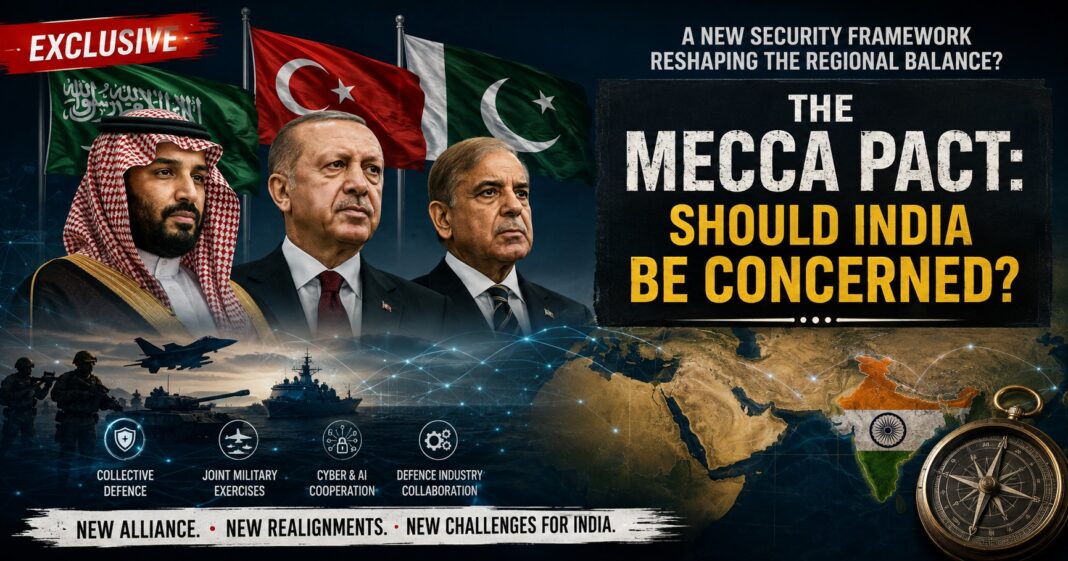
The agreement states that an armed attack against any one of the three will be treated as an attack against all. It also envisages closer political and military coordination, joint exercises across land, sea and air, cooperation in cyber and electronic warfare, unmanned systems and artificial intelligence, and deeper defence-industrial cooperation including technology transfer. Türkiye has also indicated that the framework could eventually expand, with Egypt mentioned as a possible participant.
That is significant.
But let us not make the mistake of immediately calling this an “Islamic NATO”.
It is not NATO. NATO has decades of institutional integration, permanent command structures, interoperable forces and established mechanisms for collective defence. The Mecca agreement is still an emerging security framework. Its military commitments remain less precise, and its three members have very different strategic priorities. Analysts have rightly cautioned against assuming that a signature on paper automatically creates a unified military machine.
Yet dismissing it would be equally foolish.
The real significance of the Mecca Pact lies in the geopolitical psychology behind it.
For decades, the Gulf region relied heavily on American military power for security. However, recent wars and crises have led regional powers to question the reliability of their traditional security guarantor. What happens if the US is unable or unwilling to guarantee our security?
Saudi Arabia has therefore been diversifying its strategic relationships. Its defence relationship with Pakistan has existed for decades, while its relationship with Türkiye has expanded considerably. The 2025 Saudi-Pakistan Strategic Mutual Defence Agreement already formalised an important part of that relationship. The Mecca Pact now widens the architecture
And there is another important factor: Iran.
The agreement comes against the backdrop of an extraordinarily volatile Middle East, including missile attacks and escalating confrontation involving Iran. Saudi Arabia has increasingly recognised that its geography makes it vulnerable to conflicts it does not necessarily initiate. The pact is therefore, first and foremost, a mechanism of deterrence. Riyadh wants potential adversaries to understand that attacking Saudi Arabia could trigger a broader response.
Türkiye has its own calculations. Ankara wants strategic autonomy and greater influence across the Middle East and beyond. Pakistan, meanwhile, gains something it desperately needs: strategic depth and political relevance.
And this is where India should pay attention.
Pakistan has historically attempted to internationalise the Kashmir issue. Its partnership with China has given Islamabad military and diplomatic leverage. Its relationship with Türkiye has become increasingly close. The addition of Saudi Arabia to a formal trilateral defence framework gives Pakistan another strategic platform.
That does not mean Saudi Arabia is preparing to fight India. In fact, assuming that Riyadh has suddenly become an extension of Islamabad would be a serious analytical error.
India-Saudi Arabia relations today are far too substantial to be reduced to Pakistan.
Saudi Arabia is India’s fifth-largest trading partner, while India is Saudi Arabia’s second-largest trading partner. Bilateral trade reached approximately $41.88 billion in FY 2024-25, with Indian exports at $11.76 billion and imports from Saudi Arabia at $30.12 billion. Saudi investment in India, including investments by the Public Investment Fund and Saudi-backed entities, is estimated at around $10 billion. More than 6,000 Indian companies are registered in the Kingdom.
The relationship is also strategically important because of energy.
In FY 2023-24, Saudi Arabia supplied India with 33.35 million tonnes of crude oil, accounting for approximately 14.3 percent of India’s crude-oil imports. Saudi Arabia was also India’s third-largest LPG sourcing destination, accounting for 18.2 percent of India’s LPG imports that year.
Then there is the human connection.
Nearly 10 million Indians live across the GCC, and remittances from Indians in the GCC accounted for almost 38 percent of India’s total remittance inflows in FY 2024-25. Saudi Arabia is therefore not some distant geopolitical theatre for India. It is deeply connected to India’s economy, energy security and people.
This is precisely why India must respond with maturity rather than emotion.

New Delhi’s first objective should be to ensure that the Mecca Pact does not become an anti-India security mechanism.
There is a difference between a defensive alliance formed because Saudi Arabia fears Iran and a bloc constructed to contain India. At present, the evidence points much more strongly toward the former. Pakistan may wish to use the new architecture to enhance its strategic position against India, but Riyadh’s interests are much broader. Saudi Arabia is pursuing Vision 2030, economic diversification, foreign investment and regional stability. A confrontation with India would damage many of those interests.
Türkiye is another matter.
India’s relationship with Ankara has experienced significant political friction, particularly because of Türkiye’s positions on Kashmir and its increasingly close defence relationship with Pakistan. Türkiye’s defence-industrial capabilities are also improving rapidly. The Mecca framework therefore potentially gives Pakistan access to deeper military cooperation with both Türkiye and Saudi Arabia. That deserves serious monitoring.
But India should also recognise the opportunity.
The Mecca Pact could actually encourage New Delhi to accelerate its own strategic engagement with the Gulf.
India already has a powerful economic foundation in the region. India-GCC trade reached $178.56 billion in FY 2024-25, representing 15.42 percent of India’s global trade. The GCC is also an important source of investment into India.
India therefore does not need to respond by constructing an opposing religious bloc.That would be precisely the wrong lesson.
India’s strength is that it does not have to choose between Riyadh, Abu Dhabi, Tehran, Washington, Moscow or other centres of power. India’s strategic tradition is increasingly about partnerships based on interests rather than ideological camps.
The answer to the Mecca Pact is not an “Indian NATO”. The answer is a stronger India.
A stronger navy protecting the Arabian Sea. A stronger defence industry capable of supplying partners rather than merely buying weapons. Deeper intelligence cooperation with Gulf states. Greater maritime cooperation. More energy partnerships. More investment. More technology collaboration. And, most importantly, stronger political relationships with Saudi Arabia and the wider Gulf.
India should also watch the possibility of the pact expanding. If Egypt or other major regional states eventually join, the framework could acquire substantially greater geopolitical weight. Türkiye has already indicated that the arrangement could grow.
But India should not lose sight of the larger truth.
The Mecca Pact is less a declaration against India than a declaration about a changing Middle East.
Countries that once depended almost entirely on external security guarantees are now trying to build their own networks of deterrence. Saudi Arabia wants security. Türkiye wants strategic autonomy. Pakistan wants relevance and leverage. Iran wants influence. Israel wants deterrence. The United States wants to manage its commitments. China wants economic and strategic influence.
And India?
India must want one thing above all else: strategic independence with strategic capability.
We should be concerned, but not frightened. We should watch Pakistan, but not obsess over Pakistan. We should understand Türkiye, but not surrender our relationship with the Gulf because of Türkiye. And above all, we should engage Saudi Arabia not merely as an oil supplier or a country where millions of Indians work, but as a major strategic partner.
The Mecca Pact is a warning.
But every geopolitical warning is also an opportunity.
India’s response should therefore be simple: Do not build walls because others are building alliances. Build bridges, build ships, build technology, build partnerships and, above all, build national strength.
Because in the new world emerging around us, the countries that survive strategically will not necessarily be those with the most friends. They will be those strong enough to remain friends with everyone without becoming dependent on anyone.