
Key Takeaways
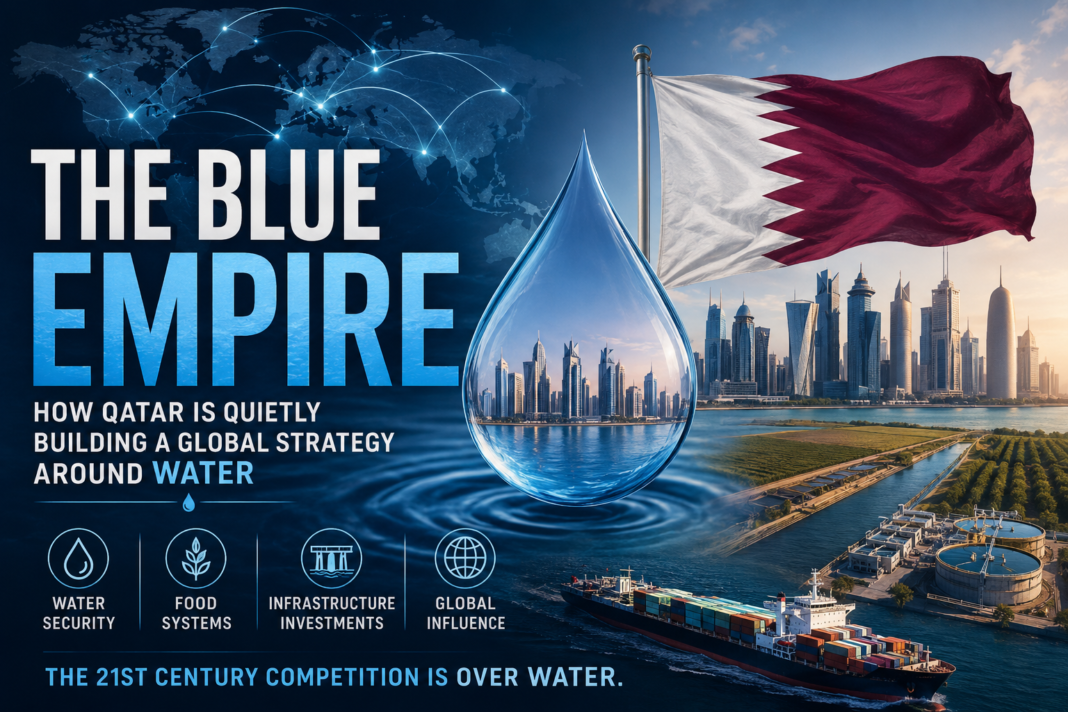
- Qatar is quietly building a global strategy around water to ensure water security and geopolitical influence.
- Qatar’s sovereign wealth fund, the Qatar Investment Authority, is a key player in this strategy, investing in desalination technologies, agricultural supply chains, and food security partnerships.
- Virtual water, the water embedded in agricultural production, is a critical component of Qatar’s water strategy, as it allows the country to import water through global food supply chains.
The great geopolitical struggles of the twentieth century were fought over territory, ideology, and oil. The defining competition of the twenty-first century may well be fought over something far more fundamental: water.
And no country appears to understand this emerging reality better than Qatar.
At first glance, the proposition sounds absurd. Qatar is a water-stressed country, with virtually no permanent rivers, minimal rainfall, and severely depleted groundwater reserves. It relies on desalination for 99 percent of its drinking water. Yet it is precisely this vulnerability that has compelled Doha to think about water not merely as a resource, but as a strategic asset.
While the world focuses on Qatar’s natural gas wealth, its diplomatic interventions, or its ownership of iconic global assets, a quieter and potentially more consequential strategy has been unfolding over the past two decades. Through sovereign wealth investments, agricultural acquisitions, desalination technologies, infrastructure financing, development partnerships, and strategic land purchases, Qatar has begun constructing what can only be described as a global architecture of water security and, by extension, geopolitical influence.
This is not a conspiracy. Nor is there evidence that Qatar is pursuing some covert project of global water control.
What is evident, however, is that Doha has recognised a strategic truth that many larger powers continue to underestimate: whoever controls access to water, food systems, and climate resilience infrastructure will exercise disproportionate influence in the century ahead.
The Strategic Trauma of Water Scarcity
To understand Qatar’s global water strategy, one must first understand the country’s existential relationship with water.
Qatar’s naturally renewable groundwater resources amount to only around 56 million cubic meters annually, yet historical extraction rates have exceeded 250 million cubic meters per year, leading to severe aquifer depletion. Agriculture consumes over 90 percent of the country’s renewable water resources, while the nation’s municipal and industrial sectors remain overwhelmingly dependent on desalination.
Today, approximately 61 percent of Qatar’s total water supply and virtually all of its drinking water comes from desalination plants. The country’s strategic water reserve system – including its massive reservoir network – was designed to ensure survival during geopolitical crises, military conflict, or infrastructure disruption.
In March 2026, renewed regional tensions in the Gulf once again exposed the vulnerability of desalination-dependent states. For Qatar, as for its Gulf neighbours, water security remains inseparable from national security.
The lesson Doha appears to have drawn is straightforward: domestic water security alone is insufficient. Strategic resilience requires global diversification.
Building a Financial Empire of Resources
At the center of Qatar’s global strategy stands the Qatar Investment Authority (QIA), the sovereign wealth fund established in 2005, which today controls assets estimated at approximately US$580 billion. Recent agreements, including a US$25 billion strategic investment partnership with Goldman Sachs and the expansion of a US$3 billion venture capital ecosystem, have further enhanced Qatar’s access to global markets, infrastructure assets, and strategic technologies.
Most observers understand QIA primarily as an investment vehicle.
That is a mistake.
Sovereign wealth funds are not merely financial institutions. They are geopolitical instruments. They purchase not only assets, but relationships, access, influence, and optionality.
Water increasingly sits at the intersection of all four.
As climate change intensifies, freshwater systems become stressed, agricultural production shifts, and migration pressures grow, the strategic value of water-rich assets will rise exponentially. Qatar’s sovereign wealth apparatus appears to understand this reality with remarkable clarity.
The Politics of Virtual Water
One of the least understood concepts in modern geopolitics is “virtual water.”
Virtual water refers to the water embedded in agricultural production. Every ton of imported wheat, rice, beef, soybeans, or vegetables effectively represents imported freshwater.
For a water-poor country like Qatar, importing food is actually importing water.
Research indicates that Qatar imports well over a billion cubic meters of virtual water annually through global food supply chains. This dependence has transformed agricultural investment abroad from an economic activity into a national security imperative.
This explains why Qatar has invested aggressively in agricultural supply chains, farmland, logistics infrastructure, and food security partnerships across multiple continents.
The objective is not simply food production.
The objective is access to water embedded within food systems.
Latin America: Buying Into the World’s Water Bank
If the Middle East suffers from water scarcity, Latin America possesses the opposite problem: abundance.
The region contains approximately one-third of the world’s renewable freshwater resources.
For Qatar, this represents strategic opportunity.
Over the past decade, Doha has steadily expanded its relationships across South America through sovereign investments, agricultural holdings, infrastructure partnerships, development financing, and diplomatic engagement.
Brazil, Argentina, Uruguay, and Paraguay collectively represent some of the most water-rich agricultural regions on Earth. Investments in these ecosystems effectively provide exposure not only to farmland but also to aquifers, river systems, hydroelectric capacity, and future agricultural productivity.
The recent acquisition of approximately 10,000 hectares in Argentina’s Patagonia region by an investor linked to Qatar’s ruling establishment illustrates the strategic logic involved. The project reportedly includes tourism infrastructure, hydroelectric generation capacity, and long-term water rights associated with mountain ecosystems. To dismiss such acquisitions as merely luxury real estate transactions would be strategically naive.
In the twenty-first century, land matters.
But water matters more.
Africa: Investing in Climate Resilience
Africa represents another critical frontier in Qatar’s water strategy.
Through the Qatar Fund for Development and various sovereign partnerships, Doha has increased investments in water infrastructure, agricultural resilience, irrigation systems, and climate adaptation projects throughout the continent.

Publicly, these initiatives are framed as development assistance.
And they are.
But development assistance has always carried strategic dimensions.
The construction of water infrastructure creates long-term institutional relationships. Ministries cooperate. Regulators engage. Universities collaborate. Technical standards become shared. Political trust develops.
In geopolitics, infrastructure builds influence.
China understood this through the Belt and Road Initiative.
The United States understood it through the Marshall Plan.
Qatar increasingly appears to understand it through water diplomacy.
Asia: Securing Food Through Water
Asia presents perhaps the clearest example of Qatar’s strategic thinking.
Countries such as India, Pakistan, Bangladesh, Indonesia, and Vietnam occupy a central position in global agricultural supply chains while simultaneously facing growing climate and water stress.
Qatar’s investments in logistics, food systems, agriculture, ports, and infrastructure across Asia should therefore be viewed through a broader strategic lens.
Food security is water security.
Every agricultural partnership in South Asia or Southeast Asia effectively represents a partnership with water systems.
This explains why Qatar’s foreign investment strategy increasingly intersects with sectors such as climate technology, desalination innovation, water recycling, sustainable agriculture, and environmental infrastructure.
The sovereign wealth fund’s recent focus on artificial intelligence, digital infrastructure, and climate-related technologies suggests that Doha views the future of water management as a technological challenge as much as a geopolitical one.
The Desalination Superpower
Ironically, Qatar’s greatest strategic advantage may emerge not from freshwater ownership but from its expertise in creating water.
For decades, Qatar has invested billions of dollars into desalination infrastructure, making it one of the world’s leading practitioners of large-scale water production technologies.
Its domestic desalination systems produce hundreds of millions of cubic meters annually, while the country’s engineers, researchers, and institutions have accumulated decades of operational experience in one of humanity’s most critical technologies.
As climate change accelerates water scarcity across Asia, Africa, and parts of Latin America, desalination technology will become increasingly valuable.
Countries that possess capital, expertise, and operational experience in water generation will wield significant influence.
Qatar already possesses all three.
A New Form of Power
There is no evidence that Qatar seeks territorial control.
There is no evidence that Qatar seeks military domination.
There is no evidence that Qatar seeks covert control over global water resources.
But there is substantial evidence that Qatar is systematically positioning itself at the intersection of water, food, energy, climate resilience, and finance.
This may ultimately prove to be a far more effective strategy.
The emerging geopolitical order will not be shaped solely by aircraft carriers, military alliances, or nuclear arsenals.
It will increasingly be shaped by who finances desalination plants.
Who controls agricultural supply chains.
Who owns climate-resilient infrastructure.
Who possesses access to freshwater ecosystems.
And who understands that the strategic commodity of the twenty-first century is no longer oil.
It is water.
In that future world, Qatar – a tiny desert state with almost no water of its own – may emerge as one of the most influential water powers on the planet.
Not because it possesses water.
But because it understood its value before everyone else did.