
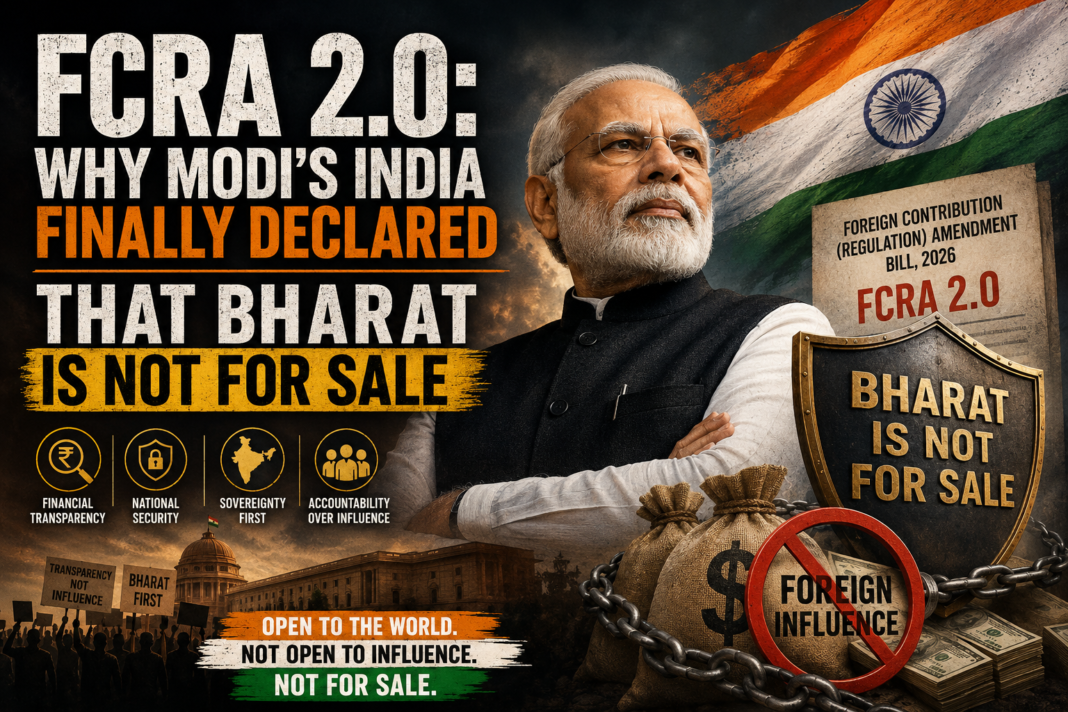

Key Takeaways
- FCRA 2.0 represents a significant national security and sovereignty reform undertaken by independent India.
- The Government of India has argued that the objective of FCRA 2.0 is to ensure that foreign contributions do not adversely impact national interest, public order, sovereignty, or strategic security.
- FCRA 2.0 introduces greater financial traceability and creates a Designated Authority to manage assets created through foreign contributions.
There comes a moment in the life of every civilisation when it must decide whether it wishes to remain sovereign or become vulnerable to influence disguised as benevolence. For decades, India treated foreign funding as charity. Prime Minister Narendra Modi’s India has finally recognised a geopolitical reality that every major power in the world understood long ago: foreign money is rarely just about philanthropy. It is often about influence, leverage, strategic penetration, narrative building, demographic transformation, and long-term geopolitical positioning. The Foreign Contribution (Regulation) Amendment Bill, 2026, and the subsequent implementation of FCRA 2.0 represent one of the most significant national security and sovereignty reforms undertaken by independent India. Predictably, sections of the global NGO ecosystem, international advocacy groups, opposition political parties, and certain religious organisations have reacted with alarm. But their outrage only underscores the strategic importance of these reforms.
Most Indians remain unaware of the sheer scale of foreign financial influence operating within the country’s social ecosystem. According to government data presented alongside the FCRA Amendment Bill, approximately 16,000 associations are currently registered under the FCRA framework and collectively receive nearly ₹22,000 crore annually in foreign contributions. Between FY2019-20 and FY2021-22 alone, over 13,500 organisations received more than ₹55,700 crore in foreign contributions. These funds have flowed into sectors ranging from education, healthcare, and social welfare to religion, environmental activism, advocacy, policy research, media engagement, and community mobilisation. No serious nation can afford to ignore the strategic implications of financial inflows of this magnitude.
India’s strategic naivety for far too long left its intellectual, cultural, religious, and institutional ecosystems vulnerable to external influence. Wars were fought on borders while institutions were left exposed to external influence. The battlefields of the twenty-first century are no longer defined merely by tanks, missiles, and aircraft carriers. Today’s wars are fought through universities, media narratives, think tanks, digital ecosystems, religious institutions, advocacy networks, environmental campaigns, and social movements. In today’s world, the weapon of choice is no longer the bullet. It is the grant. Every major geopolitical power understands this reality. The United States operates the Foreign Agents Registration Act and aggressively monitors foreign influence operations. Australia enacted the Foreign Influence Transparency Scheme Act in 2018. China subjects foreign NGOs to one of the world’s toughest regulatory regimes. European countries have increasingly tightened oversight of foreign-funded political and social networks. Why then should Bharat, a civilisation-state of over 1.4 billion people, be expected to operate under weaker standards?
The Government of India has repeatedly maintained that the objective of the Foreign Contribution Regulation Act is to ensure that foreign contributions do not adversely impact national interest, public order, sovereignty, or strategic security. FCRA 2.0 simply recognises that national security in the twenty-first century extends far beyond territorial borders. It includes financial sovereignty, institutional sovereignty, informational sovereignty, demographic sovereignty, and civilisational sovereignty.
One of the most debated provisions of the 2026 amendments concerns the creation of a Designated Authority empowered to provisionally vest, supervise, manage, and, where necessary, permanently dispose of assets created through foreign contributions when an organisation’s FCRA registration is cancelled, surrendered, or otherwise ceases to exist. Predictably, critics have called this government confiscation. That characterisation is politically convenient but strategically dishonest. The Government itself has argued that operational and legal gaps in the existing law created uncertainty regarding the management of assets created through foreign contributions. The new framework seeks to close those gaps. If an organisation builds schools, hospitals, religious institutions, training centres, community infrastructure, land banks, or social institutions using foreign money permitted under Indian sovereign law, then the Indian State has every right to ensure that those assets do not become instruments of unregulated foreign influence once that organisation loses legal authorisation to receive such funds. Sovereignty cannot stop at the bank account. It must extend to the institutions and assets created by those financial flows.
The second major pillar of FCRA 2.0 concerns financial traceability. The amendments introduce greater clarity regarding the amount of foreign contribution received, the purpose for which it is received, the geographical area in which it may be utilised, and the time period within which it must be spent. Organisations are now expected to provide significantly enhanced disclosures regarding donors, activities, digital presence, geographical footprint, and organisational leadership. Critics call this bureaucratic overreach. National security professionals call it accountability. In the age of cyber warfare, influence operations, digital propaganda, and transnational ideological networks, the ability to track financial flows is every bit as important as the ability to monitor military deployments.

Perhaps the most politically sensitive aspect of FCRA 2.0 concerns religion. As an Indian Christian who has publicly supported Prime Minister Narendra Modi and the BJP’s vision of national sovereignty despite criticism from sections of my own community, I believe this conversation requires honesty rather than rhetoric. The debate is not about religious freedom. The debate is about foreign-funded religious influence. There is a profound difference between the two. The Ministry of Home Affairs has now defined permissible religious activities more clearly under the FCRA framework, while simultaneously strengthening oversight over organisations receiving foreign contributions for religious purposes. The Government has specifically stated that organisations using foreign funds for forced religious conversions or personal enrichment will face strict action under the amended law. This is not anti-Christian. It is not anti-Muslim. It is not anti-any religion. It is pro-sovereignty.
As Indian Christians, we must ask ourselves a difficult but necessary question. Are we Indians who practice Christianity, or are we participants in transnational religious ecosystems whose strategic priorities may not always align with India’s national interests? For me, the answer has never been complicated. I am Indian first and Christian second. And because I am Indian first, I believe foreign money entering India’s religious ecosystem deserves the highest possible level of scrutiny.
The reality is that the geopolitical battle for India did not begin in 2026. It began decades ago. It has been fought through educational institutions, advocacy platforms, religious organisations, media narratives, environmental movements, rights-based campaigns, academic ecosystems, and digital influence networks funded by external actors pursuing their own strategic objectives. FCRA 2.0 does not prohibit charity. It does not prohibit religion. It does not prohibit civil society. It simply declares that none of these activities can operate beyond sovereign oversight when funded by foreign interests.
Prime Minister Narendra Modi and Home Minister Amit Shah appear to have recognised a reality that previous governments either failed to understand or lacked the courage to confront: national sovereignty is not merely territorial. It is financial. It is institutional. It is informational. It is demographic. It is cultural. It is civilisational. The battle for Bharat will not always be fought in Ladakh, Arunachal Pradesh, or the Indian Ocean. Increasingly, it will be fought inside universities, religious institutions, advocacy platforms, digital ecosystems, media narratives, and civil society organisations.
Those who oppose FCRA 2.0 continue to frame the debate as government versus NGOs. That is the wrong debate. The real question is whether Bharat possesses the sovereign right to determine who finances its institutions, influences its society, shapes its narratives, transforms its communities, and ultimately determines its future. My answer is unequivocal. Yes. Bharat has that right. And FCRA 2.0 is India’s declaration to the world that while Bharat welcomes friendship, cooperation, investment, and philanthropy, one principle remains absolutely non-negotiable: India’s sovereignty is not available for foreign funding. Bharat is open to the world. But Bharat is not for sale.