
Key Takeaways
- Iran is becoming a more radicalized and reckless regime, posing a significant threat to regional stability and national security.
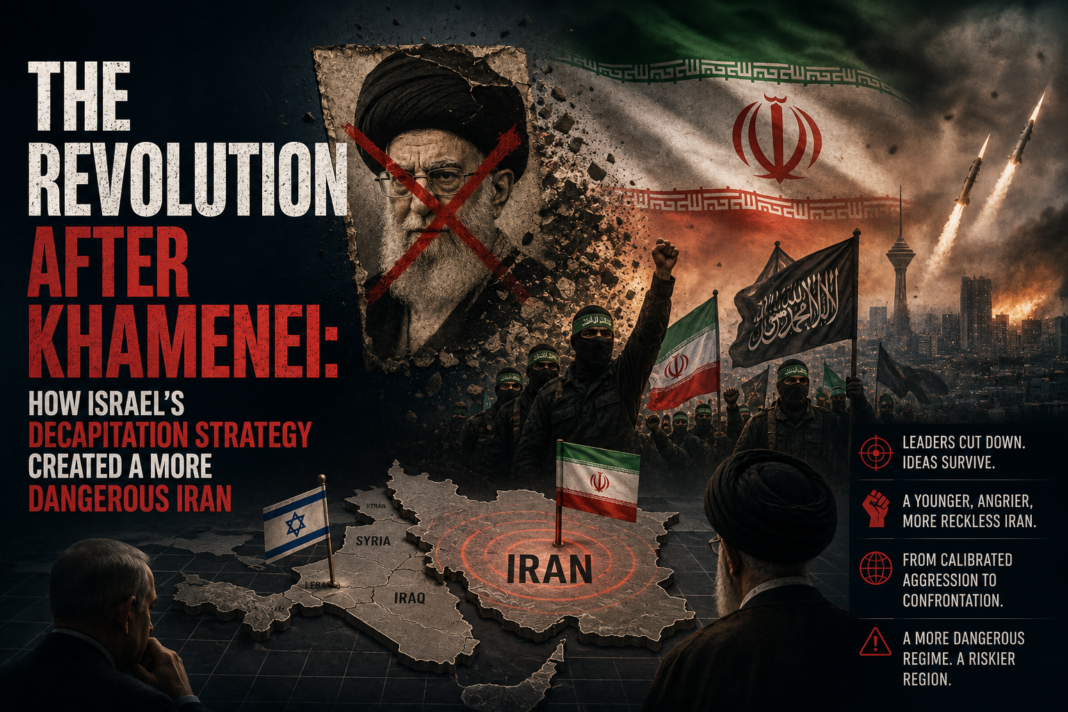
- The decapitation strategy used by Israel has inadvertently created a younger, angrier, and more unpredictable monster in Iran.
- A more radicalized Iran would likely conclude that survival through confrontation is the only way to ensure its survival.
The Middle East has always had a cruel habit of producing strategic ironies. Yet few scenarios would be more ironic, more dangerous, and more consequential than this: Israel succeeds in assassinating Iran’s Supreme Leader, dismantles much of the country’s veteran revolutionary leadership, and in doing so inadvertently creates an Iranian regime that is even more radical, more reckless, and more willing to gamble with regional war.
The assumption that eliminating a leadership structure automatically weakens an adversary has repeatedly proven false throughout history. Decapitation can create a younger, angrier, and more unpredictable monster. This is a strategic lesson that every nation confronting ideological states should understand.
The assassination of Ayatollah Ali Khamenei and the elimination of Iran’s senior political and military establishment would not necessarily have produced the collapse of the Islamic Republic. Instead, it could have triggered a revolutionary transformation within the revolution itself – a phenomenon that may have left Israel confronting a far more dangerous Iran than the one it had spent decades trying to contain.
To understand this paradox, one must first understand the strategic psychology of the Islamic Republic under its founding generations.
Ruhollah Khomeini and later Ali Khamenei represented a generation forged in existential struggle. They had survived revolution, international isolation, sanctions, assassination campaigns, and perhaps most importantly, the devastating eight-year Iran-Iraq War. That conflict fundamentally shaped the strategic culture of the Islamic Republic.
The lesson Khomeini and later Khamenei drew from the Iran-Iraq War was straightforward: survival of the regime was the supreme objective. Everything else – including ideology, territorial ambition, and regional influence – was secondary to preserving the Islamic Republic itself.
This strategic doctrine produced what many analysts described as ‘calibrated aggression’. Iran would support proxy groups, fund militant movements, challenge American interests, and threaten Israel, but it would generally avoid direct confrontations that could trigger a war threatening the survival of the regime.
For four decades, this doctrine governed Tehran’s behaviour.
Then came the strategic earthquake.
The elimination of Iran’s veteran leadership would not simply remove individuals; it would destroy an entire strategic worldview. The younger revolutionary elites emerging from the security apparatus, particularly elements associated with the Islamic Revolutionary Guard Corps, would inevitably interpret the collapse of the old order differently.
Their conclusion would not be that caution preserves regimes. Their conclusion would be that caution kills them.
From their perspective, the old leadership’s restraint, strategic patience, and calibrated escalation had failed. The veteran revolutionaries who avoided direct confrontation, who carefully managed escalation with Israel and the United States, and who prioritised regime survival above all else were ultimately eliminated anyway.
This would produce a dangerous new strategic doctrine: survival through confrontation rather than survival through restraint.
Such a regime would likely conclude that only aggressive deterrence, constant escalation, and demonstrating absolute willingness to risk regional war could ensure its survival. In effect, Tehran would undergo its own internal revolution.
The implications for Israel would be profound.
For decades, Israeli strategic planners operated on the assumption that Iran’s leadership, however ideological, remained fundamentally rational and risk-averse regarding the survival of the state. This assumption underpinned deterrence calculations across the Middle East.
But what happens when the adversary no longer shares the same definition of rationality?
A post-Khamenei revolutionary regime may very well determine that preserving the so-called ‘Axis of Resistance’ is itself essential to regime survival. Under such a doctrine, defending Hezbollah would not merely be an act of regional solidarity. It would become a strategic necessity.
This explains why a new Iranian leadership might view renewed conflict with Israel over Lebanon not as an unacceptable risk, but as an unavoidable investment in its own legitimacy.
The most remarkable aspect of this strategic transformation is the confidence with which such a regime might assess American behaviour.
The emerging leadership in Tehran could reasonably conclude that the United States, particularly under a transactional administration, would prioritise regional stability over escalation. Their calculation would be brutally simple: Washington fears another Middle Eastern war more than Tehran does.

Consequently, Iran could believe that even if hostilities resumed, American pressure would ultimately fall not on Tehran, but on Israel.
Under this framework, any memorandum of understanding between Washington and Tehran that implicitly links developments in the Persian Gulf with those in Lebanon represents a historic strategic victory for Iran.
For the first time, Iran would achieve international recognition – formal or informal – of the interconnected nature of its regional security architecture. More importantly, Tehran would effectively secure a form of veto power over developments in Lebanon.
This represents a profound strategic shift.
For Israel, it means that military operations against Hezbollah can no longer be viewed in isolation from broader negotiations with Iran. For Syria, it means further erosion of its sovereignty and increasing subordination to Iranian strategic interests. For Lebanon, it confirms what many Lebanese have long feared: that their country has become a negotiating arena rather than an independent actor.
The irony is devastating.
An operation designed to weaken Iran’s regional influence may instead institutionalise it.
This phenomenon is hardly unprecedented in history.
The assassination of political leadership often produces radicalisation rather than moderation. Revolutionary movements frequently become more extreme when their older, more pragmatic leadership cadres are eliminated. Younger leaders, lacking the historical memory of catastrophic wars and existential crises, tend to exhibit greater ideological rigidity and a higher tolerance for strategic risk.
History offers countless examples – from revolutionary France to post-colonial insurgencies, from Iraq after Saddam Hussein to Libya after Muammar Gaddafi – where the removal of established authority unleashed forces far more destabilising than those that preceded them.
The fundamental mistake is assuming that states behave like corporations, where removing senior management weakens organisational capacity. Revolutionary states do not function this way. They operate through narratives of sacrifice, martyrdom, and ideological legitimacy.
In such systems, assassination can become a recruitment strategy.
This is the strategic pickle in which Israel could find itself.
The elimination of Ali Khamenei and the old revolutionary guard may not have destroyed the Islamic Republic’s strategic ambitions. Instead, it may have liberated them from the caution imposed by leaders who remembered the horrors of the Iran-Iraq War.
The new generation of Iranian decision-makers would possess neither the trauma of 1988 nor the strategic restraint that trauma produced.
They would inherit the ideology without inheriting the fear.
And that may prove to be the most dangerous inheritance of all.
For Israel, the lesson is sobering. Tactical brilliance does not always produce strategic success. Sometimes, victory on the battlefield creates defeat in the geopolitical arena. Sometimes, eliminating an enemy’s leadership only ensures that the next generation arrives angrier, more ideological, and more willing to gamble everything.
The question facing the Middle East today is no longer whether Iran can survive its revolutions.
The real question is whether the region can survive the revolution inside Iran’s revolution itself.