


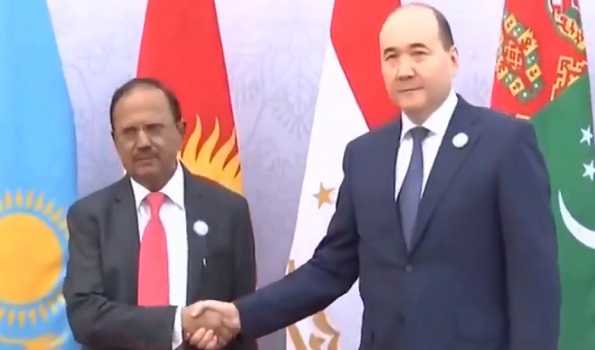

New Delhi: The National Security Advisers of India and Central Asian countries on Tuesday agreed that the expansion of terrorist propaganda, recruitment and fundraising efforts have serious security implications and need a collective and coordinated response.
The National Security Advisers/Secretaries of Security Councils of India and Kazakhstan, Kyrgystan, Tajikistan and Uzbekistan met here to discuss issues of regional security. Turkmenistan was represented by their Ambassador in New Delhi.
The joint communique issued after the meeting stated that the NSAs “agreed that the expansion of terrorist propaganda, recruitment and fundraising efforts have serious security implications for the region and, therefore, a collective and coordinated response is essential.”
The agreed that the misuse of new and emerging technologies, arms and drugs trafficking, using terrorist proxies for cross-border terrorism, abuse of cyber space to spread disinformation and unmanned aerial systems present new challenges in counterterrorism efforts and call for collective action.
The NSAs discussed that discussed the current situation in Afghanistan and its impact on the security and stability of the region.
They reiterated their strong support for a peaceful, stable and secure Afghanistan, emphasising respect for its sovereignty, unity and territorial integrity and urging non-interference in its internal affairs.
The NSAs emphasised that the territory of Afghanistan should not be used for sheltering, training, planning or financing any terrorist acts and reaffirmed the importance of UNSC Resolution 2593 (2021) that no terrorist organisation be provided sanctuary or allowed to use the territory of Afghanistan.

According to the joint communique, the NSAs “condemned in the strongest terms all forms and manifestations of terrorism and underscored the need to work collectively to fight this menace.”
The NSAs reiterated that greater connectivity could be a force multiplier for enhancing trade and commerce as well as closer interactions between India and Central Asian Countries and therefore, “deserved priority attention.”
They agreed that connectivity initiatives should be based on the principles of transparency, broad participation, local priorities, financial sustainability and respect for sovereignty and territorial integrity of all countries, the joint communique states.
The NSAs also emphasised the important role that Chabahar Port played during the humanitarian crisis in Afghanistan and its immense potential in enhancing trade and connectivity, as well as the logistics infrastructure of the Central Asian countries in the delivery of humanitarian goods to the Afghan people.
They also took note of the increase in trade between India and Central Asian countries through the Shaheed Baheshti Terminal, Chabahar Port and discussed further development of this transport corridor.
The participants supported India’s proposal to include the Chabahar port within the framework of INSTC.
The meeting of the NSAs flows from the agreement reached during the first India- Central Asia Summit held on January 27 this year, in which it was agreed that the countries will hold regular meetings of Secretaries of the Security Council to discuss issues of regional security.