
Key Takeaways
- The WhatsAppisation of Corporate India is a significant shift in customer engagement
- Conversational commerce is transforming the way businesses interact with customers
- Digital sovereignty is a growing concern in India due to dependence on foreign-owned digital platforms
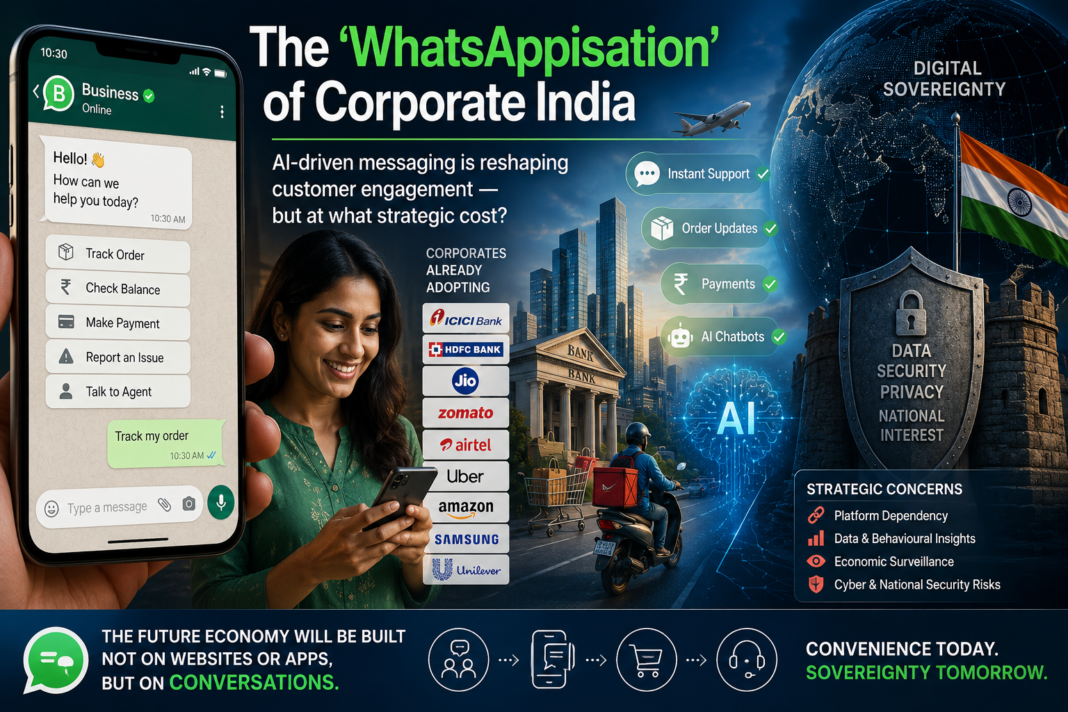
AI-driven messaging is reshaping customer engagement — but at what strategic cost?
The next big digital transformation may not happen on websites or mobile apps. It may happen inside a chat window.
Increasingly, Indian corporates — from banks and airlines to retailers, food-delivery firms, telecom operators and government-facing service providers — are shifting customer interaction onto Meta-owned messaging platforms such as WhatsApp Business and Facebook Messenger. The traditional model of websites, emails and call centres is steadily giving way to what analysts now call “conversational commerce”.
Meta itself has disclosed that users and businesses now exchange more than 600 million messages daily across its platforms. The numbers point to a structural shift in digital engagement.
India sits at the heart of this transformation. India has more than 500 million WhatsApp users. Meta executives recently stated that India is the company’s single largest market across WhatsApp, Facebook and Instagram, and a major driver of its rapidly expanding business-messaging revenues.
Why Corporates Are Migrating
Customers increasingly prefer messaging over email or voice calls. Messaging is mobile-native, immediate, flexible and frictionless. Unlike call centres, it does not force customers to wait in queues. Unlike email, it is usually read within minutes.
For businesses, the economics are compelling.
Today, a bank customer can block a credit card on WhatsApp, a food-delivery customer can track an order through chat updates, and a telecom subscriber can resolve recharge issues without ever visiting a website or speaking to a call centre executive.
A customer can now directly enter a WhatsApp or Messenger conversation to receive product recommendations, make payments, track deliveries, and raise complaints — all within a single messaging interface. This is a game-changer for customer engagement. The traditional customer journey involving websites, forms, emails and support calls is collapsing into one integrated interaction stream.
Artificial intelligence is accelerating this migration. AI-powered chatbots can now handle routine customer queries, onboarding, sales recommendations, appointment scheduling, delivery updates and post-sales support at massive scale and relatively low cost.
Meta has aggressively positioned itself at the centre of this trend. Its executives have openly described business messaging as a key future revenue engine.
India Inc Is Already There
Many major Indian and multinational companies operating in India have already embedded Meta’s messaging ecosystem into their customer operations.
Indian firms such as ICICI Bank, HDFC Bank and Reliance Jio have formally integrated WhatsApp-based customer engagement into banking, support and service workflows. Telecom operators, food-delivery platforms and retailers are rapidly adopting conversational customer interfaces across Meta’s ecosystem. Global firms operating in India — including Uber, Amazon, Samsung and Unilever — have similarly expanded messaging-led customer engagement strategies.
The phenomenon is especially powerful among India’s small and medium enterprises. For millions of smaller businesses, WhatsApp effectively functions as a combined storefront, CRM system, marketing channel and customer-support desk.
Meta estimates that paid messaging alone is already running at a billion-dollar annualised revenue stream globally, with India contributing significantly.
The Digital Sovereignty Question
Yet beneath the convenience lies a strategic concern that India cannot afford to ignore.

A growing proportion of India’s commercial communication infrastructure is now being intermediated through foreign-owned digital platforms. This raises critical questions of digital sovereignty.
When customer interaction, behavioural analytics, business communication flows and AI-driven engagement increasingly reside within proprietary global ecosystems, national dependence deepens. Data may remain encrypted in transit, but metadata, behavioural patterns and commercial intelligence still create enormous strategic value.
India has already experienced the geopolitical implications of digital dependence in other sectors — from telecom equipment and semiconductor supply chains to cloud infrastructure and social media influence operations.
Messaging ecosystems could become the next frontier. If large parts of India’s commerce migrate into privately governed foreign communication layers, platform operators gain enormous leverage over visibility; algorithmic prioritisation; pricing; API access; advertising flows; and customer data ecosystems.
The issue is no longer merely commercial; it is infrastructural and strategic.
National Security Implications
The national-security implications are equally significant.
Messaging platforms increasingly sit at the intersection of commerce, communication and AI. As generative AI gets embedded into customer interaction systems, dependence on platform-controlled AI layers may deepen further. They now mediate sensitive interactions involving banking, healthcare, logistics, governance support, digital identity verification and financial transactions.
Concentration of such activity on foreign-controlled platforms creates vulnerabilities involving cyber espionage, metadata exploitation, AI-driven behavioural profiling, economic surveillance and information manipulation.
Privacy advocates have repeatedly expressed concerns about Meta’s broader data-integration architecture. Public debate intensified after reports that Meta was expanding monetisation and AI integration within WhatsApp’s ecosystem.
India has previously resisted attempts by global technology platforms to shape the architecture of its digital ecosystem. Meta’s Free Basics initiative — launched in India through Reliance Communications, and later barred under net-neutrality regulations — was one early example of that tension.
India’s forthcoming Digital Personal Data Protection framework and evolving cyber-security regulations will therefore have to address not only data protection, but also strategic platform dependency.
The Emerging “Conversation Economy”
None of this means the trend will reverse. In fact, it is likely to accelerate.
India’s mobile-first population, relatively weak email culture, rapidly growing digital commerce ecosystem and AI adoption curve make conversational engagement almost inevitable.
The real question is whether India will merely become a vast consumer base inside foreign-owned messaging ecosystems, or whether it will build sovereign alternatives and regulatory guardrails alongside adoption.
The future digital economy may increasingly be organised not around websites or apps, but around conversations. Whoever controls those conversations will possess extraordinary commercial, technological and geopolitical influence.
The rise of Meta’s messaging ecosystem in corporate India is therefore not merely a story about customer convenience. It is also a story about who controls the infrastructure of tomorrow’s digital economy.