



Key Takeaways
- India’s first reusable hybrid rocket launch mission success marks a significant milestone in the country’s space exploration journey.
- Space Zone India’s RHUMI 2024 mission showcases the country’s advancements in aerospace technology and demonstrates the potential of reusable hybrid rockets.
- The mission’s success highlights the importance of collaboration between government agencies, civil aviation, and private companies in achieving breakthroughs in space technology.
Chennai: India’s first reusable hybrid rocket launch from a mobile Launchpad was successfully accomplished on Saturday morning.
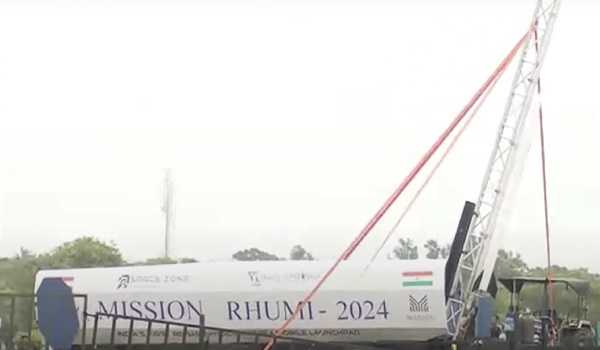
At 07.07 am, the launch of RHUMI rocket, carrying three Cube Satellites and 50 Pico satellites, took off from the mobile launch pad at Thiruvidandhai Coastal Village, Chengalpet, on the ECR, marking a remarkable achievement in India’s space exploration journey.
The launch was cleared by the government, civil aviation, IAF Tambaram, and the Airports Authority of India, and took off using a hydraulic launcher mounted on a truck.
The IAF Tambaram and Airports Authority of India played a crucial role in ensuring the mission’s success.
Scaling new heights in aerospace technology, Space Zone India, an emerging aero-tech company from Tamil Nadu, had unveiled the Mission RHUMI 2024, a first-of-its-kind milestone in the Indian aerospace industry.

The company through this mission launched India’s first reusable hybrid rocket on a mobile Launchpad that would harness the power of technology, combining the advantages of both
liquid oxidizer and solid fuel propel lant systems to improve efficiency and reduce operational costs.
“This Mobile launch system allows us to adapt to various launch scenarios with ease from any location, Dr. Anand Megalingam, Founder and CEO of Space Zone India, said.
RHUMI 1, the rocket carried three Cube satellites were designed to monitor and collect data on atmospheric conditions, including cosmic radiation intensity, UV radiation intensity, air quality, and more.
The rocket deployed 50 different Pico satellites, each dedicated to studying various aspects of atmospheric conditions such as vibration, accelerometer readings, altitude, ozone levels, toxic content, and natural and synthetic molecular bonding of fibers, enhancing our understanding of environmental dynamics.