


Key Takeaways
- The Sudan Brotherhood is a deeply embedded Islamist project that links the Sunni Muslim Brotherhood with the revolutionary machinery of Iran.
- The Baraa Bin Malik Brigade is a force that functions as the Brotherhood’s ideological shock troops, integrated directly into the Sudanese Armed Forces command structure.
- Iranian training, drones, precision munitions, and logistical support are flowing into Sudan through channels operated by the Islamic Revolutionary Guard Corps’ Quds Force.
There are wars that erupt because of politics. There are wars that erupt because of power. And then there are wars that erupt because ideology has quietly spent decades building its foundations beneath the surface of a nation.
Sudan today is not merely a battlefield between two rival military factions. It is something far more dangerous. It is the re-emergence of a deeply embedded Islamist project-one that links the Sunni Muslim Brotherhood with the revolutionary machinery of Iran. What appears to be a domestic Sudanese conflict is in fact a strategic junction in a much larger geopolitical confrontation stretching from the Horn of Africa to the Levant.
To understand the scale of the threat, one must begin in the 1950s.
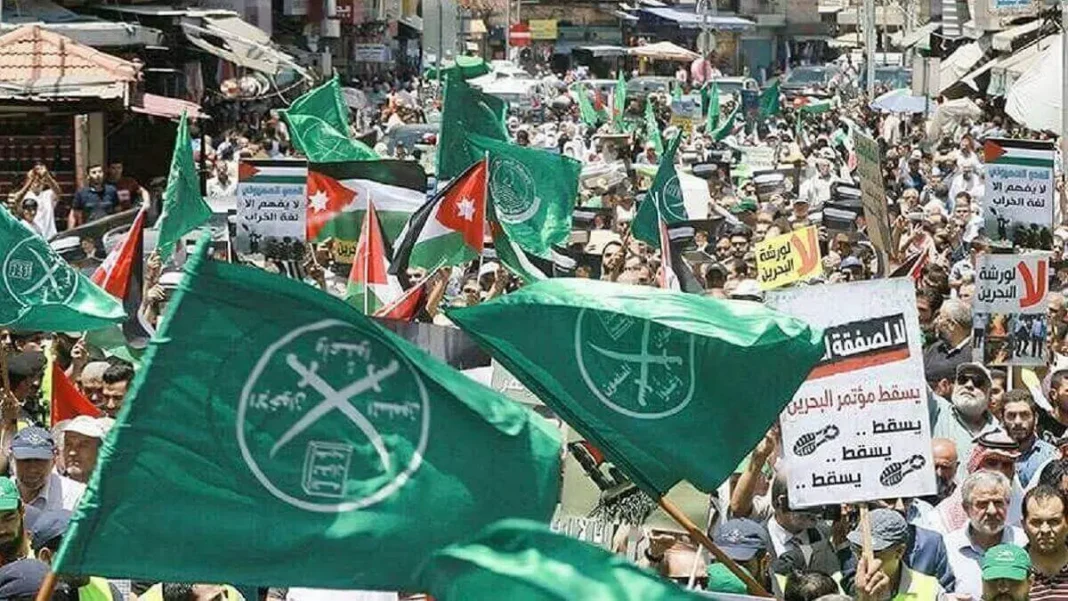
The Sudanese Muslim Brotherhood was imported from Egypt in the 1950s. The ideological seeds came directly from Egypt’s Muslim Brotherhood, carried into Sudan primarily through student movements exposed to Cairo’s Islamist intellectual ecosystem.
What began as a student ideological movement slowly transformed into something far more structured and disciplined under the leadership of Hassan al-Turabi. Turabi was not merely a cleric or political organiser; he was an architect of Islamist power. His genius lay in understanding that ideology alone could never capture the state. It had to infiltrate the institutions that actually controlled power – particularly the military and the intelligence apparatus.
Throughout the 1970s and 1980s, the Sudanese Islamic Movement embedded itself inside Sudan’s bureaucracy, universities, and most importantly, the security establishment. By the time the late 1980s arrived, the Brotherhood’s presence inside the military was no longer peripheral. It was decisive.
In 1989, Hassan al-Turabi and General Omar al-Bashir executed what would become one of the most consequential coups in modern African history. The National Islamic Front seized control of Sudan and effectively turned the country into the Muslim Brotherhood’s most successful state experiment outside the Middle East.
For the next three decades, the Brotherhood governed Sudan through the National Congress Party. The state machinery was reshaped around Islamist ideological structures. Sudan’s military-industrial complex was built with assistance from Iran. Intelligence networks were expanded. Islamist charities and religious institutions were integrated into governance.
Perhaps the most telling symbol of this period was Sudan’s hosting of Osama bin Laden between 1991 and 1996. While the world would later come to associate Al-Qaeda primarily with Afghanistan, Sudan served as one of the early safe havens where jihadist infrastructure could operate with state protection.
Sudan, under Brotherhood influence, became a crossroads for militant networks moving between Africa and the Middle East.
This history matters today because the same networks that were quietly built during those decades never truly disappeared.
When Sudan descended into civil war in April 2023 between the Sudanese Armed Forces (SAF) and the Rapid Support Forces (RSF), those dormant Islamist networks suddenly found their moment to re-emerge.
More than twenty thousand fighters linked to the Sudanese Muslim Brotherhood mobilised. These were not merely volunteers drawn from mosques or ideological groups. Many were former intelligence officers, hardened Islamist cadres, and remnants of the Popular Defense Forces that had once served the Bashir regime.
They did not form a parallel militia. Instead, they were integrated directly into the Sudanese Armed Forces command structure.
This integration transformed what might have been a conventional power struggle into something ideologically charged.
At the forefront of this mobilisation stands the Baraa Bin Malik Brigade – a force that functions as the Brotherhood’s ideological shock troops. The brigade has already been sanctioned by the United States Treasury in September 2025, but sanctions rarely slow movements that thrive on ideological conviction.
On the ground, the brigade has been ruthless. It has seized oil fields in Darfur and Kordofan, secured critical supply corridors, and carried out mass executions of civilians along ethnic lines.
These are not isolated atrocities. They are strategic acts designed to consolidate territory and control resources.
But what truly elevates this conflict from a regional tragedy to a global concern is the growing Iranian involvement.

According to statements from the United States government, Iranian training, drones, precision munitions, and logistical support are flowing into Sudan through channels operated by the Islamic Revolutionary Guard Corps’ Quds Force. Supply routes through the Red Sea and Libya have enabled Tehran to sustain the insurgent networks embedded within Sudan’s military structures.
The alignment between the Sudanese Muslim Brotherhood and Iran may appear unusual at first glance. After all, the Brotherhood is a Sunni movement while Iran leads a Shia revolutionary axis.
But ideology is rarely an obstacle when strategic interests converge. What we are witnessing is not temporary cooperation. It is strategic fusion.
The Brotherhood provides manpower, local legitimacy, mosque networks, and social infrastructure. Iran supplies the revolutionary doctrine, advanced weaponry, and centralised command architecture that allows insurgent networks to function across borders.
In the emerging regional terror architecture, the Sudanese Muslim Brotherhood occupies a particularly dangerous position.
Analysts describe it as having the highest “betweenness centrality” in the regional terror network. In simpler terms, it acts as the bridge connecting Iran’s Shia militant ecosystem – Hezbollah, the Houthis, and Iraqi militias – with Sunni Islamist networks stretching across the Horn of Africa and into the Levant.
This bridging role is what transforms Sudan from a national crisis into a strategic node in a much larger confrontation. And the consequences are already spilling into the global economy.
Energy markets are the first casualty.
The Red Sea is one of the world’s most critical maritime corridors. Oil shipments moving through the Bab el-Mandeb strait and the Suez Canal form a vital artery connecting the Middle East to Europe and beyond. Sudan sits dangerously close to this chokepoint.
Brotherhood-aligned units now threaten Port Sudan while Iranian-supplied drones extend their operational reach across the Red Sea corridor. Even limited disruptions in this region create ripple effects across global energy markets. We are already seeing the symptoms.
Brent crude prices have experienced violent fluctuations. Shipping routes through the Bab el-Mandeb have faced repeated closures. Suez Canal traffic has been intermittently disrupted. These are not merely logistical inconveniences. They are strategic shocks that destabilise entire economies.
Egypt offers a stark example of the cascading impact. The country is currently enduring twelve-hour electricity blackouts, emergency energy rationing, and fuel price increases ranging between fourteen and thirty percent. Lost Sudanese oil flows and the growing fear of Islamist infiltration along Egypt’s southern border have compounded the crisis.
Jordan and Lebanon are witnessing similar patterns of economic stress. And this is precisely where the Brotherhood’s strategy converges with Iran’s broader regional playbook.
Economic desperation is fertile ground for ideological recruitment. When fuel prices surge, electricity disappears, and unemployment rises, societies become vulnerable to narratives that promise justice, order, and divine legitimacy.
Islamist networks understand this dynamic better than most governments. Iran’s proxy strategy thrives on it.
By simultaneously threatening maritime trade routes and fuelling land-based insurgencies, Tehran creates a self-reinforcing cycle of instability. Economic collapse generates political frustration. Political frustration feeds Islamic radicalisation. Extremism strengthens militant networks that can further disrupt the economy.
Sudan has become the laboratory where this strategy is being tested. But Sudan is not the final destination. The real target is the broader Middle East and North Africa region.
If the fusion between the Muslim Brotherhood’s transnational networks and Iran’s revolutionary infrastructure continues to deepen, the result will not simply be another civil war in Africa. It will be the emergence of a new ideological axis capable of destabilising multiple regions simultaneously.
And by the time the world fully recognises the scale of that threat, the networks responsible for it may already be firmly entrenched across continents. Sudan, in that sense, is not merely a war. It is a warning.