


Key Takeaways
- Education and cinema must come together to create meaningful learning experiences.
- Cinema has the power to change behaviour by changing perception.
- Artificial Intelligence can deliver information instantly, but it’s attention, empathy, creativity, and human connection that are becoming scarce.
The future of education will not be determined merely by technology. It will be determined by how effectively we use technology to create meaningful learning experiences. As Artificial Intelligence, Virtual Reality, and digital platforms transform the way knowledge is accessed, education systems around the world face a critical challenge: how do we keep learners engaged, inspired, and emotionally connected to learning?
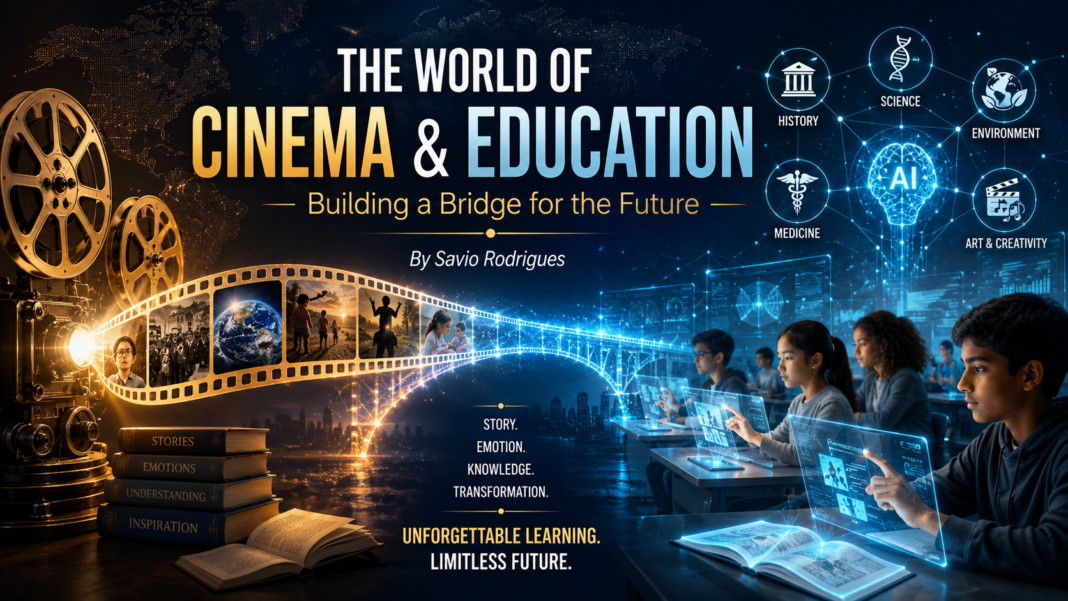
The answer may lie in an unexpected yet powerful partnership – the world of cinema and the world of education.
For more than a century, cinema has been humanity’s most influential storytelling medium. Education has been humanity’s most important institution for transmitting knowledge and values. Yet these two worlds have largely evolved separately. In the age of AI, that separation is no longer sustainable.
Research from cognitive science shows that people remember stories better than facts. Textbooks provide information, but stories give meaning. Cinema combines narrative, emotion, visuals, sound, and human experience to activate multiple brain areas. To evolve with technology and changing learner behaviour, education must embrace cinematic storytelling.
The evidence already exists.
One of the most remarkable examples comes from the impact of Steven Spielberg’s film, Schindler’s List. More than a successful movie, it became a global educational tool. Across schools and universities worldwide, the film helped millions of students understand the Holocaust in a way that no textbook alone could achieve. Students did not merely learn dates and statistics; they connected emotionally with the human consequences of hatred, prejudice, and genocide. The film eventually inspired educational programs, archives, and learning initiatives that continue to shape Holocaust education today.
A second example can be found in environmental education. The documentary An Inconvenient Truth transformed public understanding of climate change. Before its release, climate science often remained confined to scientific journals and policy discussions. The film brought complex environmental issues into classrooms and public discourse across the world. It demonstrated how cinema could translate scientific knowledge into accessible and actionable learning.
The influence of cinema on education is equally evident in India.
Few films have impacted educational conversations in India as profoundly as Taare Zameen Par. Before its release, dyslexia and learning disabilities received limited public attention. The film sparked nationwide conversations among parents, teachers, and policymakers about the pressures imposed on children and the need for inclusive education. Thousands of educators reported a greater awareness of learning differences after the film’s release. It achieved what decades of educational reports struggled to accomplish – it humanised the issue.
Similarly, 3 Idiots became one of the most influential films ever made on education. Its critique of rote learning, examination pressure, and narrow definitions of success resonated with millions of students and parents. More than a decade later, educational conferences, policy discussions, and teacher training programs continue to reference the film when discussing educational reform. Few academic papers have had such a widespread cultural impact on how society views learning.
The transformative power of cinema in education is not limited to feature films. Sometimes, a story lasting only a few minutes can leave a lifelong impact on a learner. The award-winning Spanish animated short film Cuerdas tells the story of a young girl who befriends a boy with cerebral palsy. In less than fifteen minutes, the film teaches lessons on inclusion, empathy, friendship, and human dignity more effectively than many conventional classroom lectures. Similarly, the animated short film The Present follows a boy who receives a three-legged puppy, only for viewers to discover that the boy himself lives with a disability. Used in classrooms across the world, the film challenges stereotypes and encourages students to see ability rather than disability. These short films demonstrate a fundamental truth of Film Pedagogy: learning is most powerful when knowledge is accompanied by emotion, and cinema has a unique ability to create that emotional connection.
These examples reveal a simple truth: cinema changes behaviour because it changes perception.
The world is now entering an era where Artificial Intelligence can deliver information instantly. Students can ask AI systems to explain scientific theories, solve mathematical problems, summarise books, or generate essays. Information is becoming abundant. What is becoming scarce is attention, empathy, creativity, ethical reasoning, and human connection.
These are precisely the areas where cinema excels.
Consider the field of medical education. Studies increasingly use films and visual narratives to help medical students understand patient experiences, ethical dilemmas, and emotional intelligence. While textbooks teach anatomy, stories teach compassion. Future doctors must understand both.

The same principle applies across disciplines. History becomes more engaging when learners experience historical narratives. Environmental science becomes more meaningful when learners see communities affected by ecological change. Civic education becomes more impactful when learners witness stories of leadership, justice, and social responsibility.
Technology is making this integration even more powerful.
Virtual Reality is already allowing students to walk through ancient Rome, explore the International Space Station, and experience historical events in immersive environments. The future classroom will increasingly resemble a cinematic experience where learners do not merely study concepts but live them.
Perhaps the most compelling modern case study comes from the entertainment industry itself. The global success of South Korean cultural exports demonstrates how storytelling can influence education, tourism, language learning, and national branding. Millions of people around the world began learning Korean culture, history, and language because of films and television content. This is education occurring beyond classrooms through the power of storytelling.
India possesses an even greater opportunity.
India produces more films than almost any other nation and has the world’s largest youth population. If India develops a structured framework for Film Pedagogy – integrating cinema into curriculum design, teacher training, student projects, and educational technology – it could emerge as a global leader in educational innovation.
Imagine every school operating a Film Pedagogy Club where students analyse films, create documentaries, discuss social issues, and connect classroom lessons to real-world experiences. Imagine educational films being produced in regional languages aligned with curriculum objectives. Imagine AI-powered learning platforms integrating cinematic storytelling into every lesson.
Such a vision is neither unrealistic nor distant. The technology already exists. The creative talent already exists. The educational need has never been greater.
The future of education will not belong to systems that merely deliver information. It will belong to systems that inspire curiosity, develop empathy, encourage creativity, and prepare learners for a rapidly changing world.
Cinema has already demonstrated its ability to shape cultures, influence societies, and transform human understanding. Education has the responsibility to prepare future generations for an uncertain world.
The time has come for these two powerful forces to build a bridge.
Not because cinema can make education entertaining.
But because cinema can make education unforgettable.
And in an age where knowledge is everywhere, unforgettable learning may become the most valuable educational outcome of all.