
Key Takeaways
- Russia has extraordinary cinematic talent and rich cultural stories that can inspire audiences across the globe.
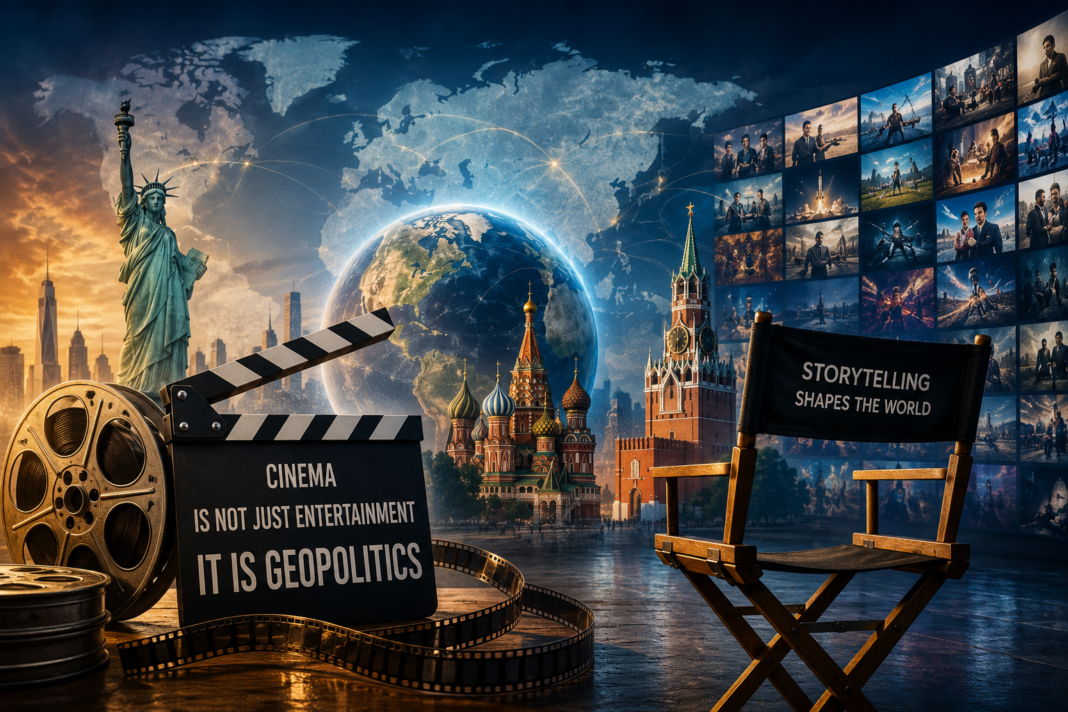
- Cinema is not just entertainment, but a tool for soft power and international influence.
- Russia must learn from America’s strategic use of cinema to reach a global audience and leverage its rich cultural heritage.
As I participate in discussions on film pedagogy and the role of cinema in shaping societies at the International Forum “Film Pedagogy. Eurasia” during the 3rd International Film Festival ‘Eurasia Kinofest’ in Sochi, Russia, one thought repeatedly comes to mind: Russia possesses extraordinary cinematic talent, rich cultural stories, world-class literature, and a civilisational history that can inspire audiences across the globe. Yet, despite these strengths, Russian cinema remains largely confined to Russian-speaking audiences.
Russia must learn from America’s strategic use of cinema as a tool for soft power, leveraging its rich cultural heritage to reach a global audience.
Not politically. Not economically. But strategically.
America understood something decades ago that many nations are only now beginning to appreciate: films are not merely entertainment. Films are instruments of influence. They shape perceptions, create aspirations, define narratives, and build soft power.
The United States did not become a cultural superpower solely because of its military strength or economic dominance. It became a global force because Hollywood entered homes and minds across the world.
For much of my childhood, my understanding of Russia came from Hollywood films. Russians were often portrayed as villains, spies, gangsters, or enemies. From the Cold War era to action films starring Sylvester Stallone and Arnold Schwarzenegger, Hollywood successfully implanted an image of Russia in the minds of billions of viewers worldwide.
That is the power of cinema.
The remarkable aspect is that America did not need governments around the world to endorse its message. Hollywood did the job naturally. Audiences consumed the content willingly. They laughed, cried, and celebrated American values without realising they were participating in one of history’s most successful soft-power campaigns.
Today, the global film industry generates more than $100 billion annually. Yet the economic value is only a fraction of its real influence. According to various studies on soft power and cultural exports, countries with strong global entertainment industries consistently enjoy greater international visibility, tourism appeal, investment attraction, and cultural acceptance.
Hollywood remains dominant, generating tens of billions of dollars annually and distributing content in nearly every country on earth. More importantly, Hollywood exports American ideas.
Russia possesses similar capabilities but has not fully embraced the international dimension of storytelling.
The challenge is not quality.
Russia has produced brilliant filmmakers. From the legacy of Sergei Eisenstein to Andrei Tarkovsky and contemporary filmmakers creating visually stunning works, Russia’s cinematic tradition is respected globally among critics and film scholars.
The challenge is audience.
Many Russian films are produced primarily for domestic consumption. Their themes, marketing strategies, and distribution models often assume a Russian audience rather than a global one. As a result, many outstanding stories never travel beyond national borders.
Meanwhile, smaller countries have demonstrated how cinema can become a strategic national asset.
Consider South Korea.
A country with a population of approximately 52 million people successfully transformed itself into a cultural superpower. The global success of Korean films and television series was not accidental.
The Oscar-winning movie Parasite introduced Korean storytelling to mainstream audiences worldwide. The global phenomenon Squid Game became one of the most watched television series in history. Korean cinema, music, and streaming content now generate billions in export revenues and have significantly enhanced South Korea’s international image.
The Korean Wave, or Hallyu, contributed an estimated tens of billions of dollars annually to South Korea’s economy through tourism, cultural exports, consumer products, and entertainment-related industries.
South Korea did not wait for the world to understand Korean culture.
It packaged its stories for the world.
Türkiye provides another compelling example.
Twenty years ago, Turkish television dramas were largely unknown outside the country. Today, Turkish series are exported to more than 150 countries and reach hundreds of millions of viewers globally. Industry estimates suggest Türkiye has become the world’s second-largest exporter of television dramas after the United States.
From Latin America to the Middle East, Central Asia, Africa, and Eastern Europe, Turkish stories have become cultural ambassadors.

As a result, Turkish tourism increased significantly in regions where Turkish television content became popular. Viewers who fell in love with Istanbul on screen wanted to experience the city in person.
That is not entertainment.
That is national influence.
Russia has advantages that Turkey and South Korea can only dream of.
Russian literature remains among the most celebrated in human history. The works of Dostoevsky, Tolstoy, Pushkin, Chekhov, and Bulgakov provide endless material for global adaptations. Russia’s history spans empires, revolutions, scientific achievements, space exploration, military victories, cultural movements, and extraordinary human stories.
The world is fascinated by Russian culture.
The question is whether Russia is telling those stories effectively to international audiences.
In the age of streaming platforms, geographical limitations no longer exist.
A film produced in Moscow can be watched in Mumbai, São Paulo, Johannesburg, London, or Jakarta within hours of release. The barriers that once restricted international distribution have largely disappeared.
This presents Russia with a historic opportunity.
Rather than focusing predominantly on Russian audiences, filmmakers should think globally from the conception stage. Scripts should consider universal themes. Productions should include international marketing strategies. Partnerships with streaming platforms should target multilingual audiences.
Most importantly, Russian filmmakers must stop assuming that foreign audiences are uninterested in Russian stories.
The success of South Korean cinema proves exactly the opposite.
Audiences do not demand familiar stories.
They demand compelling stories.
Cinema has become one of the most powerful diplomatic tools available to nations. A successful film can achieve what political speeches, government campaigns, and diplomatic missions often cannot. It can humanise a nation, challenge stereotypes, and create emotional connections across borders.
For decades, Hollywood defined Russia for the world.
Now Russia has an opportunity to define itself.
The future of Russian cinema should not be limited to entertaining Russians. It should aim to influence global audiences, shape international perceptions, and present Russia through Russian eyes rather than through foreign interpretations.
America understood this lesson long ago.
South Korea mastered it.
Türkiye embraced it.
The question is whether Russia is prepared to do the same.
Because in the twenty-first century, the most powerful weapon of influence is not a missile, a tank, or an economic sanction.
It is a story well told.