

A few weeks ago, I wrote in Goa Chronicle about an unusual journey.
It was the story of Indian cow dung travelling from the villages of Bharat to the desert sands of the United Arab Emirates.
To some readers, it appeared to be a curious trade story. To others, it was a powerful reminder that what modern society often dismisses as waste can, under the right circumstances, become a strategic resource.
The article examined how nations facing food security challenges, rising fertiliser costs and fragile supply chains were increasingly looking towards natural and sustainable agricultural inputs. The journey of cow dung from Bharat to the UAE was not merely a commercial transaction; it was a story about resilience in a world facing war, blockades, disrupted logistics and uncertainty.
At the time, I concluded that humanity might have overlooked the value hidden in traditional knowledge systems.
Little did I realise that within weeks another development would strengthen that argument even further.
This time the story emerged not from the deserts of West Asia but from California.
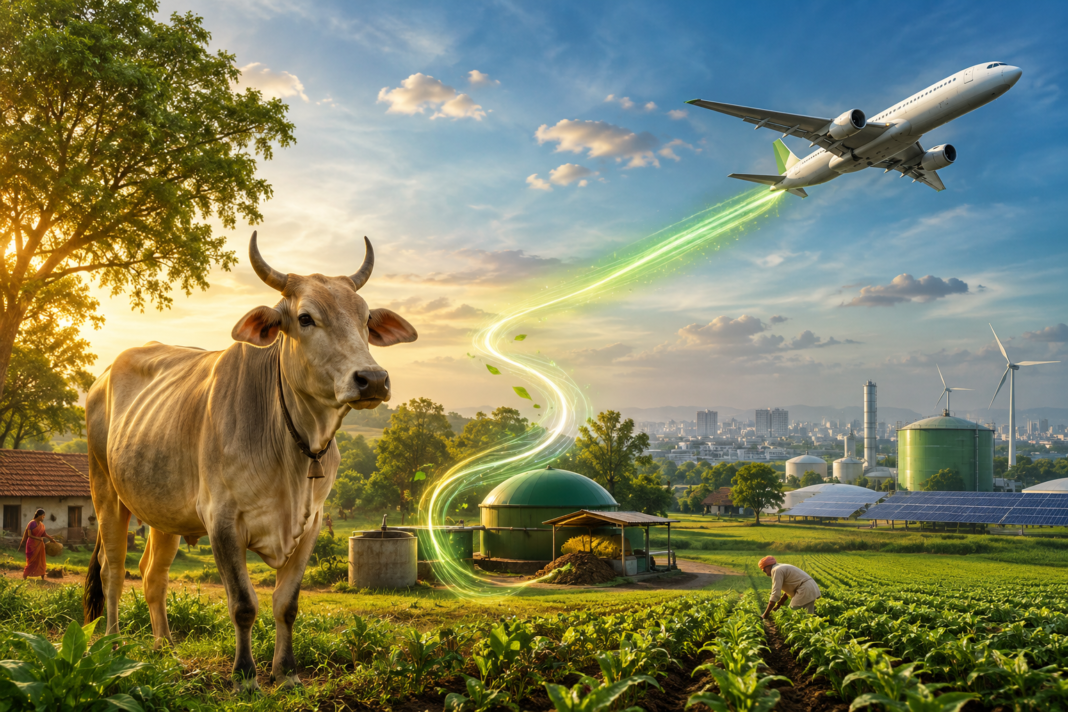
Scientists and entrepreneurs announced the successful conversion of biogas generated from cow manure into Sustainable Aviation Fuel (SAF), opening a pathway for one of the world’s most energy-intensive industries to reduce its carbon footprint.
I found myself reflecting on the extraordinary journey of a resource that many people still regard as little more than waste.
Only weeks earlier, it had been helping restore desert soils.
Now it was being discussed as a fuel capable of powering aircraft.
The symbolism was impossible to ignore.
The same cow that nourishes a family through milk could also contribute to food security, renewable energy, environmental sustainability and perhaps even the future of aviation.
Perhaps the world is not discovering something new. Perhaps it is rediscovering something very old.
The Wisdom We Forgot
For centuries, Bharat’s villages practised what the modern world now calls a circular economy.
Milk nourished families. Cow dung enriched the soil. Dung cakes provided fuel. Biogas generated energy. Agricultural waste was recycled.
Nothing was wasted. Every output became an input for something else. There were no sustainability conferences. No climate summits. No ESG frameworks.
Yet communities survived because they instinctively understood a simple principle: nature works in cycles, not straight lines.
Modern civilisation, however, became increasingly linear.
We extracted resources. We consumed them. We discarded them.
The result has been rising waste, environmental degradation, declining soil health and growing concerns about sustainability.
Ironically, the very world that once dismissed traditional practices is now investing billions of dollars to rediscover them under new names and technologies.
Regenerative agriculture. Circular economies. Carbon sequestration. Renewable biofuels. Methane capture.
The terminology may be new. The underlying principles are not.
A Lesson from a Busy Indian Road
When discussing the cow, conversations often become trapped between economics and emotion. Yet there is another dimension that deserves attention.
The cow represents a civilisational idea.
I was reminded of this while writing the second chapter of my book A Fauji in Foreign Affairs.
One day we observed a cow sitting peacefully in the middle of a busy road. Traffic moved around her. Cars slowed. Motorcyclists adjusted. Pedestrians walked past.
No one appeared angry. No one tried to force her away. No one considered her an enemy.
Life simply adapted.
For many foreign diplomats and visitors whom I interacted with during my years in diplomacy, such scenes were both fascinating and perplexing.
How could an animal sit in the middle of a road without creating conflict?
The answer was deeper than traffic management.
The cow was not exercising authority. Society was not surrendering its rights. Instead, everyone made a small adjustment.
A little accommodation. A little patience. A little respect for another living being sharing the same space.
That simple image has stayed with me ever since.
Because it symbolises something humanity desperately needs today.
Coexistence. Not dominance. Not exclusion. Not conquest.

Coexistence.
The ability to share space, resources and opportunities without conflict. The ability to recognise that human beings are not the sole stakeholders on this planet. The ability to balance progress with compassion.
In many ways, that cow sitting quietly in the middle of a busy road represented a civilisational lesson far larger than herself.
Why Sustainability Matters to Peace
When we discuss peace, we often think of diplomacy, treaties and conflict resolution. These are undoubtedly important. But peace is built upon deeper foundations.
Food security contributes to peace. Energy security contributes to peace. Environmental stability contributes to peace. Economic resilience contributes to peace.
History repeatedly demonstrates that scarcity breeds instability.
Food shortages create unrest. Resource competition fuels tensions. Energy dependence creates vulnerability. Environmental degradation generates displacement and conflict.
Conversely, societies that build sustainable systems are often more resilient, more prosperous and more stable.
Viewed through this lens, the stories from the UAE and California become far more significant.
The first demonstrates how cow-based resources can contribute to food security. The second demonstrates how they can contribute to energy security.
Together they reveal a broader truth.
The cow is not merely an agricultural asset.
She is part of an ecological system capable of generating multiple layers of value.
The Vision of the Gauvansh Akhara
This is why the vision articulated by the Gauvansh Akhara deserves serious consideration. The campaign to recognise Gaumata as the Ambassador of World Peace is often misunderstood as purely cultural or religious. In reality, its implications are much broader.
The cow symbolises compassion. The cow symbolises sustainability. The cow symbolises coexistence. The cow symbolises a development model that seeks harmony rather than exploitation.
A society that respects ecological balance is more likely to enjoy food security. A society that develops renewable energy resources is more likely to enjoy energy security. A society that values coexistence is more likely to enjoy social harmony.
And a world built on sustainability, resilience and compassion is more likely to enjoy peace.
This is not merely a spiritual proposition. It is a practical one.
The examples are already visible around us. In the villages of Bharat. In the deserts of the UAE. And now, in the laboratories of California.
From Desert Sands to Jet Fuel
The journey of Indian cow dung to the UAE demonstrated its ability to support agriculture.
The conversion of cow-manure biogas into sustainable aviation fuel demonstrates its potential to support clean energy.
Who knows what the next chapter will reveal?
Perhaps new bio-materials. Perhaps new medicines. Perhaps new climate solutions.
History has often shown that the most transformative discoveries emerge when humanity learns to look differently at familiar things.
The cow has stood quietly beside civilisation for thousands of years.
She has nourished families. Supported farmers. Sustained rural economies. Enriched the earth.
And now she may help power aircraft.
That is an extraordinary journey.
But perhaps the most extraordinary aspect is not what the cow is becoming. It is what humanity is finally beginning to understand.
The future may not belong solely to new inventions. It may also belong to the rediscovery of old wisdom.
As the world searches for solutions to climate change, food insecurity, resource scarcity and conflict, it may find that some of the answers have been standing quietly in Bharat’s villages all along.
The journey from Bharat’s villages to the UAE’s desert sands was one chapter.
The journey from cattle sheds to aviation fuel is another.
Together they tell a story of sustainability, resilience and coexistence.
And perhaps, ultimately, a story of peace. For peace is not merely the absence of war.
Peace is the presence of harmony, between nations, between communities, and between humanity and nature itself.
The story of the cow’s journey from Bharat’s villages to the deserts of the UAE and now, potentially, to the skies above us, is far from complete. It is merely one chapter in a larger narrative about sustainability, resilience and the enduring relevance of civilisational wisdom. In future articles, I hope to continue exploring similar intersections of tradition and modernity, geopolitics and ecology, local realities and global challenges. For often, the most important lessons about our future are hidden in stories that have been quietly unfolding around us all along.