
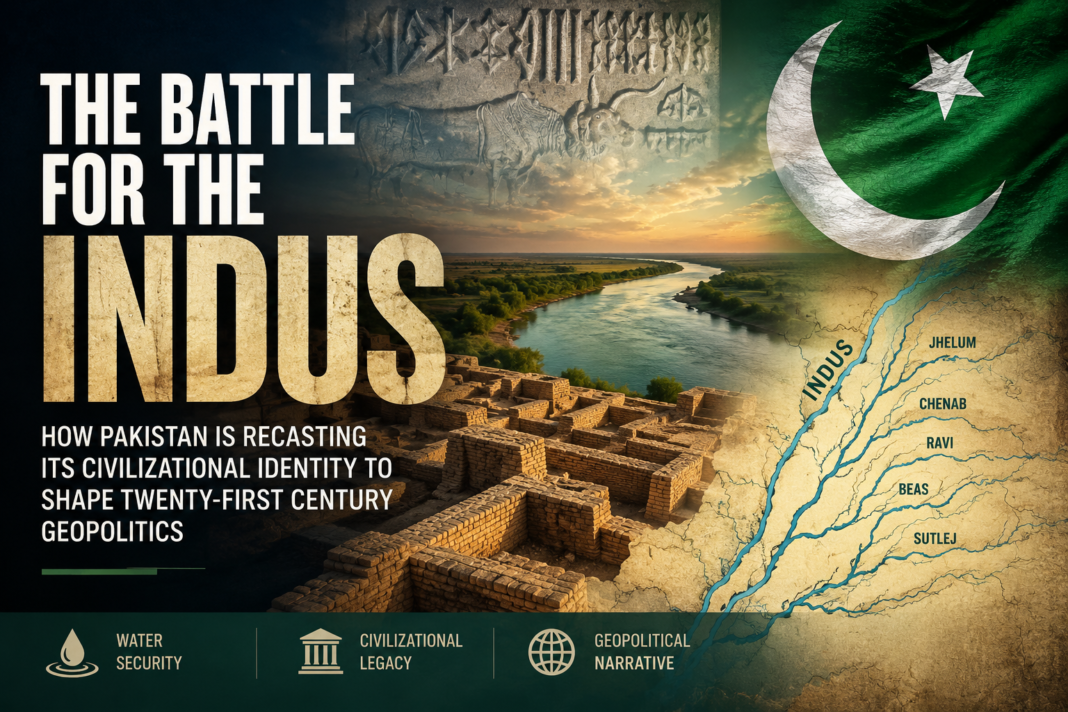

Key Takeaways
- Pakistan is recasting its civilizational identity to shape 21st-century geopolitics.
- The Indus Valley Civilization is being invoked as a foundational element of Pakistan’s historical identity.
- Every nation seeks a history older than its statehood, and ancient civilizations provide legitimacy, prestige, and continuity that modern political events often cannot.
A Statement That Changed the Debate
When Pakistan’s Information Minister Attaullah Tarar recently described Pakistanis as the “children of the Indus Valley” while asserting the country’s rights over the Indus River system, many dismissed it as yet another political statement made in the midst of a diplomatic dispute.
That would be an incomplete reading.
Governments rarely invoke ancient civilizations accidentally during contemporary international disputes. The timing, context and language of Tarar’s remarks suggest something far more significant than rhetorical flourish. They indicate the emergence of a broader narrative in which Pakistan seeks to connect its modern political identity with one of humanity’s oldest civilizations.
The obvious question is: Why invoke a civilization that flourished nearly five thousand years ago during a debate over a treaty signed in 1960?
The answer lies not merely in water politics but in the changing nature of geopolitics itself.
Increasingly, nations are discovering that history can be as powerful a strategic resource as military strength or economic influence. Civilizations confer legitimacy. Heritage shapes perception. Narratives influence diplomacy. In an age where information warfare and strategic communications have become central to statecraft, historical memory itself has emerged as a domain of geopolitical competition.
The Indus debate has therefore entered a new phase.
It is no longer only about rivers.
It is about memory.
The Reinvention of Pakistan’s Historical Narrative
Since its creation in 1947, Pakistan’s official national identity has largely been shaped by the Two-Nation Theory and its Islamic heritage. State narratives celebrated the arrival of Muhammad bin Qasim in Sindh, the Delhi Sultanate, the Mughal Empire and the country’s cultural and religious links with Persia, Central Asia and the broader Islamic world.
Ancient sites such as Harappa, Mohenjo-daro, Taxila and Gandhara were acknowledged as important archaeological treasures, but they occupied a relatively limited place in Pakistan’s nation-building narrative. They were celebrated as remnants of an ancient past rather than as the foundation of Pakistan’s modern identity.
That balance now appears to be changing.
Recent political discourse increasingly references the Indus Valley Civilization as a foundational element of Pakistan’s historical identity. Senior leaders, including Attaullah Tarar, Bilawal Bhutto Zardari, Shehbaz Sharif, Asim Munir and Khawaja Asif, have all, in varying contexts, emphasized the centrality of the Indus to Pakistan’s identity, security or historical continuity. While the wording and emphasis differ from one leader to another, the cumulative pattern is difficult to ignore.
This represents more than a change in rhetoric. It reflects an effort to deepen Pakistan’s historical timeline.
Rather than allowing the country’s story to begin in the eighth century with the arrival of Islam or in 1947 with Partition, Pakistan is increasingly looking five millennia into the past, projecting itself as the modern inheritor of one of humanity’s earliest urban civilizations.
Such a shift has significant strategic implications.
Every nation seeks a history older than its statehood. Ancient civilizations provide legitimacy, prestige and continuity that modern political events often cannot. By embracing the Indus Valley Civilization more prominently, Pakistan is attempting to enrich its national narrative with a civilizational depth that resonates far beyond South Asia.
Why Now?
Timing often provides the clearest clue to strategic intent.
Pakistan’s renewed emphasis on the Indus Valley Civilization coincides with an increasingly complex strategic environment. The country faces mounting water stress, the long-term impact of climate change, shrinking glaciers in the Himalayas and Karakoram, rapid population growth, economic fragility and growing concerns over future water availability. At the same time, the Indus Waters Treaty, long regarded as one of the world’s most durable water-sharing agreements, has entered an unprecedented period of uncertainty following renewed tensions between Bharat and Pakistan.
Against this backdrop, history has acquired renewed strategic value.
For decades, Pakistan’s diplomatic arguments centred on the legal framework of the Indus Waters Treaty. The principal emphasis was on treaty obligations, riparian rights and international law. While those legal arguments remain central, a complementary narrative now appears to be emerging, one that situates Pakistan’s relationship with the Indus not merely within the framework of a treaty signed in 1960, but within a civilizational continuum stretching back thousands of years.
This transition is strategically significant.
A legal argument speaks to governments, courts and negotiators.
A civilizational argument speaks to public opinion, academia, international media and the broader global imagination.
By invoking the Indus Valley Civilization, Pakistan appears to be broadening the vocabulary through which the water dispute is understood. The river is presented not only as an economic lifeline or a strategic resource but also as the cradle of a civilization with which modern Pakistan identifies.
Whether this reflects a consciously coordinated state strategy or the gradual evolution of political messaging is open to interpretation. What is evident is that references to the Indus, historical continuity and civilizational identity have become more frequent in Pakistan’s public discourse at precisely the moment when water security has assumed greater geopolitical importance.
There is another dimension to this shift.
Pakistan is a relatively young state confronting multiple internal and external challenges. Like many modern nations, it seeks a historical narrative that predates its political birth. By drawing upon the Indus Valley Civilization, Islamabad is able to project a civilizational identity extending nearly five millennia into the past, thereby enriching its national story beyond the framework of Partition and the Two-Nation Theory.
Pakistan’s evolving narrative should therefore be viewed not simply as a response to a bilateral water dispute but as part of a broader attempt to reposition its national identity in a changing geopolitical landscape.
The debate over the Indus is gradually moving beyond engineering, hydrology and treaty provisions. It is becoming a contest over historical legitimacy, civilizational inheritance and the power of narrative.
That transformation may prove as consequential as the dispute over water itself.
In doing so, Pakistan is not merely arguing for water rights. It is seeking historical depth, cultural continuity and greater diplomatic resonance.
Civilizations Have Become Geopolitical Instruments
Pakistan’s evolving narrative should not be viewed in isolation. Across the world, states increasingly invoke history and civilization to reinforce their geopolitical objectives.
China frequently speaks of a five-thousand-year-old civilization as part of its vision of national rejuvenation. Historical continuity forms an important component of its diplomatic messaging and domestic legitimacy.
Türkiye has revived references to the Ottoman Empire and its wider historical legacy to project influence across West Asia, the Balkans and Central Asia. Ottoman symbolism has become an important element of Turkish strategic communication.
Russia often invokes the historical legacy of medieval Rus, imperial Russia and the Soviet victory in the Second World War to reinforce its strategic worldview and foreign policy narratives.
Egypt derives considerable cultural influence from the legacy of the Pharaohs, while Greece continues to leverage the prestige of Classical civilization as a source of international soft power.
Bharat, too, increasingly presents itself as one of the world’s oldest continuous civilizations, drawing upon its philosophical traditions, archaeological heritage and cultural continuity in its engagement with the world.
These examples illustrate an important reality.
In the twenty-first century, history has become an instrument of diplomacy.
Archaeology has become a component of soft power.
Civilizations have become strategic assets.
The objective is not simply to celebrate the past but to strengthen the legitimacy of contemporary political narratives.
Viewed through this lens, Pakistan’s emphasis on the Indus Valley Civilization appears consistent with a broader international trend in which historical memory is increasingly employed to advance national interests.
Information Warfare and the Battle of Narratives
Modern geopolitical competition extends far beyond military deployments and economic sanctions.
States now compete in the information domain, where perceptions often shape policy as much as facts.
Governments invest heavily in strategic communication because they recognise that narratives influence international opinion, media discourse, academic scholarship and eventually diplomatic outcomes.
Historical memory has therefore become an important arena of information warfare.
Narratives are reinforced through political speeches, documentaries, museums, school curricula, academic conferences, tourism campaigns, social media and digital diplomacy. Over time, repeated messaging can shape how domestic and international audiences understand history.
The Indus debate illustrates this phenomenon.
For decades, discussions surrounding the Indus Waters Treaty focused primarily on engineering, hydrology and legal interpretation.
Today, they increasingly include questions of civilizational identity, historical continuity and cultural inheritance.
This does not alter the legal framework of the treaty, but it changes the context in which that framework is discussed.
Strategic communication is rarely about replacing legal arguments. It is about supplementing them with narratives that resonate more deeply with broader audiences.
By presenting the Indus as the cradle of Pakistan’s civilizational identity, political leaders seek to create an emotional and historical context that extends beyond the technical provisions of an international agreement.
Whether such narratives ultimately influence international diplomacy depends upon their credibility, consistency and acceptance by global audiences. Nevertheless, they demonstrate how modern geopolitical competition increasingly extends into the domains of culture, history and identity.
The Challenge Before Bharat
For Bharat, the emergence of this narrative presents both a challenge and an opportunity.
The challenge lies not in responding to political rhetoric but in recognising that history itself has become an important domain of strategic competition.
The opportunity lies in the extraordinary depth of Bharat’s own archaeological and civilizational record.
The Indus or Harappan Civilization extended across a vast geographical region encompassing present-day Pakistan as well as large parts of northwestern Bharat. While globally recognised sites such as Mohenjo-daro and Harappa are located in Pakistan today, Bharat is home to hundreds of Harappan settlements, including major urban centres such as Dholavira, Rakhigarhi, Lothal and Kalibangan. Archaeological surveys indicate that a majority of the known Harappan sites are located within present-day Bharat.
This underscores an important scholarly point: the Indus Valley Civilization belongs to a civilizational landscape that long predates modern political boundaries. It cannot be understood exclusively through the lens of contemporary nation-states.
Bharat’s response, therefore, should be grounded in scholarship rather than slogans.
Greater investment in archaeological research, museum development, heritage conservation, digital archives, international exhibitions and academic collaborations would strengthen the global understanding of the civilization’s shared and expansive character.
Universities, research institutions, filmmakers and cultural organisations have an equally important role to play. Historical credibility is established through evidence, excavation, peer-reviewed scholarship and sustained engagement with the international academic community.
The debate over the Indus is no longer confined to river waters.
It has become a contest over civilizational space.

It is no longer only about who controls the flow of a river.
It is increasingly about who shapes the story of that river—and, by extension, the civilization that grew along its banks.
In the emerging geopolitical landscape, those who shape historical narratives often influence diplomatic narratives as well.
The Future of the Indus Debate
The debate over the Indus River system is unlikely to diminish in the coming decades. If anything, it will become more complex.
Climate change is altering Himalayan glacial systems. Population growth is increasing demand for freshwater across South Asia. Rapid urbanisation, changing agricultural practices and growing energy requirements are placing unprecedented pressure on the river basin. These challenges would have existed even in the absence of political tensions.
Against this backdrop, the Indus Waters Treaty will continue to attract intense scrutiny from policymakers, engineers, environmental scientists and legal experts.
Increasingly, however, historians, archaeologists, communication specialists and strategic thinkers will also become part of the conversation.
The Indus is no longer merely a river system.
It has become a symbol.
It represents history, identity, sovereignty, development and national resilience simultaneously.
Future diplomacy surrounding the Indus is therefore likely to be conducted on multiple levels. Legal arguments will remain essential. Scientific assessments of river flows, climate change and water management will continue to shape policy. Yet alongside these technical discussions, competing historical narratives will increasingly seek to influence international opinion.
This represents a broader transformation in international relations.
The twenty-first century is witnessing the convergence of hard power, soft power and what might be termed historical power—the ability of states to derive legitimacy and influence from carefully constructed narratives about their civilizational past.
The countries that understand this transformation are investing heavily in cultural diplomacy, archaeological research, museum development, heritage conservation and international academic engagement.
History is no longer viewed simply as a record of the past.
It has become an investment in the future.
The Real Battle Is Over Narrative
Attaullah Tarar’s statement should therefore not be viewed merely as another political remark in an ongoing diplomatic dispute.
It is better understood as one element of a larger evolution in Pakistan’s strategic communication.
Whether deliberately coordinated or gradually developed, the emerging discourse seeks to present Pakistan not merely as a state created in 1947 but as the contemporary custodian of a civilization that flourished thousands of years before the emergence of modern nation-states.
This represents an important shift.
For decades, Pakistan’s principal diplomatic argument concerning the Indus rested upon international law and treaty obligations.
Today, that legal framework is increasingly accompanied by an appeal to history, heritage and civilizational continuity.
This does not alter the legal provisions of the Indus Waters Treaty.
Nor does it settle historical debates regarding the ownership of an ancient civilization that extended across much of the northwestern Indian subcontinent.
What it does change is the nature of the conversation.
The debate moves beyond water allocation.
It enters the realm of identity.
And once identity becomes part of geopolitics, narratives assume strategic importance.
For Bharat, the appropriate response is neither rhetorical confrontation nor historical one-upmanship.
It is intellectual leadership.
The archaeological record of the Indus or Harappan Civilization is vast. Continued investment in excavation, conservation, research, digitisation, museum development and international collaboration will naturally strengthen global understanding of the civilization’s true geographical extent and historical complexity.
Credibility is earned through scholarship.
Influence is built through knowledge.
Civilizational confidence grows from evidence rather than assertion.
Ultimately, the Indus Valley Civilization belongs to an era that predates the political frontiers of modern South Asia by several millennia. It cannot be neatly confined within contemporary borders or reduced to the exclusive inheritance of any single nation-state. Its legacy is shared, layered and far more complex than present-day political narratives may suggest.
Yet complexity rarely dominates public discourse.
Narratives do.
That is why the struggle over the Indus should not be viewed solely through the prism of hydrology, treaties or territorial politics.
It is equally a contest over memory.
Over legitimacy.
Over historical continuity.
Over the stories that nations tell about themselves—and persuade the world to believe.
Rivers define geography.
Civilizations shape identity.
Narratives influence diplomacy.
And in the twenty-first century, the ability to shape those narratives has itself become an instrument of national power.
The battle for the Indus, therefore, is not merely about the flow of water.
It is about the flow of history.
Conclusion – The Battle Beyond the River
Attaullah Tarar’s statement should not be viewed merely as another political remark made during a diplomatic dispute. Nor should it be dismissed as an isolated expression of nationalism.
It is more appropriately understood as part of a broader evolution in Pakistan’s strategic communication—one that seeks to place contemporary political issues within a much deeper civilizational framework. By invoking the Indus Valley Civilization, Pakistan is attempting to complement its legal and diplomatic arguments with an appeal to history, heritage and identity.
Whether this represents a consciously coordinated state strategy or the natural evolution of political discourse is ultimately for historians and policymakers to determine. What is beyond dispute, however, is that references to the Indus as the cradle of Pakistan’s identity have become increasingly visible in recent years. That evolution deserves careful attention because it reflects a wider transformation in global geopolitics.
Across the world, states are rediscovering history as an instrument of power. Ancient civilizations are no longer confined to museums, archaeological excavations or academic journals. They are becoming part of diplomatic language, strategic communication and national branding. The past is increasingly being employed to shape the future.
The Indus Valley Civilization occupies a unique place in this discourse. It flourished thousands of years before the emergence of modern political boundaries and stretched across a vast region of the northwestern Indian subcontinent. It cannot be reduced to the exclusive inheritance of any contemporary nation-state. Its legacy is shared, layered and deeply interconnected.
For Bharat, the challenge is not to engage in a contest of slogans but to lead through scholarship. The country’s archaeological wealth, civilizational continuity and growing body of historical research provide a strong foundation for presenting an evidence-based understanding of the Indus Civilization. Investment in archaeology, museums, conservation, academic research, digital archives and cultural diplomacy will do far more to shape international opinion than rhetorical exchanges.
The lesson extends far beyond South Asia.
The twenty-first century will not be defined solely by military capability, economic strength or technological superiority. It will also be shaped by the ability of nations to articulate credible historical narratives that reinforce their legitimacy and influence.
Missiles may deter.
Economies may prosper.
Diplomacy may negotiate.
But civilizations inspire.
And the stories nations tell about their civilizations increasingly shape how the world understands them.
The debate over the Indus is therefore no longer merely about water.
It is about identity.
It is about legitimacy.
It is about the strategic value of history itself.
Rivers define geography.
Civilizations define continuity.
Narratives define influence.
And in an age where perception often precedes policy, the battle for the Indus is ultimately a battle for the power to define the past, and, in doing so, shape the future.