

For decades, Pakistan’s military identity was defined by its relationship with the United States. The iconic image of the Pakistani military was that of American-made F-16 fighter jets, US-trained officers, Western military doctrine, and billions of dollars in American military assistance flowing into Rawalpindi’s General Headquarters.
That Pakistan no longer exists.
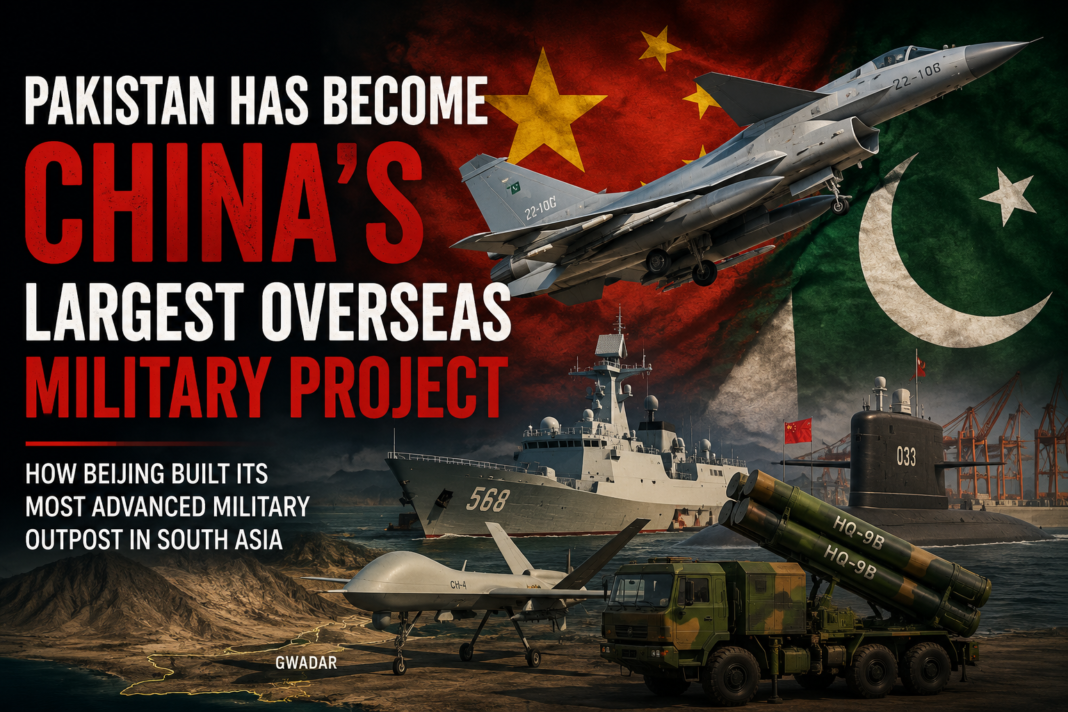
A silent but profound geopolitical transformation has occurred over the past two decades. Today, Pakistan’s military establishment is no longer primarily an American-influenced institution with Chinese equipment on the sidelines. It has evolved into something far more consequential: the world’s largest overseas extension of China’s military-industrial complex.
The latest data released by the Stockholm International Peace Research Institute (SIPRI) confirms what strategic analysts have long suspected. Between 2021 and 2025, China supplied approximately 80 percent of Pakistan’s imported military equipment, up from 73 percent during the previous five-year period. Even more significantly, Pakistan’s arms imports increased by 66 percent over the same period, making Pakistan the world’s fifth-largest arms importer. Perhaps the most striking statistic of all is this: 61 percent of China’s total global arms exports now go to a single country – Pakistan.
This is not a normal defence relationship.
This is strategic military integration on a scale rarely witnessed outside formal military alliances.
From Client State To Military Ecosystem
Traditional arms relationships are transactional. One country buys weapons from another because they are cheaper, available, or politically convenient.
Pakistan’s relationship with China has moved far beyond transactions.
Today, Pakistan’s military ecosystem increasingly functions within a Chinese strategic architecture. Its fighter aircraft, missile systems, naval platforms, drones, radar systems, electronic warfare infrastructure, satellite support architecture, and increasingly its command-and-control systems are all becoming Chinese.
China is not merely supplying weapons to Pakistan.
China is building Pakistan’s future military.
The Pakistani Air Force illustrates this transformation most clearly.
For decades, the pride of Pakistan’s air power was the American F-16. Today, the centrepiece of Pakistan’s air strategy is the Chinese-origin JF-17 Thunder, jointly produced by Pakistan Aeronautical Complex and China’s Chengdu Aircraft Corporation. More than 150 JF-17 aircraft are believed to be operational, spread across multiple variants with progressively sophisticated capabilities.
Pakistan has simultaneously inducted the Chinese J-10CE multirole fighter aircraft, equipped with advanced active electronically scanned array (AESA) radar systems and PL-15 beyond-visual-range air-to-air missiles. The significance of this cannot be overstated.
Beijing is now willing to export some of its most advanced military technologies to Pakistan.
This is precisely why recent India-Pakistan military confrontations attracted extraordinary attention from military analysts worldwide. For the first time, Chinese aircraft, Chinese missiles, Chinese radar systems, Chinese electronic warfare capabilities, and Chinese battlefield doctrines were potentially being tested in actual combat conditions against sophisticated Western-origin military platforms.
Pakistan, in effect, has become China’s forward battlefield laboratory.
China’s Floating Aircraft Carrier In The Indian Ocean
The transformation extends well beyond air power.
Pakistan’s naval modernisation programme has become almost entirely dependent on Beijing.
China has supplied Pakistan with four Type-054A/P guided missile frigates, among the most capable warships ever inducted into the Pakistan Navy. Beijing is also constructing eight Hangor-class submarines for Pakistan, derived from China’s Yuan-class submarine design. Once operational, these submarines will form the backbone of Pakistan’s underwater deterrence capability for decades to come.
This military integration perfectly complements China’s broader strategic ambitions in the Indian Ocean.
The China-Pakistan Economic Corridor (CPEC), with investments exceeding US$62 billion, was never merely an infrastructure project. It was always a geopolitical project designed to provide China with strategic depth and access to the Arabian Sea.
Gwadar Port, located barely 400 kilometres from the Strait of Hormuz through which nearly one-fifth of global oil trade passes, represents one of China’s most important geopolitical assets outside East Asia.
A Chinese-equipped Pakistani military effectively provides Beijing with strategic insurance for its economic investments and maritime ambitions.
In practical terms, Pakistan increasingly serves as China’s unofficial western military command in South Asia.
The Drone Revolution And China’s Shadow War Doctrine
Perhaps the least understood aspect of Sino-Pakistani military integration is the growing role of unmanned systems.
Pakistan has rapidly inducted Chinese-origin armed drones, reconnaissance drones, loitering munitions, and integrated surveillance systems. Chinese drone technology has transformed the economics of modern warfare by providing relatively inexpensive capabilities for surveillance, precision strikes, and asymmetric operations.
This matters enormously because the future battlefield will not be dominated solely by fighter aircraft and tanks.
It will be dominated by artificial intelligence, autonomous systems, swarming drones, electronic warfare, cyber warfare, and network-centric military operations.
China understands this.
Pakistan increasingly operates within this emerging Chinese military doctrine.
What we are witnessing is not merely the transfer of weapons but the transfer of a complete philosophy of warfare.

Why China Needs Pakistan
Many analysts ask why China invests so heavily in Pakistan despite Pakistan’s recurring economic crises and political instability.
The answer is simple.
Pakistan is indispensable to China’s rise as a global military power.
First, Pakistan serves as China’s largest export market for defence equipment. While China supplied military equipment to 47 countries during 2021-2025, Pakistan alone accounted for 61 percent of all Chinese arms exports.
Second, Pakistan acts as China’s primary demonstration platform. Every Pakistani military deployment effectively advertises Chinese military technology to potential buyers across Asia, Africa, and the Middle East.
Third, Pakistan provides strategic pressure against India without requiring China to directly engage India militarily.
For Beijing, maintaining military pressure on India through Pakistan represents a remarkably cost-effective strategic investment.
Fourth, Pakistan provides China with critical geopolitical access to the Arabian Sea and the Indian Ocean.
In geopolitical terms, Pakistan is to China what Eastern Europe was to the Soviet Union: a strategically essential buffer and projection zone.
The Decline Of American Influence
Ironically, Pakistan still operates some of the most advanced American military platforms, particularly the F-16 fleet.
The United States continues to provide limited sustainment support and selective military assistance to Pakistan. Yet Washington’s influence over Pakistan’s military establishment has dramatically diminished.
During the Cold War and the post-9/11 era, the United States viewed Pakistan as a strategic necessity.
Today, Washington increasingly views Pakistan as a strategic liability.
China, however, views Pakistan as a strategic asset.
This divergence has created one of the most significant geopolitical realignments of the 21st century.
The centre of gravity of Pakistan’s military establishment has shifted permanently eastward.
Why India Must Pay Attention
For India, the implications are profound.
The challenge facing New Delhi is no longer simply Pakistan’s military modernisation.
The challenge is that Pakistan increasingly represents an operational extension of China’s military-industrial ecosystem.
Future conflicts involving Pakistan may simultaneously serve multiple Chinese objectives:
- Testing Chinese weapons systems in combat;
- Evaluating Chinese battlefield doctrines;
- Assessing Chinese missile technologies;
- Measuring electronic warfare performance;
- Validating integrated command-and-control systems;
- Studying the effectiveness of Chinese military-industrial design philosophies.
In other words, every future India-Pakistan conflict carries the risk of becoming a proxy evaluation exercise for China’s military modernisation programme.
This reality demands a fundamental shift in India’s strategic thinking.
India’s response cannot merely be increased military spending. It must involve accelerated indigenous defence manufacturing, artificial intelligence integration, cyber warfare capabilities, space-based military infrastructure, drone technologies, electronic warfare systems, and strategic industrial self-reliance.
The Atmanirbhar Bharat defence programme is no longer merely an economic initiative.
It is a strategic necessity.
The New Strategic Reality
For decades, policymakers described the China-Pakistan relationship as an ‘all-weather friendship’.
That phrase now understates the reality.
Pakistan is no longer merely China’s closest ally.
Pakistan has become China’s largest overseas military-industrial project, its most important strategic laboratory, its principal defence export market, and perhaps its most consequential geopolitical investment.
The real strategic challenge facing India is therefore not a two-front war scenario involving China and Pakistan.
The real challenge is understanding that the China-Pakistan military relationship has evolved to a point where, in strategic terms, those two fronts may increasingly function as one.