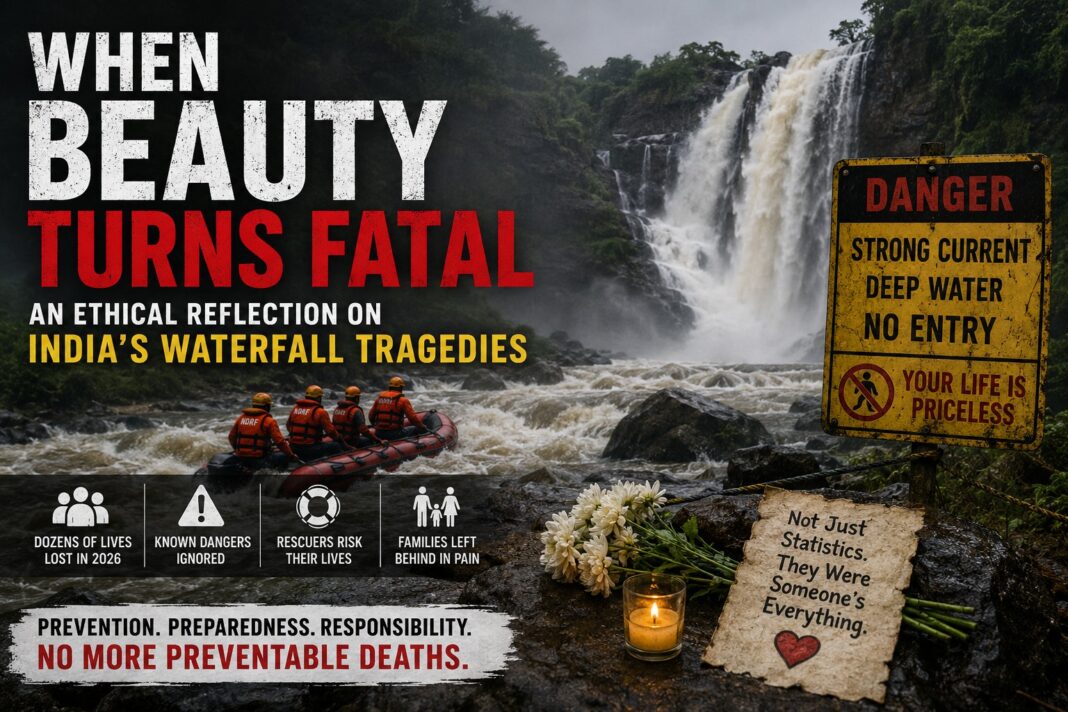

India’s waterfalls are among its greatest natural treasures. Every monsoon, they transform into spectacular destinations that attract thousands of visitors seeking adventure, photography, and moments of peace amidst nature. Yet, hidden beneath their beauty lies a disturbing reality. Throughout the first half of 2026, waterfalls across India repeatedly became sites of tragedy. Young lives were lost in preventable circumstances, rescue teams risked their own safety, and grieving families waited for days as divers searched swollen rivers for the bodies of their loved ones. These were not isolated accidents. They formed a pattern. As a society, we must ask a difficult ethical question: How many more deaths must occur before we begin treating human life as more precious than entertainment, tourism, or social media validation?
A Year Marked by Tragedy
In March 2026, a 22-year-old tourist from Chandigarh drowned at Bamaniyakund Waterfall near Mhow in Madhya Pradesh. He accidentally entered deeper waters while enjoying the waterfall with friends. What made this tragedy especially disturbing was that Bamaniyakund had already witnessed several fatalities in previous years. Authorities had earlier attempted to regulate visitor access because of its dangerous currents. Yet another young life was lost in almost identical circumstances.
Only weeks later, on 10 April 2026, three teenage girls lost their lives at Mullugummi Waterfall in Andhra Pradesh. The girls, aged between fifteen and seventeen, had travelled with friends to enjoy the scenic location. They reportedly slipped into deep water while taking photographs. One companion desperately attempted to rescue them but survived with injuries. The incident unfolded within minutes, leaving three families devastated and an entire community in mourning.
Around the same period, Tilari Falls in Karnataka claimed another victim. A young dental student drowned while visiting the waterfall. Environmental activists later criticized the authorities, pointing out the absence of adequate railings, warning systems, rescue equipment, trained personnel, and communication facilities. Their criticism was significant because it shifted the conversation from personal carelessness to governmental responsibility. When authorities know that a location is hazardous and continue to allow unrestricted tourism without sufficient safeguards, ethical responsibility cannot be ignored.
In Tamil Nadu, tragedy struck at Thalaiyuthu Falls near Oddanchatram. Three young men entered an area where public access had already been prohibited because of dangerous water conditions. They drowned despite rescue attempts, and another companion initially remained missing before search operations concluded. The prohibition existed for a reason, yet enforcement proved insufficient to prevent the loss of life.
Goa witnessed another heartbreaking incident near Dudhsagar Falls, one of India’s most visited waterfalls. Four young people, including three members of the same family, drowned while enjoying a picnic near the river connected to the waterfall. Only one member of the group survived. What should have been a day of family togetherness became an occasion of unimaginable grief.
The monsoon months brought further sorrow to Maharashtra. During the first week of July 2026, Shannon Gaspar Kini, a nineteen-year-old college student from Santacruz, travelled with friends to Pandavkada Waterfall in Kharghar, Navi Mumbai. Despite prohibitory orders restricting entry because of dangerous monsoon conditions, visitors continued entering the area. Shannon was swept away by the powerful current. The search operation continued for days. Rescuers first discovered a severed human leg downstream before eventually recovering Shannon’s body almost two kilometres away from the place where he had disappeared. The violent force of the floodwaters had carried his body over rocks and through the swollen river, illustrating the terrifying power hidden beneath what many visitors perceive as a picturesque waterfall. Even before Shannon’s recovery, another young man disappeared at the same waterfall. Mohammed Mobashir Mohammed Shahid, a twenty-year-old garage worker from Taloja, was swept away while visiting the prohibited area with friends. Rescue teams searched continuously despite difficult weather conditions. His body was recovered only after four days. For four days, his family waited in agonising uncertainty, hoping against hope that he might somehow be found alive. Instead, they received only his lifeless body.

These were not the only incidents. Across Maharashtra, reports during May and June recorded dozens of drowning deaths in rivers, reservoirs, canals, and waterfalls, particularly among young people during the summer and the onset of the monsoon. The recurring pattern demonstrates that these are not isolated misfortunes but part of a much larger public safety crisis.
Beyond Accidents: An Ethical Failure
Many observers immediately blame the victims. “They ignored warning signs.” “They entered prohibited areas.” “They were taking selfies.” These observations are often true. Yet they are not the whole truth. Ethics demands that responsibility be examined at multiple levels. Individuals certainly have a moral duty to exercise prudence. Recklessness is never a virtue. No photograph, Instagram reel, or social media recognition is worth risking one’s life. The pursuit of digital fame has encouraged many young people to approach dangerous landscapes not with humility but with misplaced confidence.
However, governments also possess a profound moral obligation. If a waterfall has claimed lives repeatedly over several years, why does unrestricted access continue? Why are barriers so easily bypassed? Why are trained lifeguards absent from many popular destinations? Why are emergency rescue boats, throw ropes, first aid stations, and surveillance systems unavailable at sites that attract thousands of tourists every weekend? An administration cannot simply erect a warning board and consider its responsibility complete. The ethical principle of the Right to Life under Article 21 of the Constitution of India requires the State not merely to react after tragedy but to anticipate foreseeable dangers. Every known accident site should become a priority for preventive action.
The Cost Paid by Families
Every drowning leaves behind more than a statistic. Parents identify bodies in mortuaries. Friends relive their final conversations. Siblings grow up with empty chairs at family gatherings. In Shannon Kini’s case, his parents waited days while search teams combed swollen waters. Mohammed Mobashir Shahid’s family endured four days of unbearable uncertainty. The parents of the three Mullugummi girls had expected their daughters to return home before evening. Instead, they received news that no parent should ever hear.
The ethical burden therefore extends beyond the victim. Rescue personnel repeatedly risk their own lives entering dangerous waters. Police officers, fire brigade personnel, National Disaster Response Force teams, local fishermen, and volunteers often work in hazardous conditions simply because someone ignored a warning sign or crossed a barrier. One reckless decision can place dozens of rescuers in danger.
A National Call to Action
India does not lack beautiful waterfalls. It lacks a consistent culture of safety. Every major waterfall should have scientifically determined danger zones, physical barriers that cannot easily be crossed, multilingual warning systems, trained rescue personnel during tourist seasons, surveillance cameras, emergency communication facilities, visitor education programmes, and strict enforcement of seasonal closures. Social media influencers should stop glorifying dangerous stunts. Tourism departments should promote responsible tourism instead of merely increasing visitor numbers. Above all, society must stop accepting these tragedies as inevitable. The stories of Shannon Kini, Mohammed Mobashir Shahid, the three girls of Mullugummi, the young dental student at Tilari, the tourist at Bamaniyakund, the youths at Thalaiyuthu, and the family near Dudhsagar are not isolated chapters. Together they form a solemn indictment of a society that too often remembers its victims only until the next headline appears.
The true measure of a nation is not how many tourists visit its natural wonders but how faithfully it protects every life entrusted to its care. When preventable deaths continue to occur at the same places under the same circumstances, they cease to be mere accidents. They become ethical failures. May these names never become forgotten statistics. May they instead become the reason why India finally resolves that no waterfall, however beautiful, should ever become a place where hope is swept away with the current.