

Key Takeaways
- President Trump’s investments in defence contractors and Pentagon suppliers raise concerns about potential conflicts of interest.
- The companies included in President Trump’s defence investments are Palantir Technologies, Lockheed Martin, General Dynamics, RTX, and GE Aerospace.
- Palantir Technologies is a defence technology company that has transformed itself into the digital brain of modern warfare, providing software and services to the U.S. military and other defence contractors.
There is an old warning often attributed to Roman statesmen: follow the money. In modern geopolitics, perhaps the phrase should be rewritten as follow the weapons contracts.
The United States is expanding military operations abroad, particularly against Iran, raising questions about a president’s ability to command the world’s largest military while holding investments in companies that profit from war.
New financial disclosures released by President Donald Trump have ignited precisely that debate.
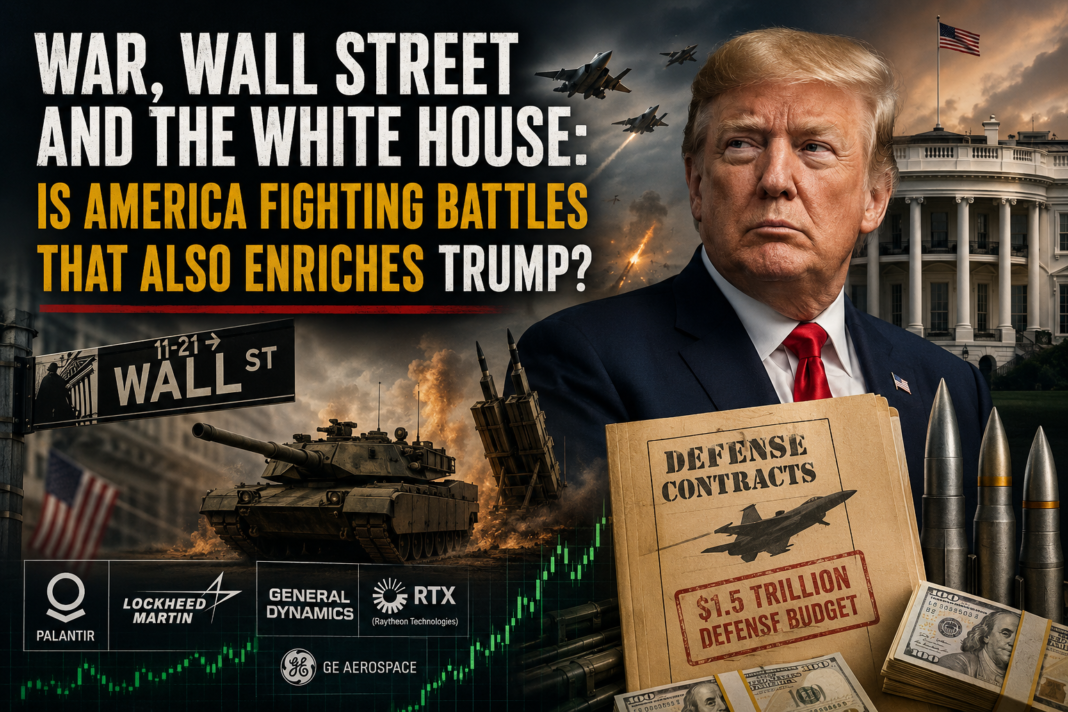
An analysis of those disclosures reveals that brokerage firms managing Trump’s assets purchased between US$9.7 million and US$24.3 million worth of shares in some of America’s largest defence contractors and Pentagon suppliers during 2025. The investments span nearly a dozen companies deeply embedded within America’s military-industrial complex, including Palantir Technologies, Lockheed Martin, General Dynamics, RTX (formerly Raytheon Technologies), and GE Aerospace.
Individually, these purchases may appear like prudent investments in blue-chip American companies. Collectively, however, they paint a far more troubling picture when viewed alongside the administration’s foreign policy decisions.
The timing is impossible to ignore.
Trump’s administration has intensified military operations against Iran, overseen one of the largest weapons stockpiling programmes in recent American history, and proposed a staggering US$1.5 trillion defence budget – a level of military expenditure unprecedented even by Cold War standards.
Every one of those policy decisions directly benefits the very companies now appearing in the President’s investment portfolio.
Legally, Trump’s brokerage firms are prohibited from accepting direct trading instructions from him or his immediate family. Yet unlike several previous presidents who placed assets into blind trusts, Trump has chosen not to do so.
That distinction matters enormously.
Without a blind trust, the President can know precisely what companies he owns. While there is no evidence that investment decisions are personally directed by him, the absence of a blind trust creates an undeniable perception problem. Every defence contract approved by his administration now risks being viewed through the lens of potential personal financial benefit.
Politics, after all, is as much about public confidence as it is about legality.
The disclosures become even more striking when examined company by company.
Among the largest purchases were shares worth between US$1.6 million and US$3.9 million in Palantir Technologies, one of the fastest-growing defence technology companies in America.
Palantir has transformed itself from an intelligence software company into the digital brain of modern warfare.
Its Maven Smart System, powered by artificial intelligence, reportedly helped identify and process nearly 1,000 military targets during the first 24 hours of operations against Iran. The software combines satellite imagery, drone surveillance, battlefield intelligence and AI-assisted targeting into one integrated combat platform.
This represents a revolutionary shift in warfare.
Wars are no longer won merely through superior firepower. Increasingly, they are won through superior algorithms.
Palantir’s rise has mirrored the Trump administration’s aggressive embrace of artificial intelligence across the U.S. military. Last year, the company secured a contract reportedly worth US$10 billion to manage the U.S. Army’s long-term software and data infrastructure, effectively positioning itself as one of the Pentagon’s most indispensable technology partners.
The President’s portfolio also includes as much as US$3 million invested in GE Aerospace, whose engines and aviation systems power numerous aircraft deployed by both the United States and Israel during operations across the Middle East.
Then comes Lockheed Martin, the world’s largest defence contractor.
Trump’s brokers acquired as much as US$1.4 million worth of Lockheed shares.
The company manufactures the iconic F-35 Lightning II and F-22 Raptor stealth fighters – two aircraft central to American air superiority and extensively used during operations targeting Iranian military infrastructure.
Beyond fighter aircraft, Lockheed is also responsible for advanced missile defence systems that have become critical amid escalating regional tensions.
Following reported Iranian attacks that damaged multiple American THAAD radar installations across the Middle East, Lockheed Martin reportedly secured a US$35 billion contract to dramatically increase production of replacement systems.
War destroys. War also creates demand. The cycle is brutally efficient. General Dynamics represents another major holding.

Trump’s portfolio includes as much as US$1 million invested in the company, whose products range from Abrams tanks to submarines, precision-guided munitions and heavy bombs widely used in modern military operations.
RTX, formerly Raytheon Technologies, also appears prominently within the portfolio, with investments exceeding US$800,000.
RTX manufactures the Tomahawk cruise missile, one of America’s most recognisable long-range precision weapons and a cornerstone of U.S. strike capabilities.
Beyond offensive weapons, RTX also produces missile interceptors, radar systems and air-defence technologies.
As American stockpiles have been depleted by sustained operations, the Pentagon has already begun replenishment efforts.
Just weeks into the Iran conflict, the Department of Defense reportedly redirected US$373 million in previously approved funding to procure 23 additional Standard Missile-3 IB interceptors manufactured by RTX.
In other words, military operations create immediate replacement orders. Missiles launched today become procurement contracts tomorrow.
That dynamic lies at the heart of what former U.S. President Dwight D. Eisenhower famously described in 1961 as the “military-industrial complex.” Eisenhower warned Americans that the growing relationship between government, military institutions and defence manufacturers could eventually distort national priorities. More than six decades later, his warning appears more relevant than ever.
The economic incentives surrounding conflict have never been larger.
Global military expenditure reached record levels in recent years, while artificial intelligence, autonomous weapons, cyber warfare and missile defence have transformed defence into one of the world’s fastest-growing industries.
For investors, defence stocks have become attractive assets. For governments, they have become strategic necessities. For elected leaders who simultaneously hold investments in those companies, however, the ethical questions become unavoidable.
Even if every transaction complies fully with financial disclosure laws, public perception remains a powerful force.
Democracy depends not merely upon legal compliance but upon confidence that decisions involving war and peace are made solely in the national interest.
When presidents own shares in companies that manufacture missiles, aircraft, surveillance software and battlefield technologies, that confidence inevitably comes under strain.
The issue extends beyond Donald Trump.
It raises broader questions that every democracy must confront.
Should serving heads of government be permitted to retain substantial investments in industries directly affected by their executive decisions?
Should blind trusts become mandatory rather than voluntary?
Should defence-sector holdings be treated differently from investments in consumer goods, banking or technology?
These are no longer theoretical debates.
They sit at the intersection of national security, corporate profit and political ethics.
America has long presented itself as the guardian of democratic values and transparent governance. Those values are tested not only during elections but also during moments when immense political power intersects with enormous private wealth.
Wars shape history. Weapons shape wars. Money often shapes both.
The real battle unfolding today may not be fought only across the skies of the Middle East. It is also being fought inside the institutions of democracy themselves, where citizens increasingly ask whether decisions involving military intervention are driven solely by strategic necessity – or whether financial interests have become silent partners in the calculus of conflict.
That question may prove far more consequential than any missile fired on the battlefield.