
Key Takeaways
- Goa lacks visionary leaders, stuck in a Panchayat mindset, hindering growth and innovation.
- Transformational leadership is needed to break free from the Panchayat mindset and create a globally competitive region.
- Goa’s greatest export should be its young people’s talents, not just tourism, to create a thriving ecosystem for AI research, marine sciences, and biotechnology.
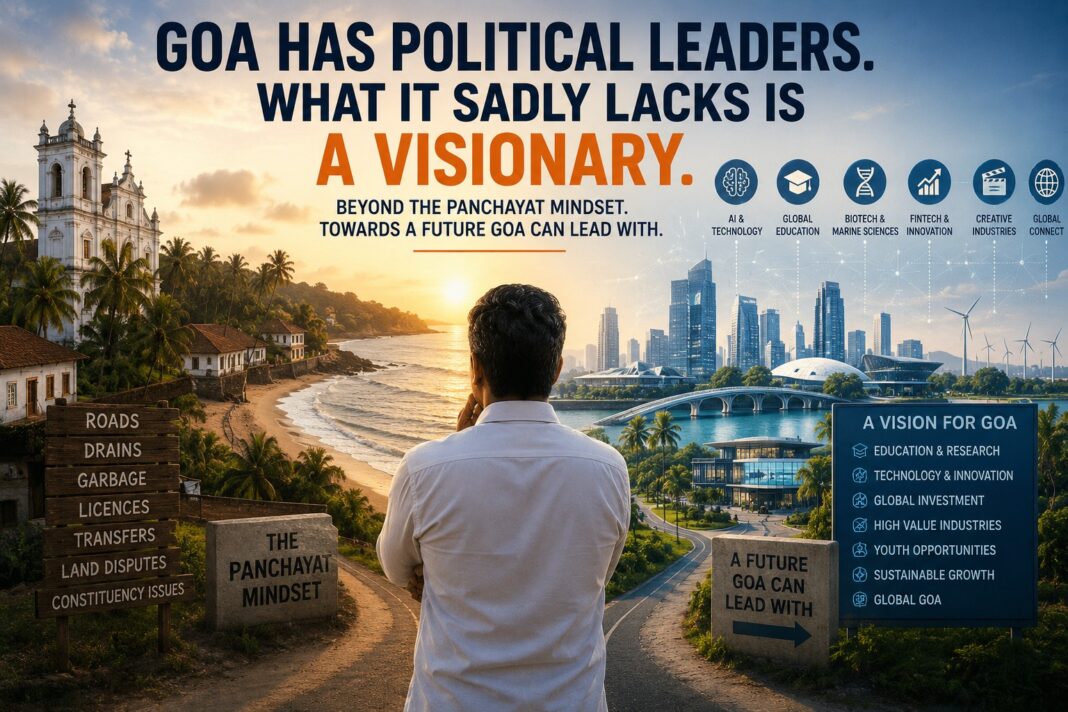
Goa has never been short of political leaders. Every election produces familiar faces, seasoned campaigners, powerful constituency managers and individuals capable of winning the confidence of their local electorate. Yet, despite this seemingly vibrant political landscape, Goa suffers from a far deeper crisis – one that rarely finds mention in political debates. The state has political leaders, but it lacks a visionary capable of taking Goa beyond its Panchayat mindset and transforming it into a nationally and globally competitive region powered by the talent of its people.
There is a profound difference between a politician and a statesman. A politician prepares for the next election; a statesman prepares the next generation. Goa has had plenty of politicians. Visionaries have been rare.
The tragedy of Goa is not its coalition politics, changing governments or political instability of the past. Those are merely symptoms. The real challenge is that the state’s political imagination has remained confined within village boundaries. Political discourse continues to revolve around roads, drains, garbage collection, land disputes, licences, transfers, constituency development, local rivalries and Panchayat-level issues. These are undoubtedly important responsibilities of any government, but they cannot become the defining ambition of an entire state.
A government must manage the present. Leadership must create the future.
The question Goa’s political class should constantly be asking is not whether another road has been laid or another bridge inaugurated. It should be asking where Goa will stand in 2050. What will be the state’s economic identity? What industries will define its prosperity? Where will its youth find opportunity? What global role will Goa play in an increasingly competitive world?
Unfortunately, these questions rarely dominate Goa’s politics.
Instead, politics often resembles an extended Panchayat meeting where every issue is viewed through the narrow lens of constituency arithmetic rather than long-term state-building.
This Panchayat mindset has become Goa’s biggest limitation. It breeds administrative management instead of transformational leadership. It rewards short-term populism over long-term planning. It encourages politicians to think in terms of electoral cycles instead of generational change. Large ideas are viewed with suspicion, ambitious projects become victims of political point-scoring, and strategic planning is sacrificed at the altar of immediate political convenience.
Meanwhile, India is changing rapidly.
States are no longer merely competing with their neighbours; they are competing with regions across the world for investment, technology, innovation and talent. Telangana transformed Hyderabad into one of the world’s fastest-growing technology hubs. Karnataka continues to strengthen Bengaluru’s global position in innovation. Gujarat has emerged as India’s manufacturing powerhouse. Tamil Nadu dominates electronics manufacturing. Maharashtra remains India’s financial capital.
Where does Goa fit into this competition?
Far too often, Goa continues to market itself almost exclusively as a tourism destination.
Tourism will always remain one of Goa’s greatest strengths. It is part of Goa’s identity and economy. But tourism alone cannot define Goa’s future. A state with one of India’s highest literacy rates, widespread global acceptance, a cosmopolitan culture, excellent quality of life, strategic coastline and global visibility possesses advantages that extend far beyond hospitality.
Goa’s greatest export today should not be its young people.
Yet every year, thousands of talented Goans leave their homeland for Bengaluru, Mumbai, Pune, Delhi, Dubai, London, Australia, Europe and North America because the opportunities matching their aspirations simply do not exist at home. Goa educates exceptional talent only to watch other cities and countries benefit from it.
That is not destiny.
It is the consequence of limited political imagination.
Imagine a Goa that becomes India’s premier centre for artificial intelligence research. Imagine global universities establishing campuses in Goa. Imagine international think tanks choosing Goa for policy research. Imagine a thriving ecosystem for marine sciences, biotechnology, climate innovation, fintech, digital tourism, gaming, filmmaking and creative industries. Imagine Goa hosting international arbitration centres, global diplomacy forums, startup summits and technology conferences that attract the world’s brightest minds.
None of these possibilities are unrealistic.
What they require is political leadership that refuses to accept that Goa’s destiny is limited to beaches, shacks and seasonal tourism.
It would be intellectually dishonest to suggest that Goa has never produced visionary leaders. It has. In the post-Liberation era, two leaders stand apart for fundamentally changing the direction of the state – Dayanand Bandodkar and Manohar Parrikar.
Dayanand Bandodkar transformed Goa’s social landscape. He understood that education was the greatest instrument of empowerment and that the future of Goa depended upon creating opportunities for ordinary Goans rather than preserving privilege for a few. His reforms altered the social fabric of the state and expanded access to education for generations. He was not simply governing Goa; he was reshaping Goan society.
Decades later, Manohar Parrikar brought an entirely different but equally important vision. He demonstrated that Goa could think beyond its size. He combined intellectual clarity with administrative efficiency and strategic thinking. Whether as Chief Minister or later as India’s Defence Minister, Parrikar proved that Goa could produce leaders who influenced national policy while modernising governance at home. He saw possibilities where others saw limitations. He understood that Goa’s small geography should never become an excuse for small ambitions.
Both leaders shared one defining quality.
They looked beyond the politics of the day.
They understood that leadership is ultimately measured not by how effectively one manages government, but by how fundamentally one changes the future.

Since Manohar Parrikar’s passing, however, Goa has struggled to produce another leader with that scale of vision.
This is not to diminish the contribution of the present Chief Minister, Dr. Pramod Sawant. He has demonstrated sincerity, commitment and a strong work ethic. Under his leadership, Goa has enjoyed political stability, continued welfare programmes and administrative continuity. He is undoubtedly a hardworking Chief Minister who wants the state to progress, and that deserves recognition.
But there is an important distinction between being an effective administrator and being a visionary.
Dr. Sawant appears focused on improving Goa as it exists today. A visionary would ask what Goa could become over the next fifty years. The difference is subtle but profound. One manages a state efficiently; the other redefines its destiny.
Goa now needs more than governance.
It needs imagination.
It needs a bold economic doctrine that positions Goa as India’s knowledge economy on the western coast. It needs policies that attract world-class universities, research institutions, technology companies, venture capital, creative industries and global entrepreneurs. It needs to become India’s preferred destination for innovation, international conferences, policy dialogues and sustainable development.
Most importantly, it needs to create an ecosystem where Goan talent no longer feels compelled to leave home to fulfil global ambitions.
Governments alone cannot achieve this. Visionary leadership also requires the courage to involve economists, scientists, entrepreneurs, technologists, urban planners, environmental experts and educators in shaping long-term public policy. Twenty-first century governance cannot remain the exclusive domain of career politicians. It demands expertise, collaboration and strategic thinking.
Goa must also abandon the false choice between development and environmental protection. The challenge is not whether Goa should develop; it is how Goa develops. Sustainable infrastructure, smart urban planning, renewable energy, coastal resilience and ecological conservation must become competitive advantages rather than political battlegrounds.
The coming decades will redefine India’s economic geography. Artificial intelligence, advanced manufacturing, biotechnology, clean energy, digital services and research-driven industries will determine which states prosper and which are left behind. Smaller states often possess greater agility to innovate and implement reforms. Goa’s size should therefore be viewed as an advantage, not a limitation.
But this transformation will not happen by accident.
It will require leadership willing to think beyond village boundaries, beyond constituency politics and beyond election cycles.
Goa does not need another politician who merely promises better roads and more schemes.
It needs someone who asks why Goa should not become India’s most innovative state.
Why should Goa not host South Asia’s finest international university?
Why should Goa not become India’s leading centre for marine sciences and ocean technology?
Why should Goa not emerge as a global destination for artificial intelligence, creative industries and digital entrepreneurship?
Why should Goa not become India’s gateway for engagement with the Lusophone world and a centre for international diplomacy and policy dialogue?
These are the questions visionaries ask.
Dayanand Bandodkar gave Goa social empowerment. Manohar Parrikar gave Goa confidence and national relevance.
The leader who defines the next era must give Goa global relevance.
Until such leadership emerges, Goa will continue to produce capable politicians, efficient administrators and successful election winners.
But it will continue to lack what it needs most – a visionary capable of lifting Goa beyond its Panchayat mindset and transforming it into one of India’s most competitive knowledge economies and one of the world’s most admired small regions.
The greatest resource Goa possesses is neither its beaches nor its tourism industry. It is the intelligence, creativity and ambition of its people.
The next great leader of Goa will be the one who finally recognises that – and builds a future worthy of their talent.