


Key Takeaways
- Iran is not just a Persian state, but a civilisational nation with diverse ethnic groups.
- External actors often fail to understand the distinction between demanding justice within Iran and demanding its dissolution.
- Ethnic fragmentation can produce the opposite effect, with communities defending the larger nation against external intervention.
There are moments in geopolitics when a single strategic mistake can undo months of carefully built military and diplomatic pressure. If reports or policy circles surrounding U.S. President Donald Trump entertain the idea of encouraging ethnic separatism inside Iran, Washington would be handing the IRGC a major gift.
History is remarkably consistent on one point. Nothing unites a divided nation faster than the perception of foreign powers attempting to dismember it.
Iran today is politically fractured. The regime faces economic exhaustion, public anger, demographic decline, corruption, sanctions, and increasing dissatisfaction even among sections that once formed its ideological backbone. The legitimacy of the ruling establishment has eroded steadily over the past decade. Urban youth openly reject the clerical order. Women have repeatedly challenged state authority. Ethnic minorities have genuine grievances over economic neglect and political representation.
These are internal contradictions. They weaken regimes.
But once those contradictions are transformed into an external struggle over national sovereignty, everything changes.
The IRGC understands this better than anyone.
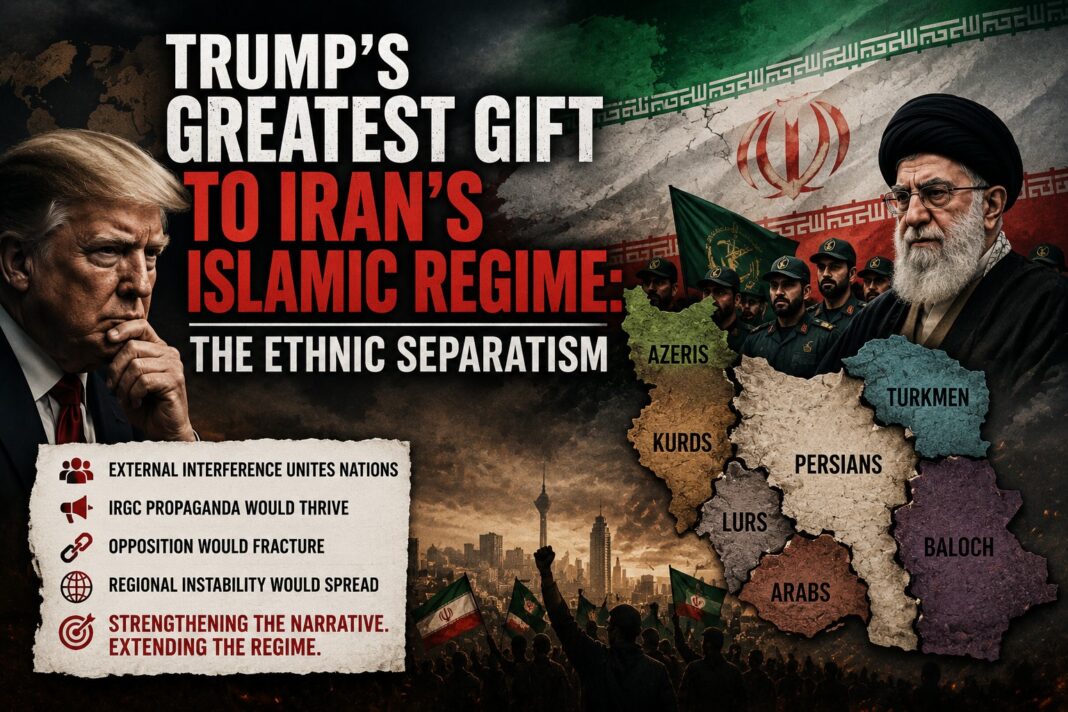
Iran is not merely a Persian state. It is a civilisational nation comprising Persians, Azeris, Kurds, Baloch, Arabs, Lurs, Turkmen and several smaller communities. Despite cultural diversity, there exists an equally powerful Iranian national identity that predates the Islamic Revolution by thousands of years.
Any foreign attempt to encourage ethnic fragmentation would not be viewed by many Iranians as support for oppressed minorities. It would be viewed as an attempt to destroy Iran itself. That distinction matters enormously.
Throughout modern history, authoritarian governments have survived not because their people loved them, but because their people feared foreign intervention more than domestic repression.
Saddam Hussein survived the Iran-Iraq War because Iraqis rallied around national defence.
Bashar al-Assad regained political legitimacy among many Syrians after extremist groups and foreign actors threatened Syria’s territorial integrity.
Even Vladimir Putin transformed domestic political discontent into nationalist mobilisation by portraying Russia as a fortress under siege.
Nationalism is often the oxygen authoritarian regimes breathe when ideology begins to fail.
The IRGC has perfected this strategy.
For decades it has portrayed itself not merely as guardian of the Islamic Revolution but as defender of Iranian sovereignty against American and Israeli conspiracies.
Its propaganda machinery has consistently warned that the West seeks to partition Iran into Kurdish, Baloch, Arab and Azeri statelets.
If Washington now appears to validate precisely that narrative, every propaganda department inside Tehran would celebrate.
The IRGC would no longer need to convince Iranians that foreign powers seek Iran’s destruction. Washington would be doing the job for them.
That would fundamentally alter the political battlefield. Instead of facing protests over inflation, unemployment, corruption and repression, the regime would shift public discourse towards defending territorial integrity.
Internal opposition would suddenly become vulnerable to accusations of collaborating with foreign powers. Moderates would retreat. Nationalists would close ranks. Fence-sitters would become defenders of the state. The opposition itself would fracture.
One of the greatest mistakes external powers repeatedly make is assuming that ethnic identity automatically translates into separatist aspirations.
Reality is considerably more complex.
Iranian Kurds demand greater autonomy. Iranian Baloch seek development and equal rights. Iranian Arabs demand better political participation.
But demanding justice within Iran is fundamentally different from demanding the dissolution of Iran.
External actors often fail to understand this distinction.
The overwhelming majority of ethnic minorities across the world possess layered identities. They may be Kurdish and Iranian. Azeri and Iranian. Arab and Iranian.

Attempting to convert cultural identity into geopolitical separatism frequently produces the opposite effect. Communities begin defending the larger nation precisely because outsiders appear intent on dismantling it. This has occurred repeatedly across history.
There is another strategic dimension that Washington cannot ignore.
Ethnic fragmentation rarely remains controlled.
If Iran begins experiencing externally encouraged separatist movements, neighbouring countries will immediately reassess their own vulnerabilities.
Turkey will view Kurdish mobilisation through its own security lens. Pakistan will worry about Baloch separatism crossing borders. Iraq would fear renewed instability. The Caucasus would experience fresh tensions involving Azeri populations. Even Central Asia would reassess ethnic fault lines. Rather than weakening Iran alone, such a strategy risks igniting an arc of instability stretching from the Mediterranean to South Asia.That serves nobody except extremist organisations waiting to exploit collapsing state authority.
There is also an uncomfortable irony.
The United States has consistently opposed separatist movements that threaten allied states. Washington supports Spain’s territorial integrity against Catalan independence. It supports Ukraine’s territorial integrity against Russian-backed separatism. It rejects attempts to redraw borders through externally supported ethnic insurgencies.
To suddenly embrace ethnic fragmentation in Iran would expose a glaring strategic inconsistency that adversaries like Russia and China would eagerly exploit.
International credibility is difficult to build and remarkably easy to lose. If the objective is regime change, then separatism is perhaps the least intelligent route available. Successful political transformation occurs when regimes lose legitimacy from within. Not when they become symbols of national survival.
The moment foreign capitals appear invested in dismantling Iranian territory rather than reforming Iranian governance, the regime’s legitimacy paradoxically increases.
Every missile launched by Israel may weaken military infrastructure. Every sanction may weaken economic resilience. But every foreign endorsement of partition strengthens the ideological argument of the IRGC.
That is precisely why the Revolutionary Guards would privately welcome such rhetoric.
It transforms them from guardians of an unpopular theocracy into defenders of an ancient civilisation. No propaganda campaign could produce a more powerful recruitment tool. No intelligence operation could manufacture a stronger nationalist response. No political speech inside Tehran could unite Persians, Azeris, Kurds, Arabs and Baloch as effectively as the perception that Washington seeks to redraw Iran’s map.
This is not merely about Iran.
It is about understanding how nations behave under existential pressure.
People who oppose governments do not necessarily oppose their country.
Indeed, they often become its fiercest defenders when confronted by external threats.
The United States would therefore be wise to distinguish between supporting political freedoms and appearing to support territorial disintegration.
The former isolates authoritarian regimes.The latter rescues them.
If Donald Trump – or anyone influential within his strategic circle – believes that encouraging ethnic separatism will accelerate the fall of the Islamic Republic, they are likely to discover the exact opposite.
They would not be shortening the lifespan of the regime.They would be extending it. They would not be weakening the IRGC.
They would be validating every warning the IRGC has issued for four decades.
And in geopolitics, there are few greater strategic blunders than strengthening your adversary’s narrative while believing you are undermining his power.
The road to regime change is paved through political legitimacy, economic pressure, diplomatic isolation and support for universal freedoms – not through the dangerous fantasy of Balkanising one of the Middle East’s oldest civilisations.
If Washington truly wishes to see a different Iran emerge, it must avoid becoming the very reason Iranians choose to rally behind the regime they otherwise wish to replace.