

Key Takeaways
- Pope Leo XIV’s Magnifica Humanitas emphasizes the importance of human dignity in the age of Artificial Intelligence.
- The document rejects machine sentience and critiques the technocratic impulse in the development of AI.
- Magnifica Humanitas challenges the notion that human beings can be optimized like machines, highlighting the value of vulnerability and empathy.
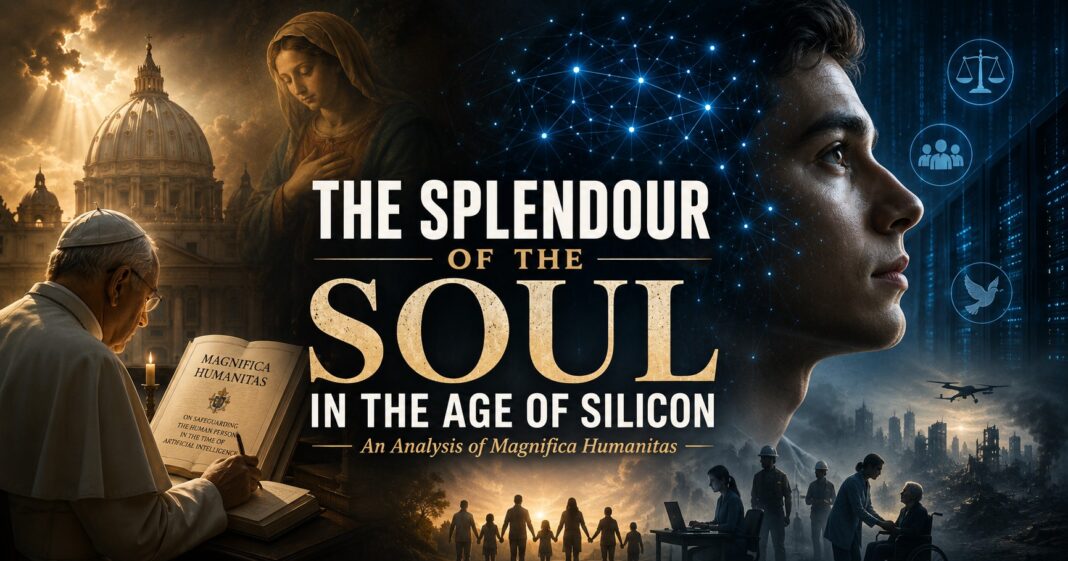
We are living through what Pope Leo XIV calls a profound “change of epoch”, a structural shift in how human beings live, communicate, work, and understand themselves. At the heart of this transformation is the meteoric rise of Artificial Intelligence (AI). While the secular world often views AI through the binaries of utopian tech-optimism or dystopian panic, the Church’s first encyclical dedicated to this frontier, Magnifica Humanitas (“Magnificent Humanity”), offers a refreshing and desperately needed framework of moral discernment. Subtitled On Safeguarding the Human Person in the Time of Artificial Intelligence, this document does not merely critique code; it fiercely defends the irreducible dignity of the human soul. Let us look past the surface mechanics of algorithms and confront the fundamental question: What does it mean to be authentically human in an automated world?
The Digital Babel vs. The Culture of Communion
Pope Leo XIV brilliantly frames the technological landscape using two contrasting biblical images: the Tower of Babel (Genesis 11:1–9) and the rebuilding of Jerusalem’s walls under Nehemiah. The “Babel Syndrome” represents the technocratic impulse – the illusion that human beings can engineer their own transcendence, bypassing human limitations through computational supremacy. In contrast, Nehemiah’s rebuilding represents a community working in solidarity, using tools not to dominate or escape, but to restore relationships and protect the vulnerable.
The Holy Father makes it clear that the Church is not anti-innovation. Magnifica Humanitas supports legitimate economic enterprise, scientific progress, and human ingenuity. However, it issues a stark warning against technological determinism, the passive acceptance that because a technology can be developed, it must dictate the terms of human existence. The fundamental criterion for any technological advance must remain the preservation and flourishing of human dignity.
The Trap of Optimization and the Value of Vulnerability
One of the most profound sections of the encyclical touches the absolute core of moral theology: the critique of the enhanced human being and the tyranny of efficiency. Pope Leo XIV notes: “When efficiency becomes the ultimate measure of value, human beings are tempted to see themselves as a project to be optimized rather than as persons called to relationship and communion” (MH 112).
In a marketplace driven by algorithmic optimization, human traits like patience, contemplation, sacrificial love, and grief are easily dismissed as systemic inefficiencies, highlighting the need for a more nuanced understanding of human value. More dangerously, the encyclical warns that if we view the human person as a biological machine waiting for a software upgrade, we subtly begin to devalue those who cannot be optimized.
We must echo the Pope’s brilliant counter-cultural assertion: our human limits, i.e. illness, suffering, ageing, and inherent vulnerability, are not coding errors to be deleted. They are the very spaces where empathy is born, where dependency forces us out of isolation, and where we discover our need for God and one another. Human beings flourish through their shared fragility, a mystery that no silicon framework can replicate.
Sentience, Truth, and the Reductions of the Heart
A major philosophical and moral contribution of Magnifica Humanitas is its absolute rejection of machine sentience. The encyclical draws a firm theological boundary line between human intelligence, which is a divine creation rooted in a spiritual soul, and computational systems optimized purely on technocratic principles. Pope Leo reminds us that “no computational system, however sophisticated, can create a heart that gives itself, or a conscience that discerns good from evil” (MH 233). When we anthropomorphise AI, treating it as if it has a conscience, we cheapen our own uniqueness.

This reductionism bleeds directly into the crisis of truth. While disinformation and information manipulation are as old as humanity, generative AI amplifies them at an industrial scale. The encyclical challenges us not just to seek legislative policies for data control but to rebuild a social fabric grounded in “honest communication and social trust” (MH 132). In our current post-truth climate, the ethical duty of the Christian thinker is to be an anchor for objective reality and authentic dialogue.
Justice in the Marketplace and the Theatre of War
Applying the traditional pillars of the Church’s Social Doctrine – the common good, solidarity, and subsidiarity – Magnifica Humanitas confronts the real-world socioeconomic fallout of the AI revolution.
The Dignity of Work: The Pope directly addresses widespread job insecurity and growing structural inequalities. Work is not merely a means to generate capital; it is a vital expression of human dignity and participation in God’s ongoing creation. When corporations replace human labour with automation solely to maximize profit margins, they violate the social contract.
The Disarming of Warfare: In a chilling warning, the encyclical demands that AI be “disarmed”, explicitly targeting the development of autonomous weapons systems. The choice to take human life must never be outsourced to an algorithmic calculation. To do so is to completely sever the moral accountability essential to the concept of justice.
Weaving Hope in a Digital Age
Ultimately, Magnifica Humanitas is not a document of despair, but a vibrant manifesto of hope. In a culture facing the risk of being consumed by a technocratic desire for raw power, control, and transactional utility, the Church proposes an ancient, yet radically modern alternative: a civilization of love.
The title itself intentionally evokes the Magnificat, Mary’s canticle of humble praise. Just as Mary looked past the imposing imperial structures of her day to sing of a God who lifts up the lowly, we too are called to look past the monolithic shadow of Big Tech. We must lovingly safeguard the grandeur of humanity bestowed upon us and revealed in its fullness in Christ, the splendour of which no machine can ever replace. We must not let algorithms write the script of our moral futures. Instead, let us become weavers of hope, ensuring that as our technology evolves, our humanity becomes more magnificent, more compassionate, and more profoundly reflective of the divine image.