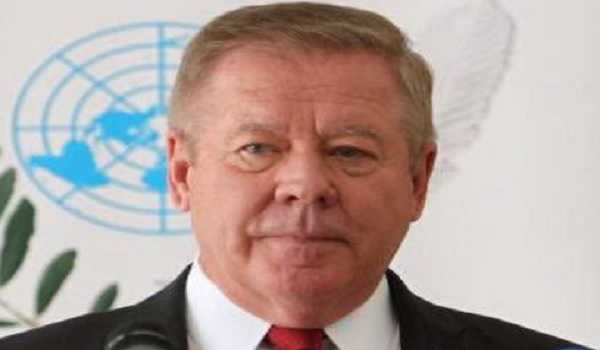

Geneva: Russia’s permanent representative to the UN Office in Geneva (UNOG), Gennady Gatilov, urged UN High Commissioner for Human Rights Volker Turk to publicly react to violations of the Russian-speaking population’s rights of Moldova.
According to Gatilov, personal messages were sent to Turk, as well as to UN Special Rapporteur on Minority Issues Fernand de Varennes and UN Special Rapporteur on Contemporary Forms of Racism, Racial Discrimination, Xenophobia and Related Intolerance K. Ashwini.
“In particular, I called on them to give a principled assessment and publicly respond to facts of violation of the rights of the Russian-speaking population of Moldova and discrimination based on nationality,” Gatilov said in a comment distributed by the permanent mission.
The permanent representative said the elections of the head of Gagauzia (an autonomous region of Moldova) held in mid-May caused Chisinau’s discontent.

“Its proteges took the last places in them, and the free and democratic choice of the Gagauz people demonstrated their unequivocal disagreement with the forced “de-Russification” and “Romanization” of the region being carried out by the authorities,” Gatilov said.
He said Moldovan President Maia Sandu has repeatedly expressed her dissatisfaction with the fact that candidates in the elections in Gagauzia addressed their electorate in their native language, Russian. Moldovan law enforcement officers made attempts to forcibly prevent the free expression of will by regional inhabitants, which predictably led to mass protests, he said.
“I would like to remind you that the Russian language is the main language for almost a million residents of Moldova. Chisinau’s attempts to divide its citizens into “first” and “second” class people according to the linguistic principle are unacceptable,” Gatilov said.
Gagauzia is an autonomy in the south of Moldova, which traditionally stands for rapprochement with Russia, while official Chisinau has proclaimed a course towards European integration. In February 2014, a referendum was held in the region to determine the vector of the country’s foreign policy. More than 98 percent of its participants supported Moldova’s integration into the Eurasian Customs Union.