


Key Takeaways
- Students have the right to question, criticise, protest, and demand accountability from the government.
- Peaceful protests are essential for a healthy democracy, but can be hijacked by those seeking anarchy.
- The government and students must work together to maintain public order and resolve grievances.
A democracy is tested not when everyone agrees, but when disagreement is expressed responsibly. India’s students have every right to question, criticise, protest and demand accountability from the government. Their voices are an essential part of a healthy democracy. But there is an equally important truth that cannot be ignored: students must never become instruments in the hands of those whose objective is not reform, but anarchy.
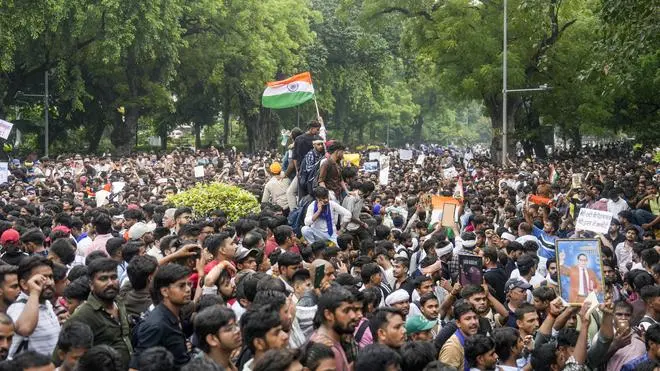
The ongoing protests in New Delhi have once again brought this distinction into sharp focus.
Students who believe they have been wronged deserve to be heard. Governments must never dismiss genuine concerns simply because they are inconvenient or politically uncomfortable. The strength of a democracy lies in its willingness to listen. Dialogue is not a sign of weakness; it is the hallmark of confidence. A government that engages with its students demonstrates faith in democratic institutions and faith in India’s youth.
However, a peaceful student movement is fundamentally different from an organised campaign designed to create instability. When protests suddenly become confrontational, when public property is damaged, when police become targets rather than partners in maintaining public order, and when the original issues are overshadowed by chaos, the question is no longer about student welfare. It becomes about who is attempting to hijack a legitimate movement.
This is where both the government and students must recognise that they are not adversaries – they are allies.
Students want solutions. Governments are expected to deliver solutions. The only people who benefit when both sides stop talking are those who thrive on disorder. Every clash between students and police, every act of vandalism, every disruption that dominates the headlines pushes the real issues further into the background. Those seeking anarchy understand this. They know that if trust between students and the government collapses, they gain influence.
India cannot allow that to happen.
The relationship between students and the State should never be one of permanent confrontation. Governments change. Policies change. Leaders change. But the nation remains. Today’s students are tomorrow’s administrators, entrepreneurs, scientists, teachers, judges and elected representatives. The government has a responsibility to protect their future, while students have a responsibility to ensure that their legitimate concerns are not exploited by those pursuing political chaos.
This requires maturity from both sides.
The government must open channels of communication quickly and sincerely. Student representatives should be invited to engage directly with decision-makers. Transparency must replace speculation. Facts must replace rumours. When students feel heard, the space available for those promoting confrontation becomes significantly smaller.
Students, too, must remain vigilant. Every movement attracts individuals and organisations whose objectives may have little to do with the original cause. They often encourage escalation because chaos attracts attention. They know that images of confrontation generate headlines, while constructive dialogue rarely does. Genuine student leaders must have the courage to distance themselves from anyone advocating violence, vandalism or confrontation with law enforcement.

The greatest victory for any student movement is not bringing a city to a standstill. It is bringing about meaningful change through democratic engagement.
The police also have a delicate responsibility. They are not enemies of students. Their duty is to maintain law and order while protecting the rights of peaceful protesters. Professional policing, restraint and proportionate action help preserve public confidence and prevent provocateurs from turning isolated incidents into larger confrontations.
Likewise, political parties across the spectrum should exercise restraint. Student movements should never become recruitment grounds for partisan battles. Young people deserve leadership that encourages dialogue, not division; solutions, not slogans; constitutional engagement, not calculated confrontation.
India has always progressed when its institutions and its youth have worked together. Some of the country’s greatest reforms have emerged from public debate, constructive criticism and democratic participation. None required anarchy. None required destruction. None required students to become shields for larger political agendas.
The real challenge before India today is not whether students should protest. They absolutely should when they believe injustice has occurred. The challenge is ensuring that peaceful democratic expression is not captured by those whose objective is to manufacture instability rather than resolve grievances.
The answer, therefore, is not confrontation between the government and students. The answer is cooperation against those who seek to divide them.
The government must reassure students that their concerns will receive a fair hearing. Students must reassure the nation that their movement remains peaceful, disciplined and independent of those who seek violence. Together, they can isolate those whose only interest lies in creating unrest.
India’s democracy is strongest when disagreement leads to dialogue, dialogue leads to reform, and reform strengthens public trust. That cycle is broken only when anarchists succeed in convincing students that the government is the enemy, and the government begins viewing every protesting student as a threat.
Neither is true.
The nation does not have to choose between listening to students and maintaining law and order. It must do both. It must protect the constitutional right to peaceful protest while showing zero tolerance for those who attempt to exploit young Indians to create chaos.
Students deserve respect. Governments must show leadership. And together, they must ensure that legitimate democratic movements are never hijacked by anarchists whose objective is not justice, but disorder.