


Key Takeaways
- Odesa Attack: The lethal targeting of the MV Golden Leo off Odesa by Russia on 19 July serves as a grim case study for a deeper, systemic crisis transforming global maritime trade.
- Neutral Merchant Mariners: Flying a neutral flag or employing neutral merchant mariners provides no insulation against state-level operations.
- Global Maritime Crisis: The Odesa Attack highlights the lethal cost to neutral merchant mariners in the ongoing global maritime crisis, with no country able to fully insulate its civilian seafarers from these realities.
The Anatomy of a High-Seas Tragedy
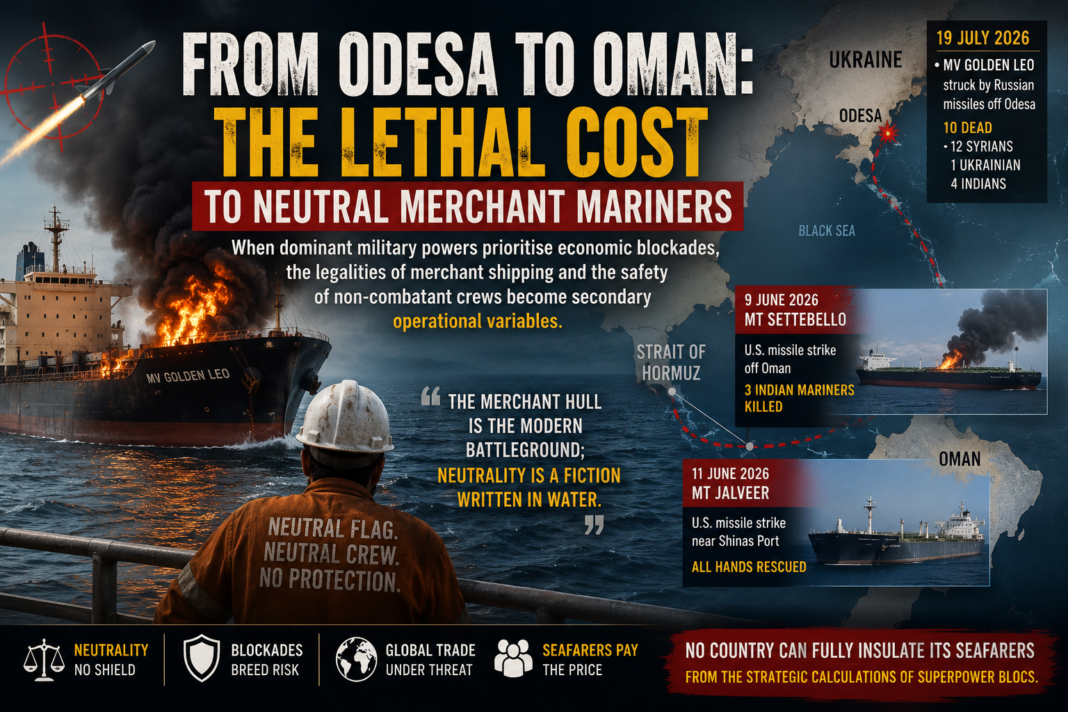
The lethal targeting of the bulk carrier MV Golden Leo off Odesa, by Russia on 19 July serves as a grim case study for a deeper, systemic crisis transforming global maritime trade: the total erasure of non-combatant immunity by contemporary military powers.
The Guinea-Bissau-flagged, Turkish-owned vessel was targeted with three Kh-59/Kh-69 cruise missiles. At least one landed a direct hit on the vessel’s starboard superstructure and initiated a major fire. It had a routine cargo of corn. It was manned by a 17-member international crew consisting of 12 Syrians and 5 Indians, and a Ukrainian harbour pilot brought on board expressly for exiting the harbour. The strike resulted in 10 confirmed fatalities: 5 Syrians, 1 Ukrainian, and 4 Indians. The fifth Indian seafarer remains hospitalised in Odesa in critical condition.
“The merchant hull is the modern battleground; neutrality is a fiction written in water.”
Russia’s Targeting Logic
Russia executes deliberate targeting of civilian bulk carriers to enforce a de facto blockade of Ukraine’s remaining export corridors. Moscow claims its strikes target “vessels operating in the interests of the Armed Forces of Ukraine”, a rhetorical shift that expands the definition of acceptable civilian collateral damage. The operational impact is immediate: Ukraine’s Black Sea grain throughput has plummeted by an estimated one-third, introducing a direct threat to global food security. Total economic warfare is on display.
“When superpowers enforce blockades, the neutral merchant mariner pays the premium in blood.”
The Convergent Mechanics of Hegemony
The Russian strike on the MV Golden Leo underscores the limits of traditional maritime protection. This strike demonstrates that state-level, precision-guided aggression remains undeterred by the legal cover of flag-state registries. Following the incident, the Indian Ministry of External Affairs (MEA) officially labelled the attack on civilian seafarers as “deplorable”.
The three American strikes in the Middle East last month (9-11 June 2026) had brought up the same issues. On 9 June 2026, a U.S. missile strike targeted the Palau-flagged tanker MT Settebello off the coast of Oman to enforce Washington’s blockade of Iranian ports. The strike killed three merchant mariners (all Indian). On the same day, the Palau-flagged MT Marivex was attacked, but all hands were rescued. Two days later, on 11 June 2026, the Guinea-Bissau-flagged asphalt/bitumen tanker MT Jalveer was struck by two U.S. Hellfire missiles near the Shinas port of Oman, but all hands were rescued. Detailed in my then analysis of US attacks on civilian shipping in Hormuz (13 Jun 2026).

Washington gave justification but offered no formal apologies, calling commercial navigation a “rough profession”. Prime Minister Narendra Modi raised the matter with U.S. President Donald Trump during their bilateral meeting on the sidelines of the G7 summit in France.
The Russian and American strikes demonstrate that flying a neutral flag or employing neutral merchant mariners provides no insulation against state-level operations. From being commercial shipping lanes, the Strait of Hormuz and the Black Sea have become active combat zones, where peacetime navigation rules are suspended. The Red Sea is on a similar trajectory.
Economic and Labour Fallout
Since Indian seafarers dominate global merchant fleets, India stands uniquely and seriously exposed to this unfolding maritime instability. The fatalities across the Black Sea and Middle Eastern theatres are triggering severe crew refusal clauses, with maritime labour unions demanding strict “no-sail” designations for active warzones. Concurrently, international maritime insurers are aggressively repricing War Risk Ratings, driving a sharp escalation in global freight costs. The Indian Directorate General of Maritime Administration (DGMA) issued a directive on 15 July 2026, prohibiting the deployment of Indian seafarers through combat zones, specifically vessels transiting the Strait of Hormuz and nearby Gulf waters.
The Geopolitical Realities
The contemporary maritime environment highlights a stark reality for nations attempting to remain neutral during great power friction. When dominant military powers prioritise the enforcement of economic blockades, the legalities of merchant shipping and the safety of non-combatant crews are treated as secondary operational variables. No country can fully insulate its civilian seafarers from these realities. Whether navigating the chokepoints of the Middle East or the shipping lanes of the Black Sea, they remain exposed to the strategic calculations of opposing superpower blocs. No easy solutions exist.
#OdesaAttack #MVGoldenLeo #BlackSea #MaritimeSecurity #IndianSeafarers #Geopolitics #MEA #GlobalTrade #StraitofHormuz #MTSettebello
(The author, an Indian Army veteran and a strategic analyst, is former Security Advisor, Ministry of Home Affairs, Government of India and former Advisor, Government of Seychelles. The views expressed are personal. He can be contacted at [email protected] , https://www.linkedin.com/in/brigsanjayagarwal/recent-activity/all/ and https://www.youtube.com/@Brig_Sanjay_Agarwal/videos )