
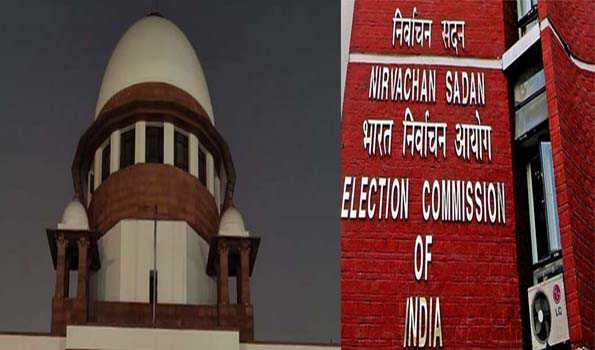

Key Takeaways
- The Supreme Court is seeking clarification from the Election Commission of India on increasing voters per polling station.
- The increase could lead to voter disenfranchisement and overcrowding at polling stations.
- The Representation of the People Act requires sufficient polling stations to ensure easy access for all voters.
New Delhi: The Supreme Court on Monday sought an explanation from the Election Commission of India (ECI) regarding its decision to increase the number of voters per polling station from 1,200 to 1,500.
The court expressed concern over the potential impact on voters and emphasised that no citizen should face inconvenience while casting their vote.
A bench comprising Chief Justice of India (CJI) Sanjiv Khanna and Justice Sanjay Kumar was hearing a Public Interest Litigation (PIL) challenging the ECI’s communications on this policy change.
The Chief Justice of India (CJI) asked the Election Commission of India (ECI) how an Electronic Voting Machine (EVM) can handle a polling booth with over 1500 voters. He also questioned how a single EVM, which can cast 45 votes per hour, can handle all 1500 votes if there is 100% voting from 6 a.m. to 5 p.m.
The CJI questioned the ECI’s preparedness to handle situations where over 1,500 voters might arrive at a polling station.
At the same time, Justice Kumar enquired whether the new policy applies to individual polling booths within a station.
Senior Advocate Maninder Singh, representing the ECI, defended the decision, stating that the system has accommodated the increase since 2019 and that political parties are consulted for each booth before finalising arrangements. He assured the court that a detailed affidavit would clarify the policy.

The bench directed the ECI to file the affidavit within three weeks, explaining the rationale behind the decision. The matter is scheduled for further hearing in January 2025.
During an earlier hearing, Senior Advocate Dr Abhishek Manu Singhvi, representing the petitioner, argued that increasing the voter limit per booth could create logistical challenges, leading to long queues and voter fatigue.
He claimed that the change disproportionately affects marginalised communities and daily wage earners, who cannot afford to spend excessive time at polling stations.
The petition also highlighted concerns about insufficient data to justify the increase, noting the lack of a census since 2011. It argued that without proportional expansion of polling infrastructure, the policy risks overcrowding and voter disenfranchisement.
Referring to Section 25 of the Representation of the People Act, the petitioner emphasised the need for sufficient polling stations to ensure easy access for all voters, particularly those from underprivileged groups.
The PIL seeks to reinstate the previous cap of 1,200 voters per booth and calls for progressive measures to reduce structural barriers to voting, aligning with democratic principles and the right to vote