
Key Takeaways
- The West Asia War is a conflict of managed instability where no side emerges victorious, yet each ensures it does not suffer total defeat.
- The war has reached a strategic stalemate, not because of indecision, but because of constraints, with each actor bound by limitations that shape its actions.
- The economic dimension of the conflict has a significant global impact, with disruptions in key shipping routes and energy supplies affecting markets, inflation rates, and economic stability.
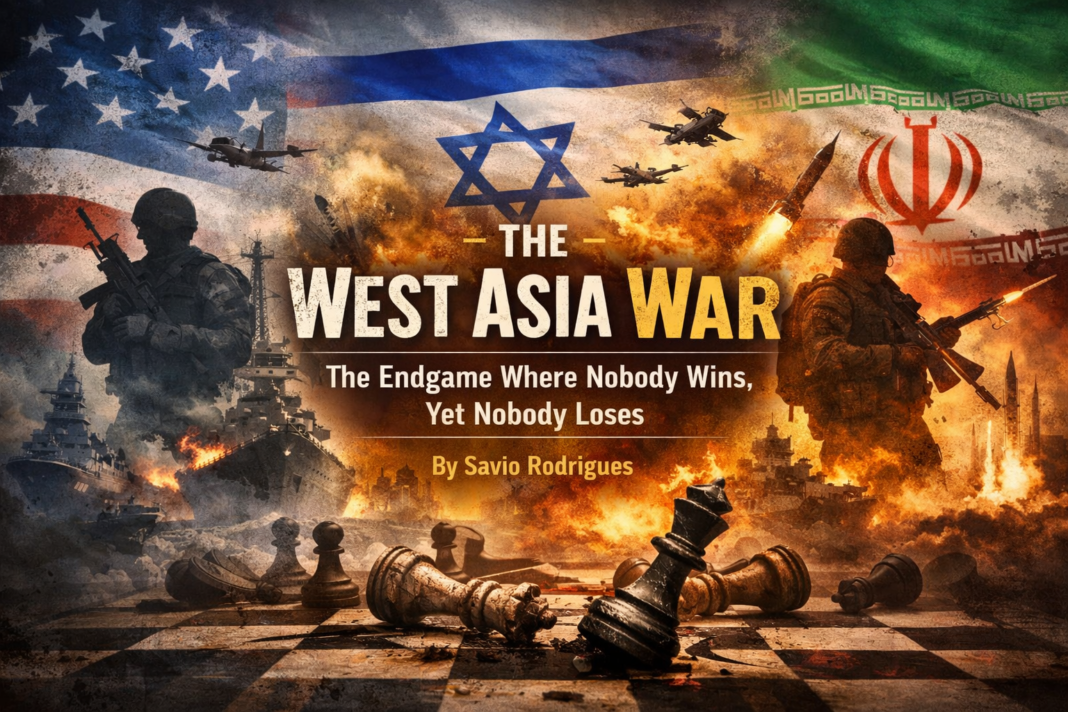
There are wars that conclude with decisive victories, marked by surrender documents and victory parades. And then there are wars that refuse such neat endings – wars that stretch, evolve, and embed themselves into the geopolitical fabric of our times. The conflict between the US, Israel, and Iran has evolved into a pattern of managed instability, where no side emerges victorious, yet each ensures it does not suffer total defeat. Iran has adapted to this pattern, recalibrating its strategy to ensure that any attempt at decisive victory would come at an unacceptable cost.
At the outset, the conflict appeared to follow a familiar script. The United States and Israel demonstrated overwhelming military superiority through swift and precise strikes, targeting key Iranian military installations and leadership structures. For a brief moment, the optics suggested dominance, even victory. But modern warfare, especially in the Middle East, is rarely defined by opening moves. It is defined by endurance, adaptation, and the ability to absorb and respond.
Iran, long accustomed to asymmetric warfare, did precisely that. Instead of collapsing under pressure, it recalibrated. Its strategy was never to match the United States or Israel in conventional strength, but to ensure that any attempt at decisive victory would come at an unacceptable cost. Through missile retaliation, drone strikes, and the strategic use of regional proxies, Iran expanded the battlefield beyond traditional lines. The Strait of Hormuz, one of the world’s most critical energy corridors, became a point of leverage rather than vulnerability. In doing so, Iran demonstrated a crucial principle of modern conflict: survival, not conquest, is often the true measure of success.
For the United States, this situation presents a familiar dilemma. Historically, American military engagements have begun with overwhelming force and clear objectives, only to encounter the complexities of prolonged involvement. The political appetite for extended conflict is limited, particularly when the costs – economic, strategic, and human – begin to outweigh the perceived gains. Escalation remains an option, but it is an increasingly unattractive one. A deeper military commitment risks not only regional destabilisation but also global economic repercussions, from rising oil prices to disrupted supply chains. In this context, the United States finds itself balancing strength with restraint, aware that winning every battle does not necessarily translate into achieving a sustainable strategic outcome.
Israel, meanwhile, faces a different but equally complex challenge. Its security doctrine has evolved from deterrence to proactive engagement, seeking to neutralise threats before they fully materialise. Yet this approach carries inherent risks. Every preemptive strike invites retaliation, and every expansion of defensive buffers creates new points of friction. The financial burden of sustained military operations is significant, and the political landscape – both domestically and internationally – is becoming more complicated. Israel’s objective of long-term security remains clear, but the path to achieving it grows increasingly uncertain as the conflict deepens without resolution.
What emerges from this dynamic is not chaos, but a form of structured tension – a system in which conflict is continuous but controlled. Ceasefires are temporary, serving as pauses rather than solutions. Negotiations occur, but they often function as extensions of the conflict rather than genuine efforts to end it. Military actions are calibrated carefully, designed to signal strength without triggering uncontrollable escalation. This is the essence of managed instability: a state in which all parties operate within understood limits, pushing boundaries without crossing thresholds that would lead to total war.

The economic dimension of this conflict further reinforces its global significance. Disruptions in key shipping routes and energy supplies ripple across continents, affecting markets, inflation rates, and economic stability. The war, though geographically concentrated, exerts a worldwide impact, illustrating the interconnected nature of modern geopolitics. In such an environment, prolonged instability becomes not just a regional issue but a shared global concern.
At its core, the conflict has reached a strategic stalemate – not because of indecision, but because of constraints. Each actor is bound by limitations that shape its actions. The United States cannot afford unchecked escalation; Israel cannot afford complacency; Iran cannot afford capitulation. These constraints create a delicate equilibrium, where movement is constant but resolution remains elusive. It is a balance maintained not through peace, but through the careful management of conflict.
Perhaps the most important realisation is that this war may not have a traditional endgame at all. There will likely be no definitive conclusion, no moment that clearly marks its end. Instead, the conflict will evolve, shifting between phases of intensity and relative calm. Direct confrontations may give way to proxy engagements, cyber operations, and economic pressures. The nature of the war will change, but its underlying tensions will persist.
In this sense, the America-Israel-Iran war reflects a broader transformation in the nature of global conflict. The era of decisive, clearly defined wars is giving way to an era of prolonged, ambiguous struggles. Victory is no longer absolute, and defeat is no longer total. Instead, the objective becomes more nuanced: to maintain one’s position, to prevent the adversary from achieving dominance, and to navigate an environment where stability is achieved not through resolution, but through balance.
This is the uncomfortable reality of the present moment. The war continues not because solutions are absent, but because the available solutions are incompatible with the core interests of the parties involved. Each side has secured partial gains, yet none has achieved its ultimate objectives. The result is a conflict that sustains itself, adapting to circumstances and resisting closure.
In the final analysis, the endgame is already visible – not as a conclusion, but as a condition. It is a state where no side wins, yet all avoid losing outright. It is a war without a clear finish, defined by endurance rather than outcome. And it is a reminder that in the complex landscape of modern geopolitics, the line between war and peace is no longer fixed, but constantly negotiated.