
Key Takeaways
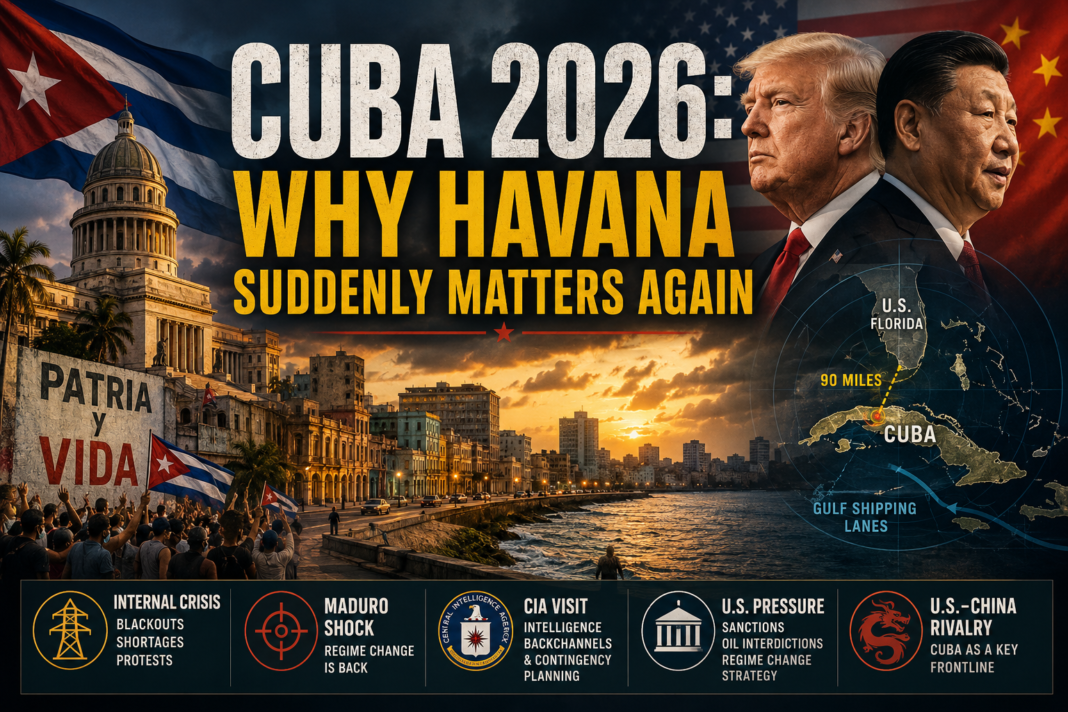
- Cuba’s economy is under severe strain due to collapsing tourism revenues, fuel shortages, sanctions, weak productivity, infrastructure decay, and the decline in subsidised Venezuelan oil support.
- The US–China rivalry is making Cuba strategically relevant once again, as Washington fears that Cuba could evolve into a Chinese surveillance, telecom, and signals-intelligence platform barely ninety miles from American shores.
- CIA Director John Ratcliffe’s visit to Havana suggests active intelligence backchannels, crisis-management coordination, contingency planning, and close American monitoring of Cuban regime stability.
While much Indian attention remains focused on U.S. Secretary of State Marco Rubio’s India visit from 23–26 May 2026, a potentially more consequential strategic signal may have emerged quietly from the Caribbean.
On 14 May 2026, CIA Director John Ratcliffe visited Havana amid nationwide blackouts, fuel shortages, anti-government protests, and escalating U.S. pressure on Cuba. An unusual visit. It came barely months after Washington’s dramatic January 2026 operation that captured Venezuelan President Nicolás Maduro and transported him to the United States. That single event fundamentally altered the strategic psychology of Latin America, especially Cuba.
Cuba’s Deepening Internal Crisis
Cuba’s economy is under severe strain due to collapsing tourism revenues, fuel shortages, sanctions, weak productivity, infrastructure decay, and the decline in subsidised Venezuelan oil support. President Miguel Díaz-Canel remains in power, backed by the Communist Party, the military-security establishment, and the legacy structures of the Castro era.
The economy has been battered by collapsing tourism revenues, fuel shortages, sanctions, weak productivity, infrastructure decay, and the sharp decline in subsidised Venezuelan oil support. The result has been rolling blackouts, shortages of food and medicines, transport paralysis, industrial disruptions, rising emigration, and growing public frustration. Political dissent remains tightly controlled, but the social pressure beneath the state-controlled surface is clearly mounting.
Why Cuba Matters Strategically Again
Cuba is no longer merely a nostalgic Cold War relic. It is becoming strategically relevant once again because of its proximity to the U.S. mainland, its location near Gulf shipping lanes and the Florida Strait, and its growing role in the intensifying U.S.–China rivalry. Washington increasingly fears that Cuba could evolve into a Chinese surveillance, telecom, and signals-intelligence platform barely ninety miles from American shores. Chinese involvement is reportedly expanding through telecom infrastructure, surveillance systems, digital connectivity, and broader commercial engagement. Russia continues political and intelligence cooperation with Havana as well, although Moscow’s ability to economically rescue Cuba remains constrained by the Ukraine war.
The Maduro Shock
By the physical capture and removal of President Maduro, the U.S. effectively demonstrated that Washington was willing to use direct force for regime/leader-change objectives again. For Havana, this became a strategic shock. For decades, Venezuela kept Cuba economically afloat through subsidised oil shipments. After Maduro’s capture, Venezuelan instability deepened, oil logistics deteriorated, and Cuba’s fuel crisis worsened dramatically. Yet the psychological effect may have been even greater than the economic one. Havana now fears sanctions escalation, covert destabilisation, cyber operations, elite fragmentation, and even the possibility of “Maduro-style” decapitation operations. American rhetoric has simultaneously hardened, with several U.S. political figures openly discussing regime-change possibilities in Cuba.
The Significance of the CIA Visit

Against this backdrop, the 14 May 2026 visit by CIA Director Ratcliffe was far from routine diplomacy. It strongly suggests active intelligence backchannels, crisis-management coordination, contingency planning, and close American monitoring of Cuban regime stability. Washington appears to be pursuing a dual-track strategy. Publicly, it is escalating pressure through sanctions, aggressive rhetoric, and anti-China coalition building. Privately, it appears to be maintaining intelligence dialogue, crisis-management channels, and controlled engagement. Historically, such combinations usually indicate that Washington seeks leverage and managed transition rather than immediate military intervention.
Rubio’s Parallel Diplomacy
The overlap between Ratcliffe’s Havana visit and Rubio’s India visit is geopolitically revealing. Rubio is of Cuban-origin, a hardliner on Havana, and now central to Trump-era foreign policy thinking. He represents the ideological face of America’s renewed pressure campaign. Under his influence, Washington’s Cuba policy appears to be shifting from merely “containing Cuba” toward actively “changing Cuba”. That distinction is strategically significant.
What Happens Next?
Several future scenarios now appear plausible. The most likely is intensified managed pressure, in which Washington tightens financial sanctions, oil interdictions, maritime pressure, and restrictions on military-linked Cuban enterprises in order to trigger divisions among the elite, force economic reforms, and encourage negotiated political transition without direct invasion.
A second possibility is internal fragmentation inside Cuba. If blackouts, shortages, protests, and migration pressures intensify further, they could lead to military fractures or controlled political transition.
A third scenario involves deeper Chinese involvement, with Beijing increasing fuel support, emergency credit, telecom integration, and security cooperation in order to prevent regime collapse. For China, losing Cuba would represent both a symbolic and strategic setback near the U.S. mainland.
Finally, covert confrontation may intensify if Cuba moves significantly closer to Chinese military or intelligence structures. This could lead to expanded cyber operations, intelligence warfare, sanctions enforcement, and a concerted influence operation by the U.S.
Strategic Bottom Line
Cuba is once again emerging as a frontline geopolitical theatre, not because of ideology alone, but because it now sits at the intersection of U.S.–China rivalry, energy insecurity, intelligence competition, migration pressures, and regime-change politics. Rubio’s India visit may dominate headlines across Asia; but Ratcliffe’s quiet Havana mission may ultimately reveal where the sharper edge of American strategy now lies.