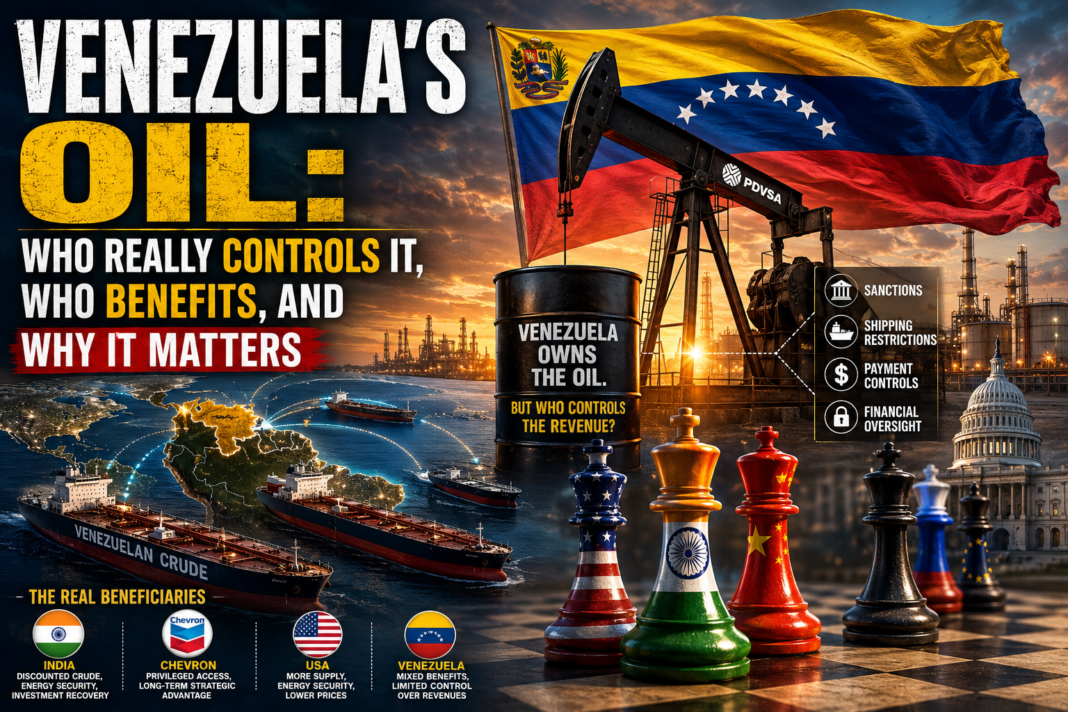

The struggle over Venezuelan oil has never been merely about energy. It is about political power, geopolitical influence, sanctions, debt recovery, market access, and control over the world’s largest proven hydrocarbon reserves. The central question is not who legally owns the oil—Venezuela does—but who controls its sale, who captures the revenue, and who derives strategic advantage. In 2026, Washington’s policies, sanctions mechanisms, and licensing regimes have fundamentally reshaped Venezuelan oil exports.
Ownership Versus Control
Legally, Venezuela’s oil reserves belong to the state and are administered through Petróleos de Venezuela S.A. (PDVSA), the national oil company. Yet legal ownership and effective control are no longer synonymous. While PDVSA continues operating fields and overseeing production, its freedom to market oil internationally remains heavily constrained by U.S. sanctions, licensing requirements, banking controls, shipping restrictions, and financial oversight.
A significant portion of Venezuela’s export system now functions under conditions where Washington exercises substantial influence over who may buy Venezuelan crude, how payments are processed, and where revenues ultimately flow. This creates a unique situation: an OPEC member formally owns its resources but faces external constraints shaping their commercial disposition. The consequence is not direct American ownership of Venezuelan oil, but considerable American leverage over its monetization.
Where Does the Money Go?
The traditional model under Hugo Chávez and Nicolás Maduro was straightforward: oil revenues flowed through PDVSA into government coffers, financing public spending, subsidies, patronage networks, social programs, and the security apparatus. That model has been progressively and significantly altered by sanctions, debt obligations, arbitration awards, and licensing arrangements.
Today, revenues from many transactions face external scrutiny. Significant portions are absorbed by operating costs, debt servicing, investor repayments, and joint-venture commitments before reaching the Venezuelan state. In several arrangements, payments route through controlled financial channels designed to prevent direct access by sanctioned entities.
Recent reports indicate some oil revenue having been directed toward mechanisms supporting Venezuelan workers and stabilizing domestic financial conditions through selected banking channels. The stated American objective is ensuring revenues benefit ordinary Venezuelans while minimizing diversion through corruption or regime-controlled structures. Whether fully achievable remains debated, but the trend is unmistakable: the Venezuelan government captures a smaller share of oil rent than it once did.
The Real Beneficiaries
The greatest immediate beneficiaries are not necessarily located in Venezuela.
India has emerged as perhaps the most significant commercial winner. Indian refiners dramatically increased Venezuelan crude purchases, taking advantage of substantial discounts relative to Brent benchmarks. Companies such as Reliance, IOC, and HPCL gain competitively priced feedstock while diversifying away from excessive dependence on any single supplier. Equally important, Indian state-owned investments trapped in Venezuela for years may finally have a pathway toward recovery.
Chevron is the principal corporate beneficiary. As the only major American oil company maintaining significant operations inside Venezuela, it occupies a privileged position in any recovery scenario. Beyond current production, Chevron gains access to some of the world’s most extensive undeveloped reserves, providing enormous long-term strategic value.
American consumers may benefit indirectly. The Trump administration’s energy strategy seeks to increase supply availability and moderate prices. Additional Venezuelan barrels contribute to this objective, even though immediate impact on global prices remains limited.
For Venezuela itself, benefits are mixed. Workers may receive greater income stability and economic activity may improve modestly. Yet the state’s ability to capture and freely deploy oil revenues remains constrained compared with the pre-sanctions era.

China, by contrast, appears among the relative losers. Once the dominant buyer of Venezuelan crude and major financing source, Beijing’s influence has diminished as sanctions, licensing requirements, and changing trade patterns redirected flows elsewhere. Russia faces similar limitations, though it retains political and strategic relationships with Caracas.
The Economics of Venezuelan Crude
A common misconception is that Venezuela’s vast reserves automatically translate into immense profitability. The reality is more complicated. Most reserves concentrate in the Orinoco Belt and consist of extremely heavy crude requiring dilution, upgrading, specialized transportation, and complex refining processes.
These technical challenges ensure Venezuelan crude trades at persistent discounts—approximately $25 below Brent. While headline reserve figures exceed Saudi Arabia’s, extraction costs, infrastructure deterioration, operational inefficiencies, and years of underinvestment significantly reduce commercial attractiveness. Industry estimates suggest full-cycle production costs often approach $39–$46 per barrel, leaving limited margins when prices soften.
Consequently, Venezuela’s challenge is not geological abundance but economic viability. Possessing the world’s largest reserves does not automatically confer market power if production capacity and infrastructure remain impaired.
Implications for OPEC and Global Markets
Despite geopolitical drama, Venezuela’s current production remains modest by global standards. Even optimistic forecasts place output near 1 million barrels per day—a fraction of historical levels and only a small percentage of world supply.
For this reason, OPEC+ does not view Venezuelan recovery as an immediate threat. The greater concern lies in the long term. If American influence over Venezuelan exports expands while U.S. domestic production remains strong, Washington could indirectly shape additional volumes originating from an OPEC member. Such an outcome would challenge traditional assumptions about cartel cohesion and pricing power—especially after UAE quit OPEC last month.
The strategic irony is striking: an administration advocating lower oil prices could simultaneously exercise significant influence over supply from one of the world’s largest reserve holders. This potentially creates a new mechanism for influencing global energy markets outside conventional OPEC frameworks.
The Larger Geopolitical Significance
The Venezuelan oil question ultimately concerns much more than petroleum. It sits at the intersection of great-power competition, sanctions policy, energy security, and hemispheric influence. Washington seeks to limit Chinese and Russian leverage in Latin America. Beijing seeks to preserve access to strategic resources. India seeks affordable energy and recovery of stranded investments. Venezuela seeks economic revival without surrendering sovereignty.
The most important analytical point is simple: ownership, production, and control have become separated. Venezuela owns the oil. Yet the ability to determine who buys it, how revenues are handled, and who ultimately captures the economic rent is increasingly shaped by external power.
This reality represents one of the most consequential shifts in global energy politics of the past decade. The implications will continue unfolding over the years.
Tags: #VenezuelaOil #Geopolitics #EnergySecurity #OPEC #Sanctions #IndiaEnergy #USForeignPolicy