
In West Asia the repeated collapse of ceasefire arrangements and their extension suggest that the United States has walked itself into a corner here. No easy exits.
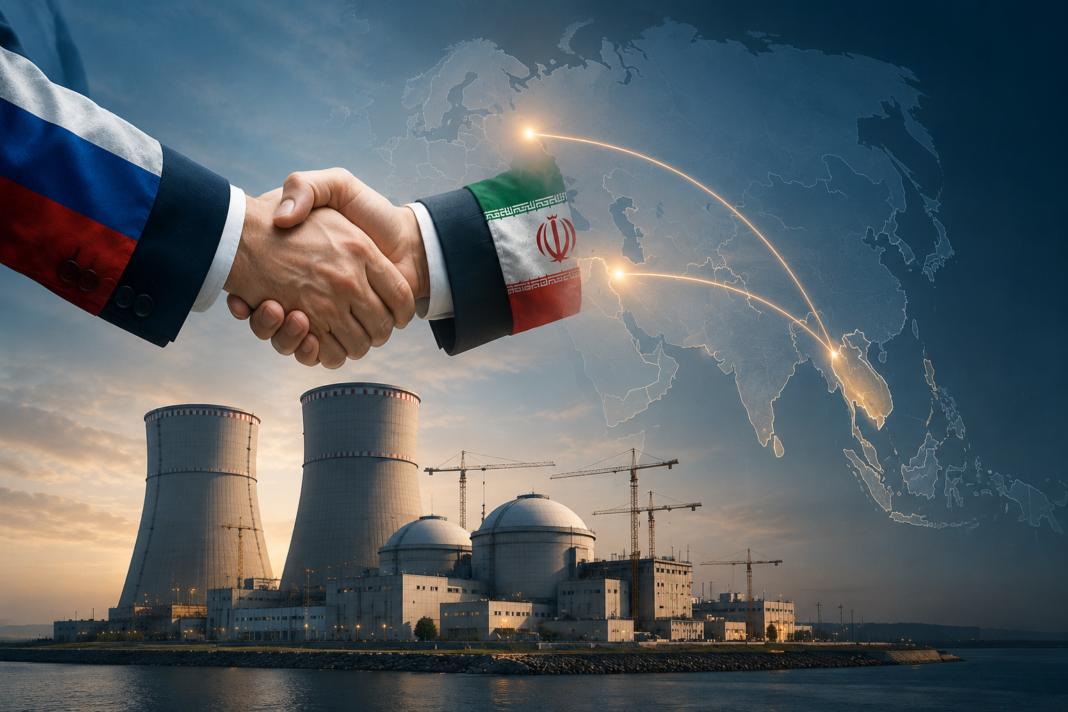
The most important geopolitical developments are often recognised only in hindsight. One such development was the US$25 billion Russia-Iran nuclear agreement announced in September 2025. At first glance, the deal appeared to be a major energy infrastructure project. In reality, its significance lies not just in the reactors themselves, but in what it reveals about the deepening Russia-Iran partnership, the limits of Western pressure, and the changing balance of power across Eurasia
Under the agreement, Russia will help construct four nuclear power reactors with a combined capacity of approximately 5 GW at Sirik in Iran’s southern Hormozgan province. The project builds upon a long history of nuclear cooperation between Moscow and Tehran, including Russia’s construction of the Bushehr nuclear power plant and its subsequent expansion projects.
Beyond Energy: Deepening the Russia-Iran Strategic Partnership
Prima facie, the project is an energy investment. Iran faces growing electricity demand, periodic power shortages, and the need to diversify domestic energy production. Additional nuclear generation capacity can help address these challenges while potentially freeing more hydrocarbons for export.
However, major nuclear projects are never purely commercial. They bind countries together through fuel supply arrangements, technical support, maintenance contracts, training programmes and regulatory cooperation that often endure for decades. In effect, Russia is deepening its presence within a critical sector of Iran’s national infrastructure.
The agreement should therefore be viewed as part of a broader trend. Over recent years, Russia and Iran have expanded cooperation across defence, energy, transport connectivity, financial arrangements and sanctions-resilience mechanisms. The latest deal reinforces this trajectory, reflecting a willingness on both sides to invest in long-duration projects that require political confidence, strategic trust and continuity of policy.
For Moscow, the project generates economic benefits for its nuclear industry while expanding geopolitical influence. For Tehran, it provides additional infrastructure, technological support and tangible evidence that it retains access to major international partners despite efforts to isolate it. More broadly, the agreement signals that both countries expect their partnership to remain strategically significant for decades to come.
The agreement also carries symbolic significance. It comes years after the United States unilaterally withdrew (May 2018) from the Joint Comprehensive Plan of Action (JCPOA), the 2015 nuclear agreement designed to limit Iran’s nuclear programme in exchange for sanctions relief. While the Russia-Iran deal is focused on civilian nuclear energy, it underscores a broader reality: efforts to isolate Iran have not prevented Tehran from finding major partners willing to invest in long-term strategic projects.
Implications for Major Powers
For the United States, the agreement highlights the limits of sanctions as a primary instrument of statecraft. Pressure can constrain adversaries, but it can also encourage the formation of alternative partnerships and networks. This is corroborated by Iran acquiring full membership of the BRICS grouping.
China is an indirect beneficiary. Beijing remains Iran’s most important economic partner and energy customer. A more resilient and economically connected Iran supports Chinese interests in regional stability, energy security, and Eurasian connectivity.

Israel will closely monitor the expansion of Iranian nuclear infrastructure, even though the project is civilian in nature. The increased Russian presence in Iran’s nuclear sector may also complicate future strategic calculations.
Meanwhile, Gulf states are likely to adopt a cautious rather than a confrontationist approach. While they remain wary of a stronger Iran, they also have a growing interest in regional stability and economic integration.
Why India Should Pay Attention
For India, the most important implications are geoeconomic rather than nuclear.
A stronger Russia-Iran partnership enhances the long-term viability of the International North-South Transport Corridor (INSTC), which remains central to India’s efforts to improve connectivity with Eurasia. It also increases the strategic relevance of Chabahar as a gateway to Central Asia and beyond.
At the same time, India must continue balancing relationships with the United States, Russia, Iran, Israel, and the Gulf states. As geopolitical alignments become more complex, maintaining strategic flexibility will become even more important.
Energy security remains a concern. Any future escalation involving Iran could affect shipping through the Strait of Hormuz, with implications for oil prices, freight costs, and India’s import bill.
The Bottom Line
The Russia-Iran nuclear agreement is strategically significant because it reflects a deep geopolitical reality. The reactors will take years to build; but the strategic message has already been delivered. It is now starkly embedded in the revised security calculus. That message is clear: Russia and Iran are binding themselves into a long-term strategic relationship designed to endure sanctions, political pressure, and regional uncertainty.
For India and other major stakeholders, the deal is another indicator that the emerging international order will be shaped increasingly by durable networks of cooperation rather than by the preferences of any single power.
Tags. #Geopolitics #Iran #Russia #India #StrategicAffairs #InternationalRelations #EnergySecurity #INSTC #MultipolarWorld #GlobalStrategy #NuclearEnergy #Eurasia #RussiaIranNuclearAgreement #JCPOA