


Key Takeaways
- Discover the inspiring stories of eleven iconic Indians in ‘The Incredible Indians’ by acclaimed author Rajesh Talwar.
- The book takes a unique approach by focusing on the personal journeys, challenges, and aspirations of the eleven national icons.
- The stories are made both inspiring and accessible to children through the engaging play format featuring present-day schoolchildren.
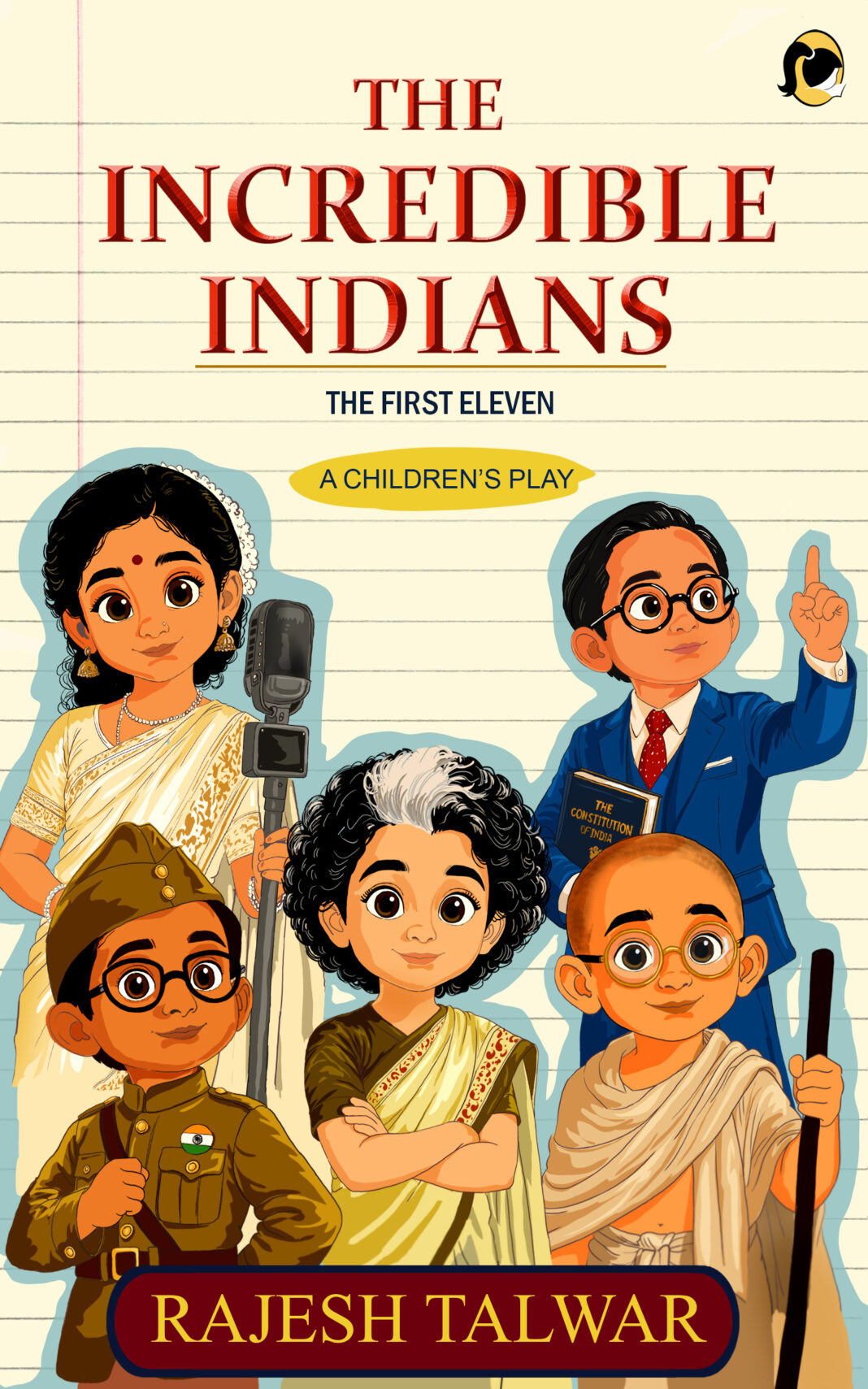
Acclaimed author and global policy thinker, Rajesh Talwar, returns with his latest book, ‘The Incredible Indians: The First Eleven’ (Ponytale), shortly after being honoured at the India–UK Achievers Awards 2026 at the British Parliament. The book is an engaging and inspiring work for young readers that brings to life the journeys of eleven iconic Indians through a dramatic and accessible storytelling style.
Blending history, personal struggles, and powerful narratives, it introduces children to personalities such as APJ Abdul Kalam, Dr B.R. Ambedkar, MS Dhoni, Amitabh Bachchan, Asha Bhosle, and Ratan Tata in a way that feels relatable, relevant, and contemporary.
In this engaging children’s play, eleven incredible and iconic Indians are brought to life through the eyes of ‘The Creative Five’, a group of school children working on a class project. Rather than listing facts, the children dramatize the struggles and challenges these figures faced at different stages of their lives.
Readers will see Dr. B.R. Ambedkar confronting discrimination in childhood, M.S. Dhoni overcoming obstacles in his youth, and Field Marshal Manekshaw and Prime Minister Indira Gandhi navigate challenges as mature leaders.
They will discover how Mohammad Rafi’s childhood shaped him into one of India’s greatest singers, and how Ratan Tata’s humanism and generosity defined one of the country’s richest industrialists. The childhood of legendary singer Asha Bhosle is explored alongside that of President A.P.J. Abdul Kalam, including a scene on the happiest day of his life.
The book takes a unique approach by focusing on the personal journeys, challenges, and aspirations of the eleven national icons, making them both inspiring and accessible to children. This approach helps to make the stories more relatable and engaging for young readers. Presented through an engaging play format featuring present-day schoolchildren, the book also encourages values of empathy, leadership, national integration, and social awareness.
The collection also honours Mahatma Gandhi, Subhash Chandra Bose, and Babasaheb Ambedkar, who contributed to the freedom struggle, as well as Amitabh Bachchan and Asha Bhosle, who continue to inspire today. Together, these stories show how each of the eleven icons helped build the nation and left a lasting legacy.
Rajesh Talwar is an internationally acclaimed and award-winning author whose literary work spans 45 books across fiction, non-fiction, plays, children’s literature, and self-help. His writing explores a wide range of themes including social justice, law, culture, human rights, terrorism, aesthetics, and the complexities of Indian society and the legal system. His plays move from contemporary socio-political realities to historical retellings, while his novels delve into subjects as diverse as identity, conflict, and justice.
Among his notable non-fiction works are ‘Courting Injustice: The Nirbhaya Case and Its Aftermath’ (Hay House, 2013) and ‘The Mahatma’s Manifesto: A Critique of Hind Swaraj’ (Om Books International, 2025). His well-known children’s books include ‘The Bearded Prince’, ‘The Three Greens’, and ‘The Boy Who Wrote a Constitution’. His recently released title, ‘Bollywood, Hollywood and the Future of World Cinema’, examines the evolving intersections of global cinema and cultural storytelling.
Beyond literature, Talwar served in senior positions with the United Nations across three continents over two decades. He has studied at prestigious institutions including Harvard, Cambridge, Oxford, the University of Nottingham, and Hindu College, Delhi University. He also trained in filmmaking at the London Film Academy and is currently co-directing an AI-generated animated feature film, ‘Smoky Sky Songs’.
Recently, he was honoured with the India–UK Achievers Award 2026 at the British Parliament and received the International Alumni Laureate Award from the University of Nottingham for his contributions to literature, public policy, and social issues.
To delve deeper into the premise on which Rajesh’s latest release is based, Sonakshi Datta of GoaChronicle asked him a few questions about his new book.
‘The Incredible Indians’ Author Rajesh Talwar
What made you choose the specific eleven personalities that you have discussed in your book?
Each of the eleven was chosen for different reasons, and they are by no means meant to be representative of a country as vast and diverse as India. The selection is a blend of the contemporary and the historical.
Naturally, towering figures such as Mahatma Gandhi, Subhash Chandra Bose, and B.R. Ambedkar could not be left out. They are icons whose contributions continue to shape India’s identity. At the same time, I felt it was important to include personalities from the present day, such as Amitabh Bachchan and M.S. Dhoni, who resonate more strongly with the younger generation.
The book also pays tribute to legends in music and industry: Asha Bhosle, whom we lost earlier this year, is remembered as a timeless voice, and Ratan Tata, who symbolizes integrity and leadership in business. A.P. J. Abdul Kalam was included because of his special connection with children and his inspirational journey. Similarly, Mohammed Rafi, also associated with the world of music, was chosen because a voice of his calibre and range comes only once in a century.

Finally, the book features Indira Gandhi alongside Field Marshal Sam Manekshaw, in the context of the 1971 Indo-Pak war that led to the creation of Bangladesh. It was a moment that defined both political and military leadership in India’s history.
Why did you choose the play format for your latest release?
Many books of this kind are filled with facts and figures, but they don’t always give the reader a real sense of the person hidden behind such prosaic details. Facts can be easily forgotten, but stories stay with us. I wanted my book to be memorable, and that is why I chose the play format.
Through scenes from each icon’s life, readers experience their struggles and achievements in a way that feels alive and relatable. The format allows personalities to speak and act on stage, making their character and spirit shine through, something that a purely factual account could never fully capture.
Your book’s title says ‘The First Eleven’, does this mean that readers could anticipate the coming of a sequel?
Yes, there is certainly a possibility of a sequel, provided the demand from children and readers is strong enough. For my books, I always have different themes and topics competing for priority in my mind. While I don’t rely solely on sales figures to guide my writing, I also don’t ignore them completely. If readers respond enthusiastically, I would be very open to continuing the series with another set of personalities.
What all lessons and values do your latest release has for children to learn from?
Many of the eleven icons featured in the book faced immense struggles, and their journeys offer powerful lessons for young readers.
From B.R. Ambedkar, children learn resilience and the importance of standing up for one’s rights, as he rose from a discriminated Dalit child to chairing the drafting committee of India’s Constitution. From Mahatma Gandhi, children can learn the power of non-violent resistance when it is combined with iron determination and will power.
Asha Bhosle, who began working as a child and faced rejection, shows perseverance in the face of setbacks. Subhash Chandra Bose teaches courage, having stood up to bullying at school, and that too from an English teacher in a position of authority.
Indira Gandhi exemplifies the fighting spirit in the context of the nation’s self-respect and related moral issues, resisting pressure from even a global superpower, such as the United States, during the 1971 war. Sam Manekshaw highlights leadership, planning, and foresight.
Ratan Tata demonstrates that humanity and compassion can coexist with business success. Amitabh Bachchan shows the value of absorbing the right lessons from elders, which sustain you throughout life. Mohammed Rafi underscores the importance of parental support and the seizing of opportunities when they come your way.
M.S. Dhoni teaches taking calculated risks and learning to keep a cool head under pressure. A.P.J. Abdul Kalam inspires us with his achievements, but also reminds us of the importance of compassion and kindness.
Each scene in the book dramatizes the struggles and triumphs of eleven incredible Indians, making the lessons vivid and memorable. Most importantly, children will enjoy reading these stories while absorbing values that can guide them throughout their lives.
What makes ‘The Incredible Indians: The First Eleven’ a must- read for children?
A school teacher friend once remarked to me that young people don’t have enough icons to look up to. I disagreed with him. India has plenty of inspiring figures, though I did agree that their stories were not always presented in a dramatic or engaging way. That is something I wished to change.
Children need role models, and they need to encounter them in a way that sparks imagination and admiration. This book presents eleven incredible Indians through vivid, play-like scenes that highlight their struggles and achievements. The selection spans different walks of life, be it arts, military, politics, industry, sports, music, and cinema. As a consequence, every child will be able to find someone to admire and emulate.